Why is my CAC so high?
Your customer acquisition cost (CAC) is usually high because of what happens after the click, not because of who you're targeting. The offer, the landing page, and your margin math decide whether a click becomes a profitable sale. The ad's only job is to earn the right click. Before touching targeting again, compute your break-even return on ad spend (ROAS) from your real contribution margin, then check your funnel for a message-match gap between the ad and the page. Most high CAC problems are margin problems or offer problems wearing a targeting costume.
- High CAC is usually a downstream problem: the offer, the landing page, and your margin, not the media buy.
- Break-even ROAS = 1 divided by your contribution margin, so a thin margin sets a steep target no ad account can out-optimize.
- Before you call your CAC "high," check whether it's actually above your true break-even or just above a number you picked without the math.
- A gap between clicks and sales usually points to message match on the landing page, not the ad itself.
- Check your real store revenue and your true margin before you blame targeting again.
Why is my CAC so high even though my targeting looks fine?
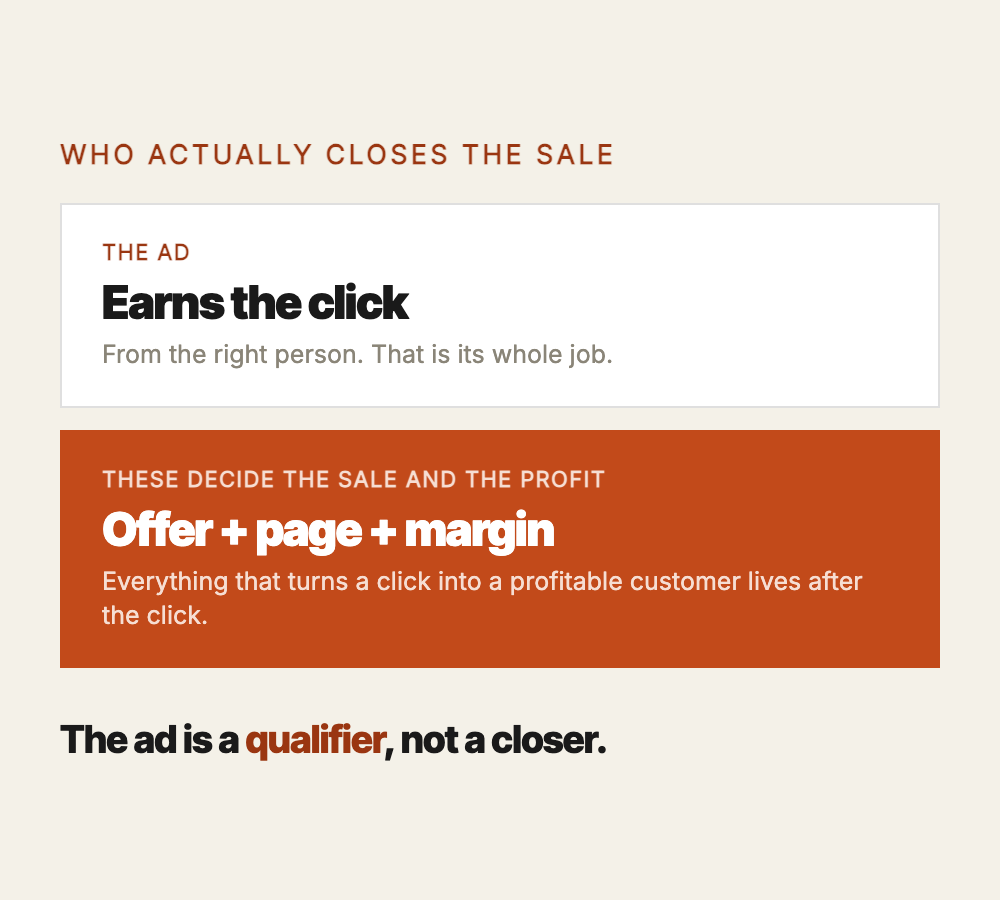
An ad has one job: earn a click from the right person. It doesn't decide whether that person buys, and it doesn't decide whether the sale is profitable. Those two outcomes are set by what happens after the click, the offer and the landing page, and by what was already true before the ad ran, your margin.
Direct-response advertising has understood this for a long time: the offer beats the creative. A great ad in front of a weak offer still fails. A mediocre ad in front of a strong offer still sells.
Field research backs this up too. Blake, Nosko, and Tadelis (Econometrica, 2015) found that paid clicks often aren't as incremental as advertisers assume, meaning the ad gets credit that belongs to the offer and the demand that already existed.
So when targeting and delivery both look healthy but CAC keeps climbing, the honest next question isn't "which audience," it's "what happens after they click."
Is my CAC actually high, or just higher than a number I made up?
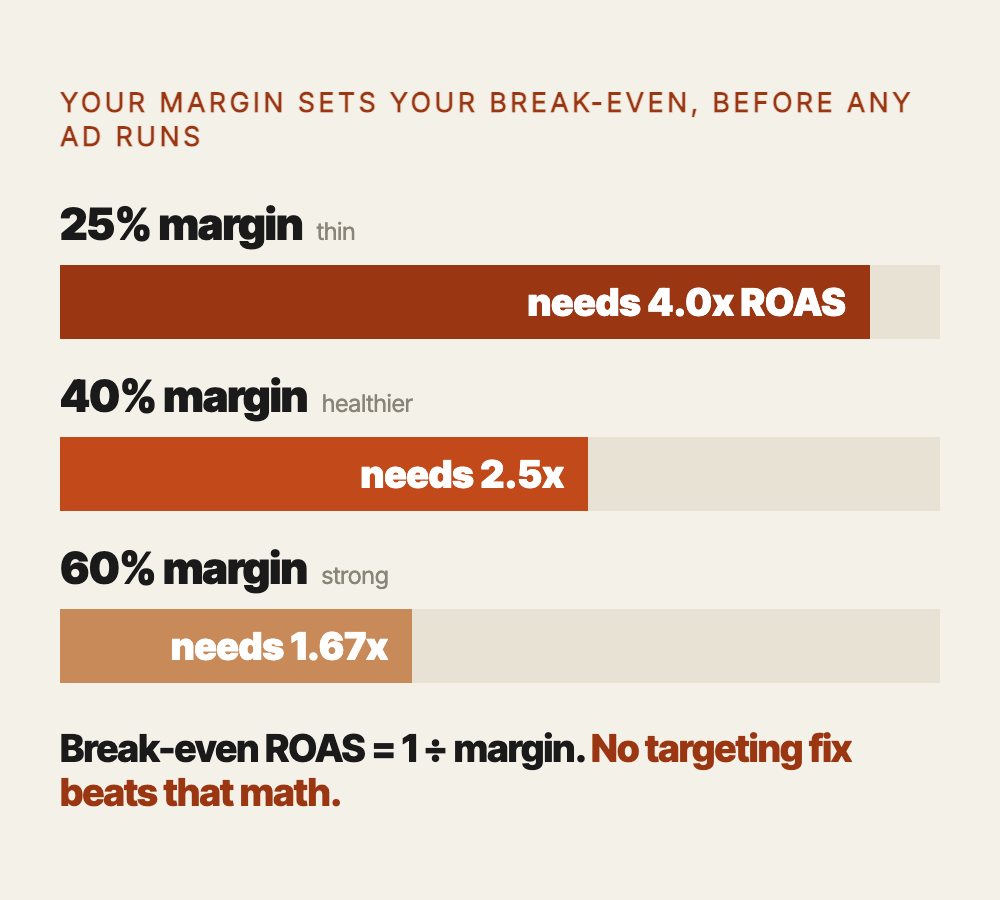
Most founders compare CAC to a round number they picked once and never revisited. The more useful number is your break-even ROAS, the point where an ad stops losing money. That number comes from one formula: break-even ROAS = 1 divided by your contribution margin.
A 25% contribution margin needs a 4.0x ROAS just to break even. A 40% margin needs 2.5x. Notice how much room that leaves, or doesn't leave, for profit above break-even.
The common mistake here is using gross margin instead of contribution margin. Gross margin ignores shipping, payment fees, and returns, so it makes your break-even look easier to hit than it actually is.
If you run that math and your ads are already sitting near your true break-even, your CAC isn't broken. Your margin is thin, and that is a different problem than a targeting one, with a different fix.
Why won't better targeting bring my CAC down?
Think of your ad performance as a fraction. The numerator is revenue per ad dollar, the thing a media buyer can actually influence by finding better audiences and better creative. The denominator is your contribution margin, which was fixed before the ad ever ran.
A media buyer can improve the numerator. No media buyer can fix the denominator. Handing a margin problem to a targeting tool is asking the wrong layer of the business to solve it.
There's also a scale effect working against you. As you spend more, you reach past your best, cheapest buyers into colder, more expensive ones, so the natural direction of CAC as spend grows is up, not down.
More budget without a change to the offer or the margin usually makes this worse. That's not a targeting failure either, it's what happens when you scale past the audience that was already primed to buy.
My ads get clicks but few of them buy, so is that my CAC problem?
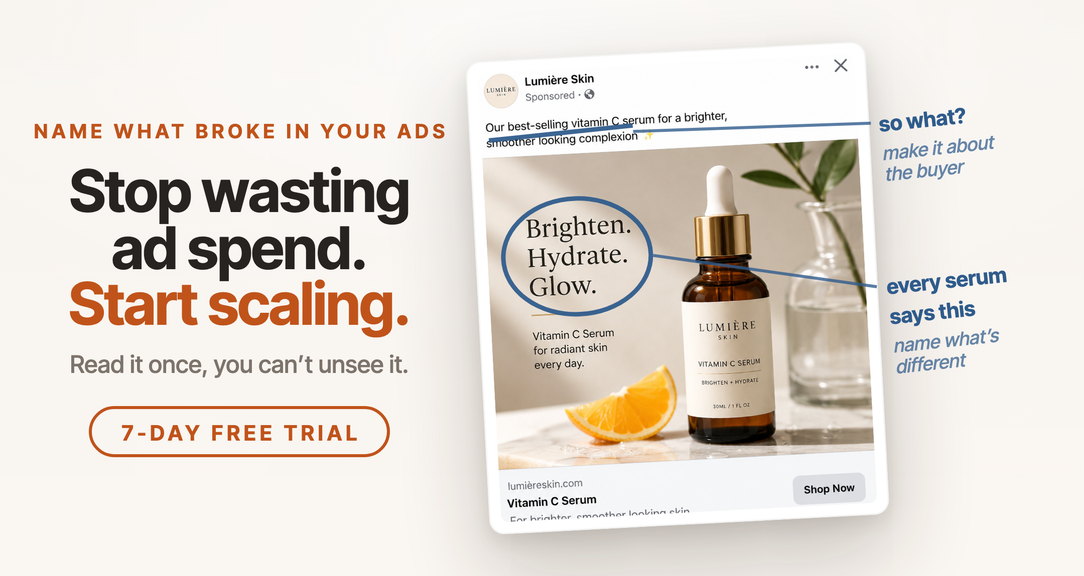
A high click-through rate paired with a low conversion rate (CVR) is a common pattern, and it usually points past the ad to the landing page, specifically to message match, whether what the page says matches what the ad promised. This mechanism has research behind it: Pirolli and Card's information scent work (1999) describes how people abandon a page fast when it stops matching the scent that got them to click.
Two things are worth knowing before you panic about a low conversion number. First, low single-digit conversion is normal in e-commerce, not a red flag by itself, and Ruler Analytics reports around 2.4% for retail and e-commerce.
Second, since Apple's iOS privacy changes, some of your "no sales" are actually sales your ad platform simply can't see and attribute back to the click. Not every gap is a broken funnel, and this gets its own full breakdown in the companion article on why your ads get clicks but no sales.
How do I actually bring my CAC down?
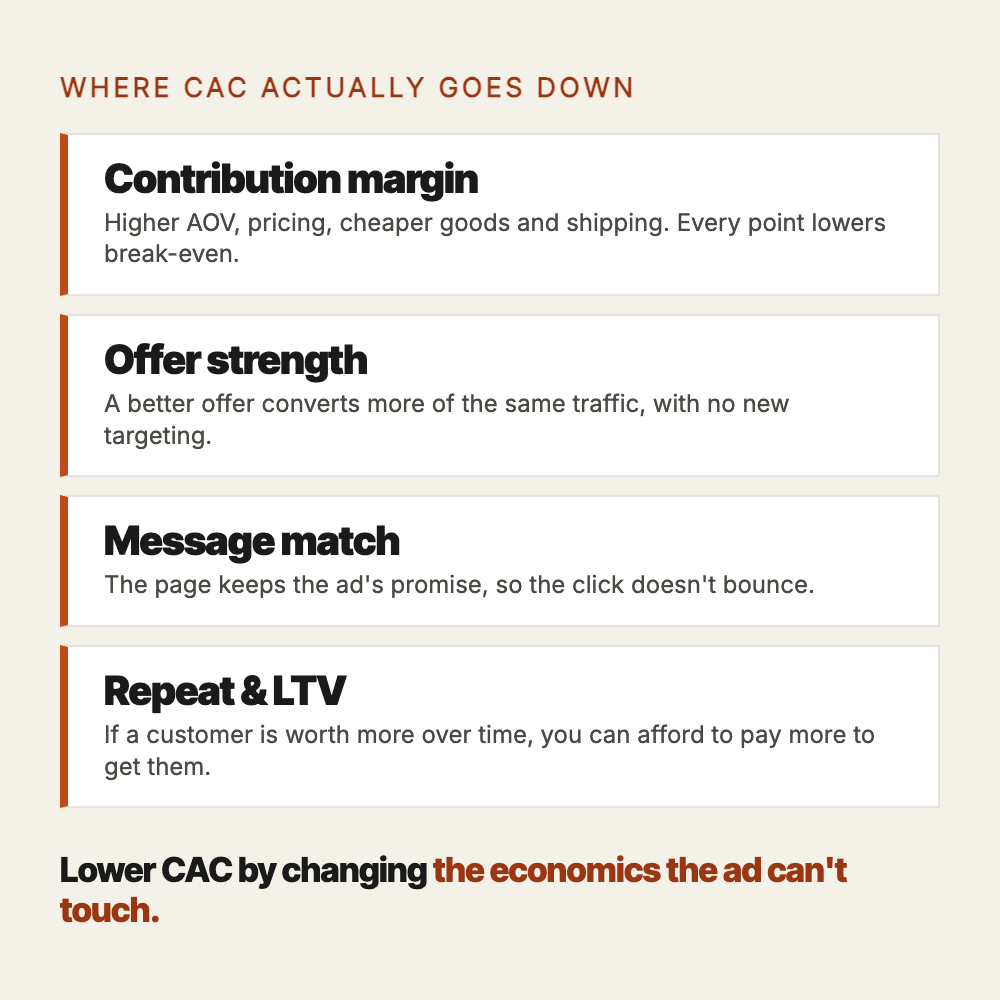
Since CAC is set mostly by what's downstream of the ad, that's also where the real levers live. None of this is a paid method, it's just naming where the work actually is.
- Raise your contribution margin. A higher average order value (AOV), better pricing, lower cost of goods, or cheaper shipping. Every point of margin you add lowers your break-even ROAS.
- Strengthen the offer. A better offer converts more of the same traffic without touching targeting at all.
- Fix message match. Make the ad and the landing page tell the same story, so the click doesn't bounce.
- Lift repeat purchase and lifetime value (LTV). If a customer is worth more over time, you can afford to pay more to acquire them, which quietly lowers the pressure on CAC.
What should I check before I blame the ads again?
Work in this order. First, compute your true break-even ROAS from your real contribution margin, not gross margin.
Second, compare your real store revenue to what your ad dashboard reports. Advertisers structurally cannot measure their own ad return with precision (Lewis and Rao, Quarterly Journal of Economics, 2015), so you may be chasing measurement noise instead of a real problem.
Third, read the funnel itself, the gap between clicks and sales, and check the offer and the landing page for a message-match break. Only after those three checks does it make sense to look at the ad.
The belief shift underneath all of this: the ad is a qualifier, not a closer. It earns the click from the right person, and the offer, the page, and the margin close the sale and decide whether it was worth having.
If you've been chasing CAC by testing new audiences and creative, you've likely been asking the media buy to fix a margin and offer problem it was never built to solve. The Realignment Protocol is the paid framework built to diagnose this across all four layers, but the diagnosis itself starts with the checks above.
Frequently asked questions
What is a good CAC?
There's no universal good CAC. It's set by your contribution margin and your customer's lifetime value (LTV), not by an industry average. The only number that matters is your own break-even ROAS, calculated as 1 divided by your contribution margin.
Does a higher average order value (AOV) lower my CAC?
A higher AOV doesn't lower your CAC directly, but it raises the margin you earn per order, which lowers your break-even ROAS. That gives your ad account more room before it stops being profitable.
Is the 3:1 LTV:CAC rule real?
The 3:1 lifetime value to CAC ratio comes from David Skok and was built as a floor for SaaS businesses, not a law for direct-to-consumer (DTC) brands. Treat it as a reference point from a different business model, not a target to hit exactly.
Will lowering my budget lower my CAC?
Not reliably. Spend and CAC interact with your margin and your audience depth, not with budget size alone. Cutting budget without fixing the offer, the page, or the margin usually just delays the same problem.
Should I just switch to a new audience?
Only after you've confirmed the problem is actually a targeting problem. If your break-even math and your funnel both check out and CAC is still high, a new audience is worth testing. If they don't check out, a new audience won't fix a margin or offer problem.
Related reading: if raising the budget is when your costs jumped, see why Facebook ads break when you scale. For the broader read on which layer actually broke, see why Facebook ads stop working. For the framework this all sits inside, visit the Hub.