Why did my Facebook ads stop working?
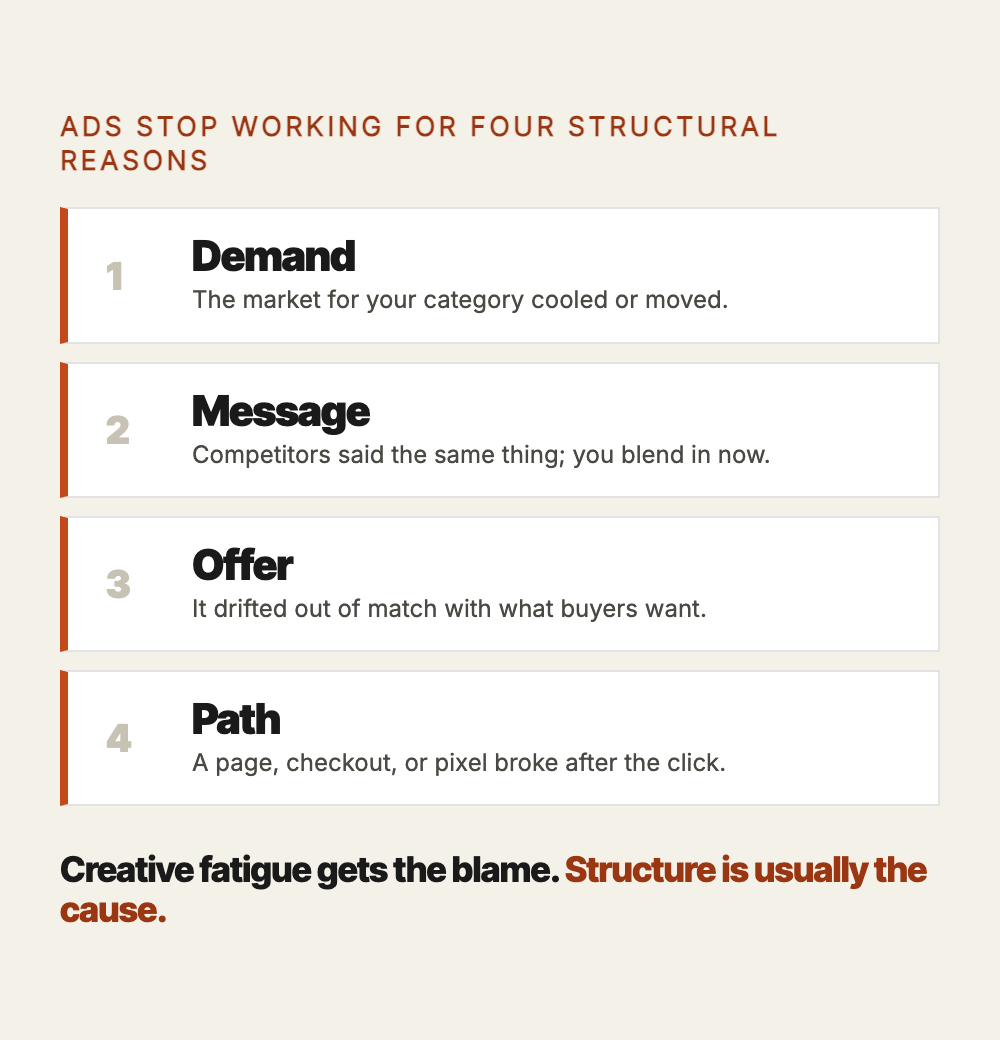
Facebook ads typically stop working for four structural reasons: demand for your category dropped or shifted; your message no longer stands out because competitors have said the same thing many times; your offer drifted out of match with what buyers currently want; or something in your post-click path, a landing page, checkout step, or broken tracking pixel, degraded without anyone noticing. Creative fatigue is the most common explanation given and the least common root cause.
Your campaigns were profitable. You did not change the budget, did not touch the audience, did not fire anyone. Then the numbers dropped and stayed down. You swapped the creative. Still down. The most common explanation you will hear is "creative fatigue," the idea that people got bored of seeing your ad. That explanation is usually wrong, or at least incomplete. When ads stop working for no visible reason, the cause is almost always structural. This article walks you through a four-part diagnostic so you can find where the break actually is.
- Measure first: a reporting drop and a real performance drop look identical in the dashboard. Check your store or CRM numbers before diagnosing anything.
- Four structural causes: demand shifted, your message no longer stands out, your offer drifted, or the post-click path broke. Creative fatigue is rarely the root cause.
- Read the metrics in order: CPM tells you about the auction, CTR tells you about the message, CVR tells you about the offer and landing page. The one that moved first points to the real problem.
- New creative is not a fix: swapping the ad only addresses fatigue. It does not fix demand, positioning, offer drift, or a broken checkout path.
- The checks are free: compare platform vs. store data, check your pixel, review the landing page on mobile. None of these require a tool or a consultant.
Is the drop in my Facebook ads even real?
Before you diagnose anything, check whether the platform is actually measuring correctly.
A reporting drop and a real performance drop look identical in the dashboard. The number goes down and the account signals a problem. But sometimes the number went down because the platform stopped counting correctly, not because fewer people bought. A broken measurement system produces a fake crisis.
Three checks take about ten minutes and answer this before you touch anything else.
Compare platform conversions against your store or CRM for the same time window. Pull the number of purchases your ad platform reported for the last 30 days. Pull the actual orders from your store backend or CRM, your customer database, for the same window. If the platform shows substantially fewer sales than actually happened, you have a measurement gap. The ads may be fine. The tracking is not.
Check that the attribution window has not changed between the two periods you are comparing. An attribution window is the number of days after a click or view that the platform will still credit a sale to that ad. If you are comparing a period when the window was set to seven days against a period when it was set to one day, you are not comparing the same thing. The narrower window produces a smaller reported number without any change in actual sales. Your attribution window is in Ads Manager, under Settings, then Attribution settings.
Check that your pixel still fires after any recent site update. A pixel is the small tracking code on your site that tells the ad platform when a purchase happens. Theme updates, plugin changes, and checkout redesigns can break the purchase event silently. The platform stops receiving the signal. Sales keep happening. The reported number drops.
No one outside your account can look at your dashboard and tell you whether the drop is a measurement problem or a real performance problem. That distinction lives inside your data. The comparison check above answers it in ten minutes.
Why do Facebook ads stop working when nothing changed?
This is the harder question. You did not touch anything. The ads look the same. The audience is the same. So why did performance drop?
The answer is almost always one of four structural causes. These are worth naming explicitly because they require different responses. Treating them as a single "performance problem" is why most accounts cycle through creative swap after creative swap without fixing the underlying issue.
Cause 1: Demand shifted. Demand for most products is not flat. It moves with seasons, news cycles, and what people are currently worried about or excited about. A skincare product that rode a trend in one quarter may face a genuinely smaller pool of eager buyers six months later. The product did not change. The size of the currently-ready audience did. Your CPM (cost per thousand impressions) rises because fewer people in your target audience are in the right mental state to respond.
Cause 2: Your message is no longer different enough. When your category is new and your offer is the first of its type, the same headline stops people scrolling. Over time, other brands run ads making similar promises to the same audience. Your buyer has now heard that type of message many times, from many sources. What used to feel new feels like background noise. The ad still runs. The message just no longer registers as worth a click. According to NCSolutions (2024), the creative itself drives approximately 49% of a campaign's incremental sales lift, more than targeting or reach combined. When your message blends in with the noise, that advantage quietly disappears even though the physical ad did not change.
Cause 3: The offer drifted out of match. Your offer is everything the buyer is being asked to say yes to: the price, the promise, the guarantee, the friction of the checkout process, and whether the stated outcome still matches what buyers currently want. Markets move. A promise that felt compelling eighteen months ago may now feel ordinary because competitors made the same promise, or because buyer priorities shifted. The offer did not change. The context around it did.
Cause 4: The path from click to purchase breaks down. Your landing page, your checkout flow, your post-click sequence. These can degrade without anyone touching them. Page speed worsens after a site update. A plugin breaks a form field on mobile. A price test left an inconsistency between the ad and the page. Conversion rate drops while everything upstream looks fine. From the ad account, this looks like the ad stopped working.
These four causes (Demand, Positioning, Offer, and Conversion Path) are the structural layer underneath every performance drop. Reading them as separate causes matters because the fix for each is different. Demand shifts call for audience or timing decisions. Positioning failures call for message changes. Offer drift calls for a rethink of what you are actually promising. Conversion Path failures call for post-click debugging. Treating all four as "the creative needs refreshing" is the most common and most expensive mistake in ad account management.
If you want to know which of the four failed and what to do about it, that is what the Realignment Hub framework is built to diagnose. The article below names the checks that help you identify which layer moved.
How do I tell if it is the creative or something underneath?
You look at which number broke first.
Ad accounts have three main handoff points you can read directly. CPM is what you pay to show your ad to a thousand people: the auction layer, mostly about demand and competition. CTR (click-through rate) is what percentage of people who saw the ad clicked it: the creative and message layer. CVR (conversion rate) is what percentage of people who clicked actually bought or completed the desired action: the offer and post-click layer.
Here is a scenario. Imagine your account last month had a CPM of $14, a CTR of 1.8%, and a CVR of 6%. This month CPM is $22, CTR is still 1.7%, and CVR is still 6%. What broke?
The CPM rose sharply and the CTR held. That tells you the auction layer is the suspect, not the creative. More advertisers may have entered your category, or the pool of people who match your targeting shrank, making each impression more expensive. Testing new creative angles will not fix this. The message is working. The environment changed.
Now take the same account with a different pattern. CPM is steady at $14. CTR fell from 1.8% to 0.9%. CVR is unchanged. What broke?
Now the creative is the suspect. The auction is priced the same. The offer is converting at the same rate for people who click. But fewer people are clicking. The message stopped cutting through. This is where testing new hooks, new angles, or new proof points is the right move.
Third pattern. CPM is steady. CTR is steady. But CVR dropped from 6% to 2%. What broke?
The problem is downstream. The landing page, the offer, or the checkout path. The ad is doing its job: reaching people at the right price, getting them to click. Something between the click and the purchase broke. No amount of ad-side work will fix a post-click problem.
Most accounts show a messy version of all three happening at once, which is why a single "swap the creative" response rarely solves the whole problem. You are treating one variable when two or three have moved.
Most accounts show a messy version of all three happening at once.
For context on what healthy numbers look like: according to WordStream's 2024 Facebook Ads benchmark report, the average conversion rate across industries is 8.78%, with wide variance by vertical. A sudden drop below your own historical baseline matters far more than any industry average. Your baseline is the benchmark worth tracking.
Is creative fatigue actually the problem with my Facebook ads?
Creative fatigue is real, but it is narrower than most people think. It means your audience has seen the same ad enough times that they have stopped registering it. The signal to watch is frequency, the average number of times one person has seen a given ad. Frequency is available as a column in your ad set or ad-level breakdown in Ads Manager.
According to industry practitioner research compiled by LeadEnforce (2024), when ad frequency climbs above 3 to 4 on cold audiences alongside a declining CTR, creative fatigue is a likely contributing factor. Meta's own Ads Manager can show a "Creative fatigue" status warning, sometimes appearing within the first seven days of a campaign if frequency builds quickly in a small audience (AppsFlyer, 2024, citing Meta Ads Manager behavior).
What matters more than any threshold is the pattern fatigue produces. Your CTR falls. Your cost per click rises. And CPM may stay flat or drift upward as the platform reads weaker engagement.
If your CPM has spiked but your CTR is holding, fatigue is not the explanation. Something else changed in the auction. The platform is paying more to reach your audience, or your audience has shifted, or a structural problem further down is making the whole system look like a creative problem from the top.
Swapping creative addresses fatigue specifically. It does not address demand shifts, positioning gaps, offer drift, or post-click failures. This is why new creative sometimes helps for a few days and then the numbers fall again. The creative was not the root cause.
Why does new creative on my Facebook ads sometimes work for a week and then stop?
Because novelty has its own short-lived effect, and because the algorithm rewards new creative with an initial exploration phase.
When you launch a new ad, the platform does not immediately know who responds to it. It spends the first few days testing the ad against a broader slice of your audience than it would normally reach. This exploration period can produce better-than-normal numbers for a short time, lower CPMs and higher engagement, simply because the system is casting a wider net before it narrows.
Once the exploration phase ends and the algorithm settles into its learned audience, the structural problems reappear. If the underlying issue was demand, positioning, offer, or the post-click path, none of those changed during the creative swap. The brief improvement was real, but it was telling you something: the account has a deeper problem the creative swap did not reach.
This is also why running the same ad to a new, cold audience sometimes re-ignites performance temporarily. You moved the ad into a pool of people who have not built up familiarity with your message. But if what the ad says no longer fits what that market wants to hear, the cold audience will also wear out, usually faster than the first one did, because you are attracting volume without qualification.
What should I check before the next Facebook ads test?
Before you build anything new, get clear on what actually moved.
Pull your account-level data for the 30 days before the drop and the 30 days after. Look at CPM, CTR, and CVR as separate lines, not just cost per result. Note which one broke first and by how much. CPM and CTR are standard columns in Ads Manager. CVR requires adding a custom metric or comparing click data against your CRM's post-click records.
Check whether a real change happened outside the account. Did a competitor launch a major campaign or a heavily discounted offer in your category? Did you change the landing page, even a small update? Did your product pricing or shipping terms change? These are questions anyone running ads should be able to answer from their own records.
For competitive noise specifically: the clearest source is the Meta Ad Library (facebook.com/ads/library). Search your category to see active ads across advertisers. If the number of active ads from competitors has grown meaningfully since the period when performance was strong, that is a signal that your message may need to differentiate more sharply to cut through a more crowded space. That differentiation decision is a positioning question. The checks below identify whether your metrics confirm it.
Check the landing page manually, on a real mobile device, on the connection your buyer actually uses. Forms break. Pages load slowly. Mobile layouts collapse. Things your desktop testing never caught.
Check whether the audience you are targeting has genuinely shifted. Interest-based audiences and lookalike audiences drift as the platform's underlying data changes. An audience that was tight and responsive six months ago may now include people who matched the signal for reasons that no longer hold.
None of these checks require a tool or a consultant. They require honesty about what you actually know versus what you assumed was stable.
Try this on your own account: look at your last significant drop in results. Write down which of the four causes (Demand, Positioning, Offer, or Conversion Path) the CPM/CTR/CVR pattern most strongly points to. Then ask: if you were advising a friend running a completely different product in a different category with the same metric pattern, would your diagnosis change? If it would, the metric pattern is telling you something about the structure of the drop, not just the product.
Frequently asked questions
Why did my Facebook ads stop working after two weeks?
Two weeks is roughly when the initial exploration phase ends and when early frequency effects start to compound. If performance was strong in week one and fell in week two, the most likely causes are: the algorithm finished exploring and narrowed to a smaller, more expensive audience; frequency built quickly in a small audience; or the offer or post-click path had a structural problem that the initial novelty masked. Check CPM and CTR separately across the two periods to see which layer moved first.
Do Facebook ads just stop working eventually?
Not in the way the question implies. The auction, the audience, and the competitive environment all change continuously. An ad that worked a year ago can fail today because the market has heard that message many more times since then, not because ads as a channel runs dry. Ads are a match between a message and a moment in the market. When the moment changes, the message needs to change too.
Should I restart my Facebook ad campaign?
Restarting has a narrow use case: when you need the algorithm to re-learn the audience from scratch because targeting or creative changed substantially. It does not fix structural problems. If the offer is off, restarting shows the off-offer to a fresh pool. If the landing page is broken, restarting sends more traffic into a broken path. Restart after you have identified and fixed the underlying issue, not before.
Why are my Facebook ads working for some audiences but not others?
Different audiences carry different levels of familiarity with your type of message. An audience that has seen many ads in your category is harder to move with the same claim than one that has not. The same words carry a different weight depending on how many times the person has already heard that type of promise from other brands. This is not a targeting mechanics issue. It is a message-to-market fit issue: the message that works for a less-saturated audience may need to lead with a different proof point for a more experienced one.
My Facebook ads platform shows fewer sales than my store. Which number is right?
Your store or CRM is right. The ad platform only sees sales it can attribute to a click or view within its attribution window, the number of days it looks back from a purchase to find an ad interaction. If that window is short, or if the tracking pixel broke after a site update, the platform undercounts. Your store records every completed order regardless of where the buyer came from. Start by checking whether the pixel still fires and whether the attribution window changed recently.
My Facebook ads cost per result doubled but I did not change anything. What happened?
A CPM spike with no account-side changes almost always points to the auction. Either competition for your audience increased, or the audience pool shrank, making each impression more expensive. The response is not to bid more. It is to reassess whether the audience you are targeting is still the right one, or whether your message needs to be different enough to compete at the new price. The Meta Ad Library (facebook.com/ads/library) is a fast way to check whether competitive spend in your category increased during the same window.
If you want to understand what separates a CPM problem from a positioning problem, and what a structured framework for reading all four causes looks like, the Realignment Hub covers that diagnostic methodology. You start with a 7-day free trial that opens the whole system. You can read through the structural framework before you pay anything. What is the Realignment Protocol and how does it work? covers the four-pillar framework in detail.
This way of reading an account is taught in the Realignment Hub.
A 7-day free trial shows the whole map. It costs nothing to see if it changes how you read creative.
Start your free trial →