What is a good (break-even) ROAS?
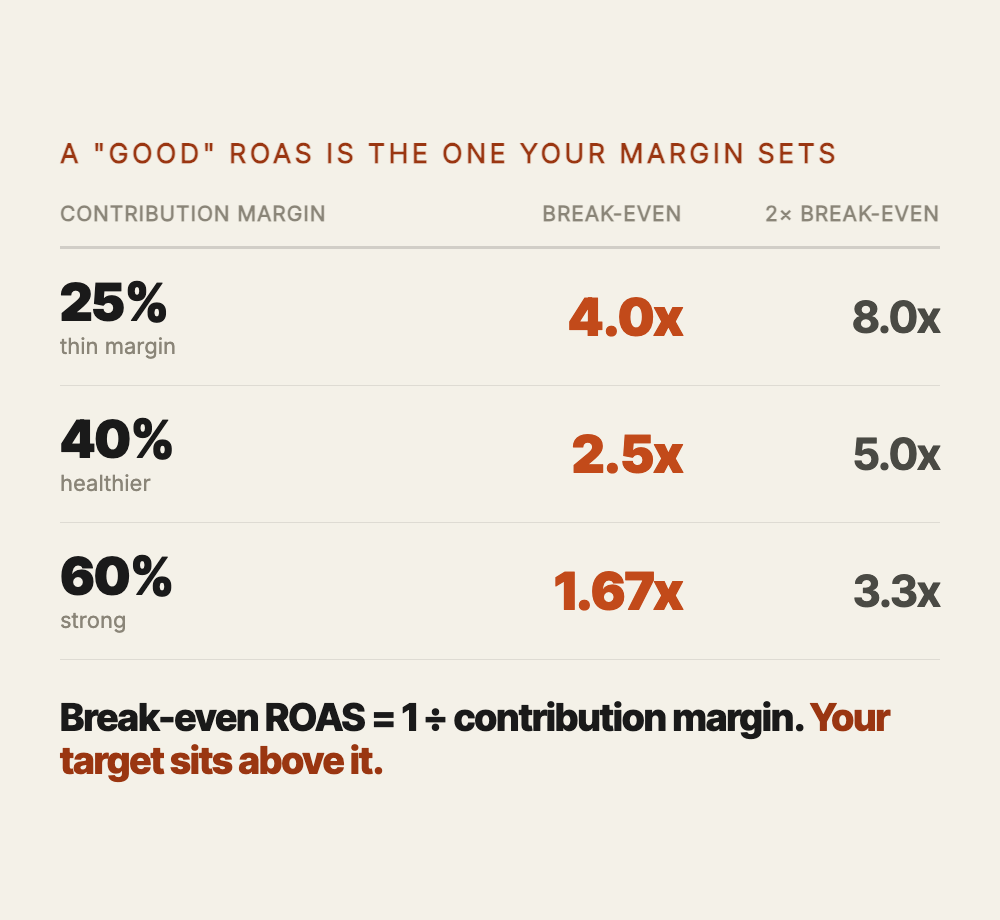
There is no universal good return on ad spend (ROAS). The only number that matters is your break-even ROAS, and it is set by one thing: your contribution margin. Break-even ROAS = 1 divided by your contribution margin. A 25% margin needs 4.0x just to break even; a 40% margin needs 2.5x. Calculate it on contribution margin, after shipping, fees, and returns, not gross margin, or the number will flatter you. Anything above your break-even is profit, anything below is a loss, whatever the industry average claims.
- A "good" ROAS is the one your margin sets. There is no cross-industry number that means anything for your account.
- Break-even ROAS = 1 divided by your contribution margin. 25% margin needs 4.0x, 40% needs 2.5x, 60% needs 1.67x.
- Use contribution margin (after shipping, fees, and returns), not gross margin, or your break-even will look easier than it is.
- Your target ROAS sits above break-even, by the profit you want to keep. It is a choice, not a benchmark.
- Judge the business on blended ROAS. Platform ROAS understates the truth since Apple's privacy changes.
Is there such a thing as a good ROAS?
Not as a fixed number. A ROAS of 3x can be excellent for one store and a slow bankruptcy for another, and the only thing that changed is the margin underneath it.
ROAS is just revenue divided by ad spend. On its own it tells you how much money came back per ad dollar, but not whether that money covered the cost of making and shipping the product. That is why a benchmark from a blog or a case study cannot tell you if your ROAS is good.
The number that can tell you is your break-even ROAS: the point where a campaign stops losing money. Everything else is measured against that.
The formula, the margin trap, and your real target are below
What is break-even ROAS and how do I calculate it?
Break-even ROAS is the ROAS at which a campaign makes exactly zero profit: the revenue covers the ad spend and the cost of the goods, with nothing left over and nothing lost.
The formula is short: break-even ROAS = 1 divided by your contribution margin. If your contribution margin is 40%, your break-even is 1 divided by 0.40, which is 2.5x. If it is 25%, your break-even is 1 divided by 0.25, which is 4.0x.
Read the table above from the top. The thinner your margin, the higher the ROAS you need just to stand still, and the less room you have left for profit. This is fixed before a single ad runs, which is why it is the honest starting point for judging any campaign.
Why does my break-even feel wrong when I hit it and still don't profit?
Almost always because the margin in the formula was gross margin, not contribution margin. Gross margin counts only the cost of goods. It ignores shipping, payment processing fees, and returns, all of which are real money that leaves on every order.
Contribution margin is what remains after all of those variable costs. It is a smaller number, so it produces a higher, truer break-even ROAS. Use gross margin and your break-even looks easy to clear, then the profit never appears.
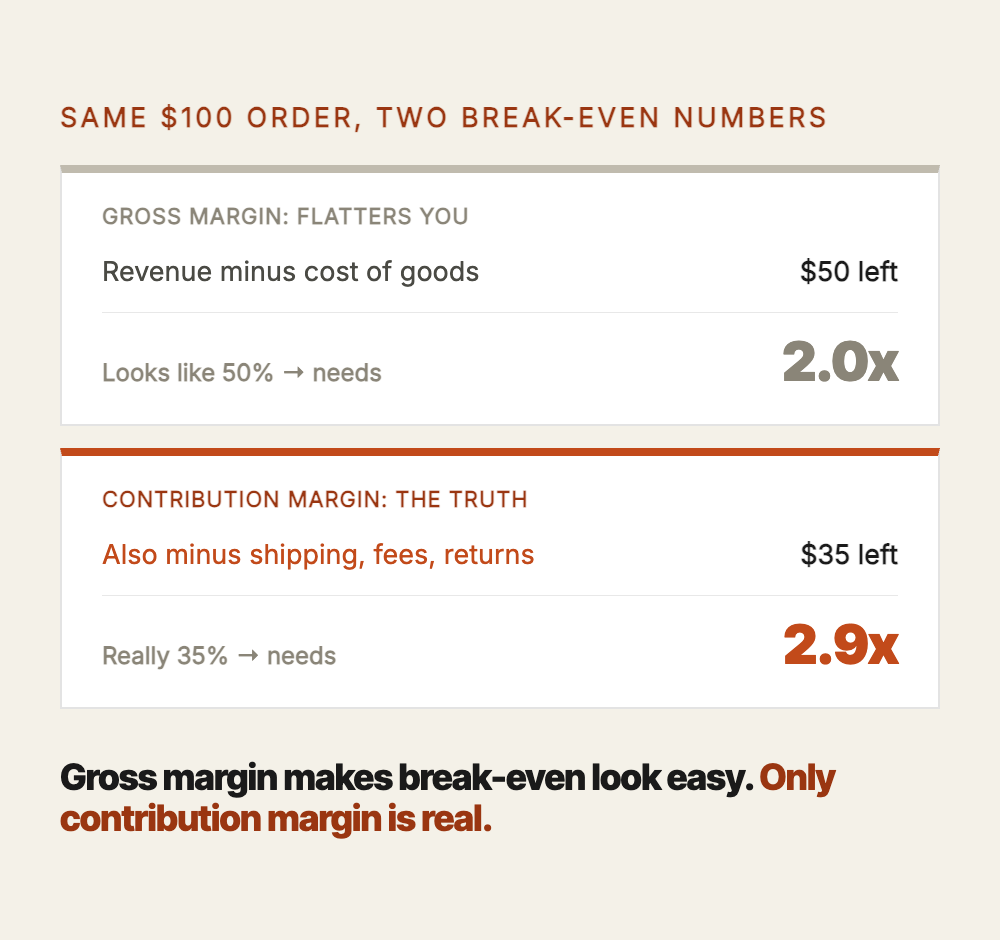
The fix is to build your break-even on the fully loaded per-order costs. It will feel less flattering, and it will finally match your bank account. A high cost per customer is often this same margin problem wearing a different name, which is covered in why your CAC is so high.
What ROAS should I actually aim for?
Your target sits above your break-even, and the gap is the profit you want to keep. Break-even keeps the lights on; your target is what makes the business worth running.
A simple way to set one is to pick a multiple of break-even. In the table above, the last column shows twice break-even, which is the point where your ad-driven contribution equals your ad spend. That is an illustration, not a law. The right target is a business decision about how much margin you are willing to reinvest in growth versus keep as profit.
The useful shift is that your target becomes something you choose on purpose, tied to your own margin, instead of a number you inherited from someone else's account.
Are industry ROAS benchmarks useful at all?
Barely, and mostly as a loose sanity check. An industry-average ROAS blends together businesses with wildly different margins, price points, and repeat-purchase rates, so it cannot tell you whether your specific campaign made money.
There is one more trap worth naming. The ROAS your ad platform reports only counts the sales it can attribute, which understates reality since Apple's iOS privacy changes. Blended ROAS, your total revenue divided by your total ad spend, is closer to the truth for the whole account.
The belief shift underneath all of this: a good ROAS is not a number you look up, it is a number you calculate from your own margin. The Realignment Protocol is the paid framework that connects this margin math to the offer and the conversion path, but the break-even calculation itself is yours to run today.
Frequently asked questions
Is a 3x ROAS good?
It depends entirely on your margin. At a 25% contribution margin your break-even is 4.0x, so a 3x ROAS loses money. At a 40% margin your break-even is 2.5x, so a 3x is profitable. There is no good ROAS without your margin attached to it.
What is the difference between ROAS and break-even ROAS?
ROAS is the revenue you earned per dollar of ad spend. Break-even ROAS is the point where that revenue exactly covers the ad spend and the cost of the goods, so profit is zero. You compare your actual ROAS against your break-even to know if a campaign made money.
How do I calculate break-even ROAS?
Break-even ROAS = 1 divided by your contribution margin. If your contribution margin is 40%, your break-even ROAS is 1 divided by 0.40, which is 2.5x. Use contribution margin after shipping, fees, and returns, not gross margin.
Does a higher average order value (AOV) lower my break-even ROAS?
Only if it raises your contribution margin. A higher AOV that carries the same percentage margin does not change your break-even ROAS, but if the larger order dilutes fixed per-order costs like shipping, your margin rises and your break-even ROAS falls.
Should I use platform ROAS or blended ROAS?
Platform ROAS only counts sales the ad tool can attribute, which understates reality since Apple's privacy changes. Blended ROAS, total revenue divided by total ad spend, is closer to the truth for a whole account. Judge the business on blended and use platform numbers to compare campaigns.
Related reading: if your ads clear break-even but customers still cost too much, see why your CAC is so high. If clicks are not turning into sales at all, see why your ads get clicks but no sales. If costs jumped when you scaled, see why Facebook ads break when you scale.