Why do my Facebook ads stop working when I raise the budget?
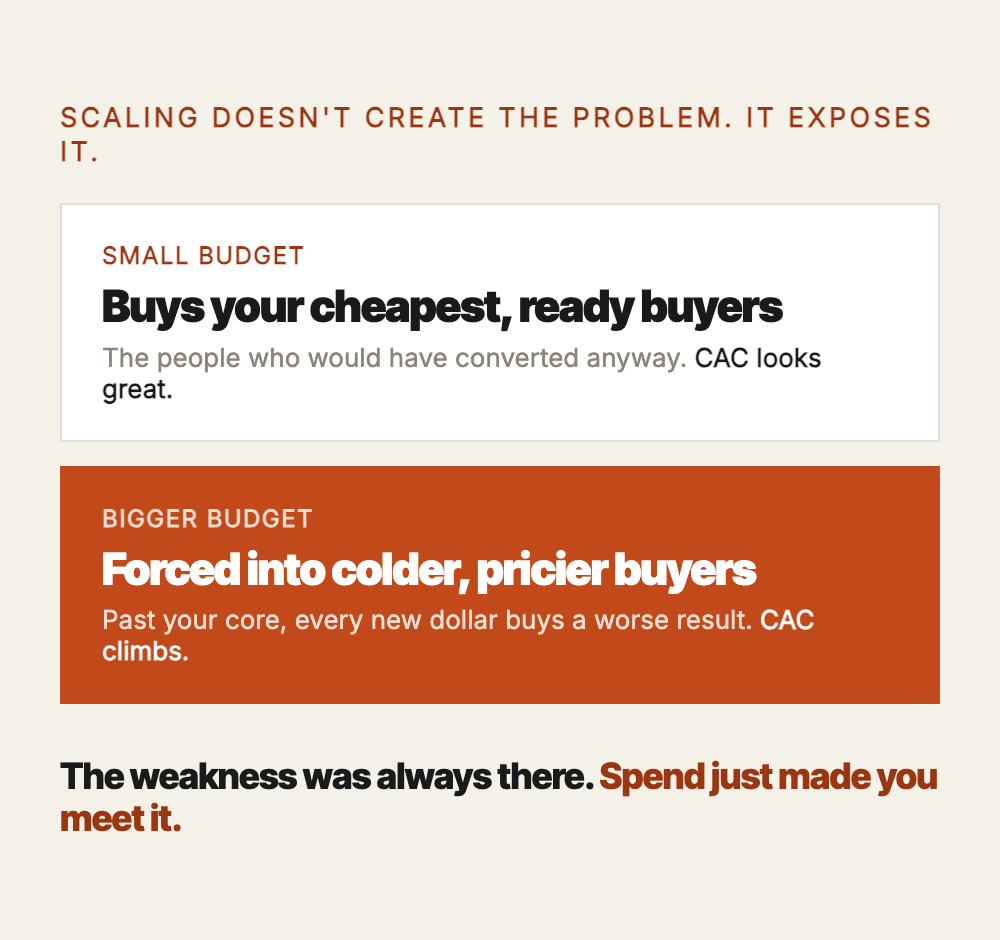
Your ads did not break. Raising the budget exposed a weakness that was already there, hidden by the cheap high-intent buyers a small budget quietly picked off first. At low spend, Meta finds the people who would have bought anyway. More budget forces spend past that self-converting core into colder, pricier territory, so each new dollar converts worse even while the account average still looks fine. The real move is to read marginal results and real revenue, and to fix creative variety, audience breadth, and offer margin before you scale, not after.
- A small budget quietly harvests the cheapest, highest-intent buyers first, so scaling forces spend into colder, more expensive territory and each new dollar buys a worse result.
- Diminishing returns are real: a peer-reviewed eBay experiment found true paid-search ROI (return on investment) turned negative once buyers who would have converted anyway were removed.
- Meta's learning phase is real and needs about 50 optimization events in 7 days to exit, but the popular claim that a 20 percent budget change resets it is folklore, not something Meta's documentation says.
- Because advertisers cannot measure their own ad ROI precisely, part of any post-scale drop is measurement noise, not a dead ad.
- Fix the fundamentals first: scale in small steps, hold changes, and fix creative variety, audience breadth, and offer margin before you scale rather than after.
Why do my Facebook ads get worse the moment I raise the budget?
At a small daily budget, Meta's algorithm isn't finding new buyers so much as picking off the ones who were already going to buy. These are the highest-intent people in your audience, the ones who saw your product a few times, searched the brand name, and were one nudge from converting anyway.
A small budget can only reach a small slice of your audience, so it spends almost entirely on that easy slice. Reported ROAS (return on ad spend) looks great because you're mostly paying for conversions that would have happened without the ad.
Raise the budget and Meta has to keep spending. It runs out of that easy slice fast and starts buying impressions further out, people who are colder, less convinced, and more expensive to move.
The ad didn't change. The pool of people it's buying from did.
This isn't folklore. A peer-reviewed field experiment on eBay's paid search (Blake, Nosko and Tadelis, Econometrica, 2015) found that once you remove buyers who would have converted anyway, the true return on that spend was actually negative, even though the reported numbers looked strong.
Scaling doesn't create the weak spot. It reveals one that was always priced in.
The learning-phase truth, the diagnostic, and the fix are below
Does a bigger budget really reset Meta's learning phase?
Meta's learning phase is real and it is documented. When you launch or meaningfully edit an ad set, Meta needs to gather signal, typically around 50 optimization events within a 7-day window, before delivery stabilizes and costs settle. Significant edits, including a big budget jump, can send an ad set back into that unstable phase.
Where the folklore creeps in is precision. A common rule floating around media-buyer forums says any budget change over 20 percent resets the learning phase.
That specific number is not in Meta's own documentation. Meta only says significant changes may cause the algorithm to re-enter learning, without publishing a fixed threshold.
Why this matters for you: if you doubled your budget and results wobbled for a few days, that's plausibly a real learning-phase disruption, not proof the ad is broken. But if you're nudging spend up 15 to 20 percent and blaming a folklore threshold for every dip, you're diagnosing the wrong problem. The honest version is messier than the meme: bigger changes are riskier, but there's no clean magic number to hide behind.
Why does each new dollar buy worse results than the last?
Your dashboard shows one blended average: total revenue divided by total spend. That number flatters you, because it mixes the cheap early conversions, the buyers who would have bought anyway, with the expensive new ones scaling forced you to chase.
The question that actually matters isn't "what's my average ROAS." It's "is the next dollar I spend still profitable." Those are different questions with different answers, and the average can stay healthy-looking long after the marginal dollar has gone underwater.
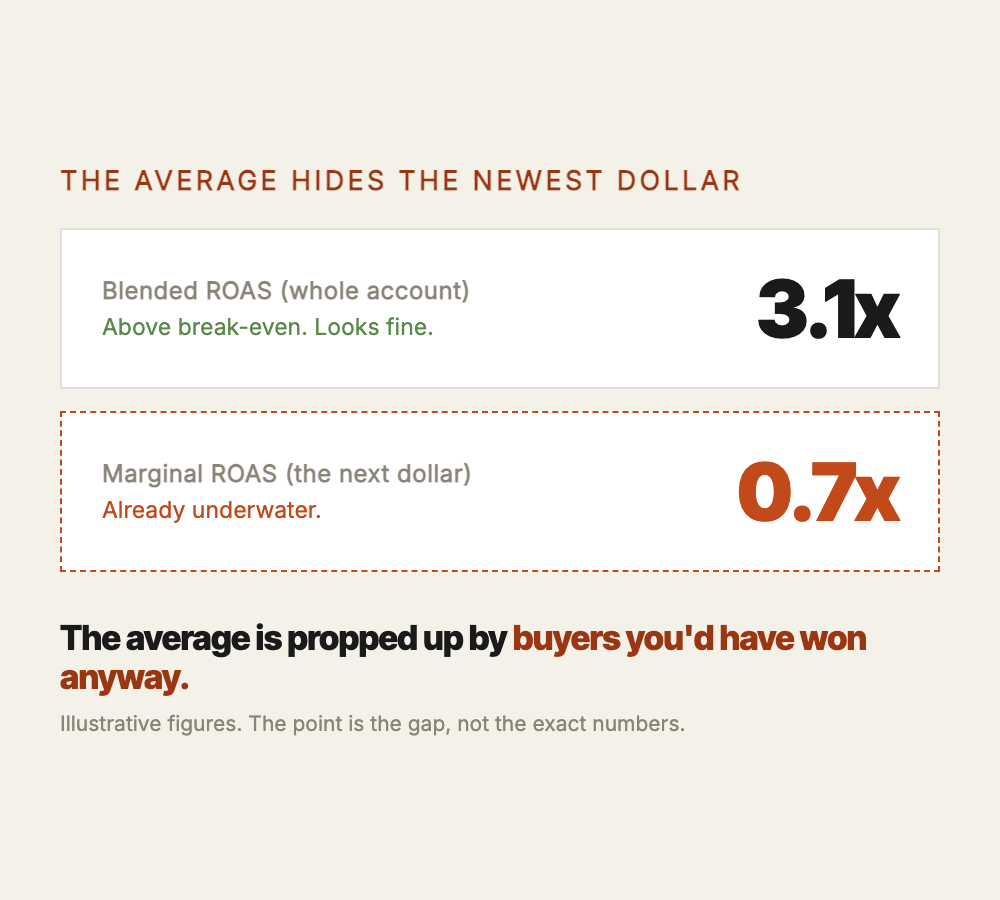
This is exactly what the eBay research found: reported returns looked strong in aggregate, but the true incremental return, what the ad actually caused beyond people who would have bought anyway, was negative. A blended average sitting comfortably above breakeven can be hiding a marginal dollar that's already losing money.
If you only ever check the blended number, you'll keep scaling well past the point where it stopped working, because the dashboard has no way to show you where the good buyers ran out and the expensive ones began.
Is my ad actually dead, or is the dashboard lying to me?
Before you kill a campaign that broke after a budget increase, ask a harder question first: are you sure the drop is real?
Advertisers structurally cannot measure their own ad ROI with much precision. In a large study spanning 25 experiments and $2.8 million in ad spend, the median confidence interval on measured advertising ROI was over 100 percentage points wide (Lewis and Rao, Quarterly Journal of Economics, 2015). That means the true number could plausibly sit almost anywhere inside a huge range, even from a properly run test.
Practically, some of what looks like a post-scale collapse is measurement noise, not a dead ad. Before you touch the campaign, check real money. Compare actual store or bank revenue for the period against what the ads dashboard reported.
If real revenue held up close to what the platform claimed, you likely have a genuine marginal-return problem worth investigating. If the dashboard number and the bank number were never close to begin with, you may be reacting to noise, not to a real change in the ad's performance.
How do I raise a budget without breaking the campaign?
Two habits cause most of the panic. First, jumping the budget in one big step instead of scaling gradually and holding. Second, changing the creative at the same time as the budget, which triggers a second learning-phase reset that gets blamed on the budget alone.
Raise spend in smaller increments and give each step time to stabilize before the next one. Resist the urge to touch anything else mid-scale, no new creative, no audience edits, no bidding changes, while you're watching an ad set settle into a bigger budget.
Ad frequency wearout is real too. Research on frequency and attitude response shows the effect on how favorably people respond peaks around 10 exposures per person, then decays, while recall, by contrast, keeps climbing with repetition.
Refresh creative on a schedule before frequency forces your hand, rather than reactively swapping creative the moment a scaled campaign wobbles. Wearout is reversible with fresh variants. It is not a sign the account is broken.
What should I fix before I scale, not after?
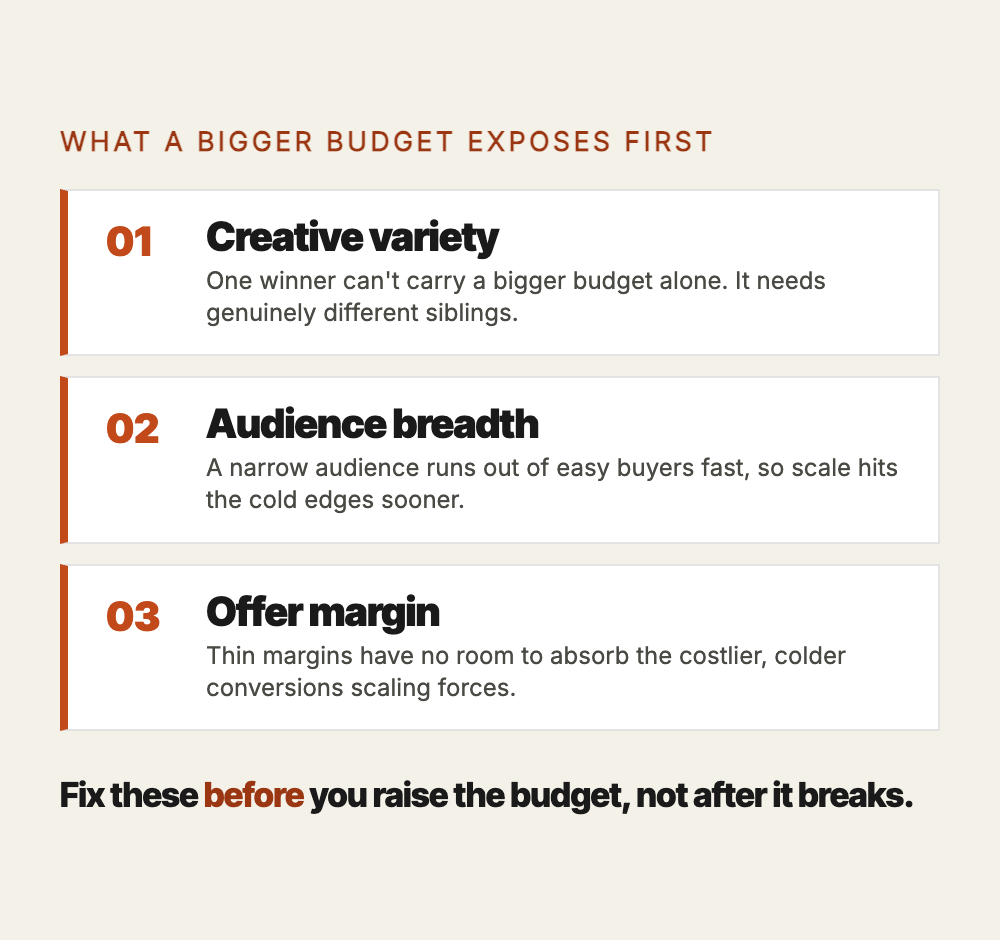
Scaling doesn't just spend more, it removes the cover a small budget was providing. At low spend, one decent hook, one audience, and a passable margin can carry you, because you're only ever reaching the easiest buyers. At higher spend, that same setup gets exposed fast.
Three things get exposed first:
- Creative variety. One winning ad can't carry a bigger budget alone. It needs siblings, genuinely different concepts, not recolored versions of the same one.
- Audience breadth. A narrow audience runs out of easy buyers quickly, so scale pushes you into the cold edges faster.
- Offer margin. Thinner margins have less room to absorb the costlier, colder conversions scaling forces you into.
Fixing those three things in a systematic way is the harder part, and it is the paid work this article doesn't try to teach. If you want the framework that maps it, that is what the Realignment Protocol covers.
What matters here is the shift in how you see it. Scaling did not break your ad. It shone a light on a weakness that was sitting there the whole time, quietly subsidized by the cheapest buyers in your audience.
Fix the fundamentals first, and the budget becomes something you can actually raise.
Frequently asked questions
Will a small budget increase reset my learning phase?
Meta says significant edits can trigger a learning-phase reset, but it hasn't published a fixed percentage threshold like the "20 percent rule" repeated online. A small, incremental increase is less likely to cause major disruption than a large jump, but there's no guaranteed safe number.
Is a bad week after scaling proof my ad is dead?
Not on its own. Advertisers can't measure ad ROI precisely, and post-scale campaigns often run through a learning-phase wobble. Check real revenue against reported numbers over at least one full week before concluding the ad is actually dead rather than temporarily unstable.
Should I lower the budget back down if it breaks?
If you just raised it and results wobbled, holding steady through the learning window often tells you more than reversing immediately. Constant up-and-down changes keep resetting the learning phase, which can make an ad look broken when it's actually never been allowed to stabilize.
How much should I increase budget at a time?
There's no single documented safe percentage, but the practical habit that avoids compounding problems is smaller, spaced-out increases with time to stabilize between them, rather than one large jump paired with other changes like new creative.
Does raising budget make my CPM (cost per thousand impressions) go up?
It can. Spending more forces the auction to buy impressions beyond the cheapest, most qualified slice it was reaching before, which tends to cost more per thousand impressions. The exact size of that increase varies by account and isn't something to treat as a fixed number.
If a budget increase was not involved and your ads faded anyway, the causes are different: demand shifts, offer drift, and post-click leaks. See why Facebook ads stop working. And if an unchanged ad lost delivery overnight, that is a delivery shift, covered in why your Facebook ad died overnight. For the broader framework this all sits inside, visit the Hub.