Why did my Facebook ad die overnight when I changed nothing?
Your Facebook ad most likely lost delivery because ad delivery is decided in a live, relative auction that keeps running after launch, not just at it. Meta ranks each ad's relevance against the other ads competing for the same people, so when the field around you shifts, an unchanged ad can lose reach with zero account-side changes. Before assuming anything, rule out three faster explanations: a broken or newly limited tracking setup, an account-wide outage, or ordinary creative fatigue. Run the fifteen-minute diagnostic below before you touch the campaign.
- Delivery is re-decided continuously: an unchanged ad can lose reach with no account action. That is normal now, not proof you broke something.
- Delivery is relative, not fixed: Meta ranks your ad against everyone else competing for the same audience, so your reach can fall when competitors change, with no edit on your end (Meta ad relevance diagnostics).
- Diagnose in order: rule out a tracking or reporting gap, then a platform outage, then an accidental learning-phase reset, then check the delivery-shift signature.
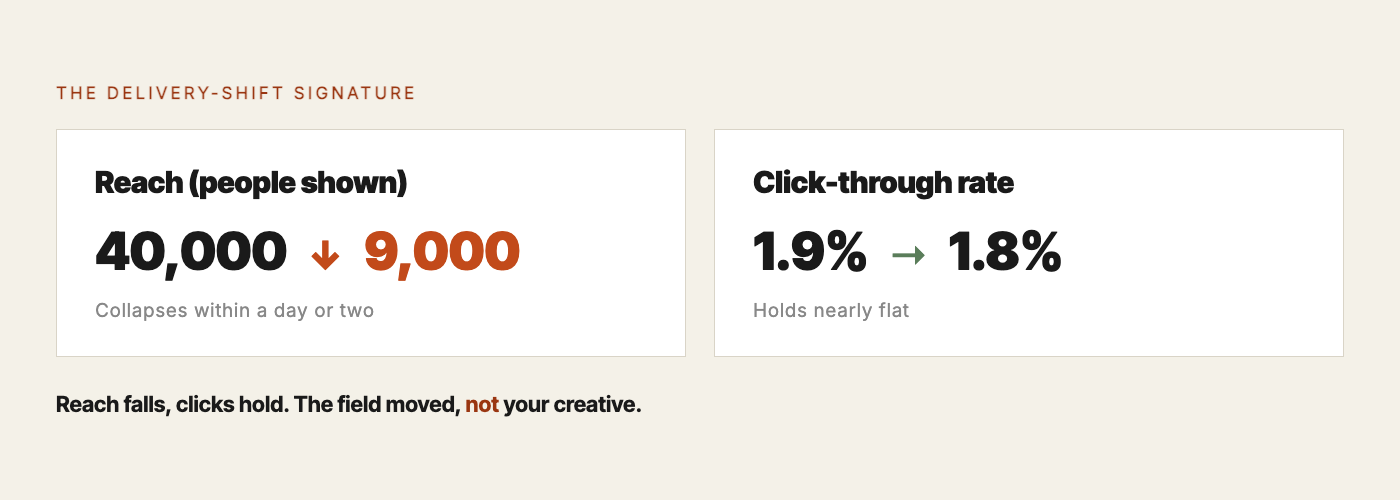
- The delivery-shift signature: reach and impressions collapse while click-through rate holds. Fatigue is the opposite, click-through rate falls while reach holds. Treat this as a diagnostic heuristic, not a Meta rule.
- The fix depends on the cause: once tracking and learning-phase issues are ruled out, new distinct creative competes better than reviving the same ad into the same field.
Why did my Facebook ad suddenly stop delivering when I changed nothing?
The honest answer is that "nothing changed" is only true from your side of the account. Meta's delivery system did not freeze the moment your ad went live and leave it alone. It keeps evaluating every active ad against the current auction, the current pool of competing creative, and the current behavior of the audience it is trying to match. None of that is static, even when your campaign settings are.
This is a real shift in how delivery works, not a conspiracy theory. Meta's own ad relevance diagnostics are relative rankings, they score your ad against the other ads competing for the same people, not on a fixed scale. That comparison runs continuously, not once at launch. So a winning ad from three weeks ago is being judged against today's competitive field, not the one it won in, and it can lose ground without you touching it.
The practical result: an ad can be pushed down with no edits on your end, because the environment around it moved. This feels like the platform broke something. Usually it re-decided something.
Before you accept that explanation, three simpler and faster-to-check causes need to be ruled out first, covered in the diagnostic section below. Overnight death has more than one possible cause, and the re-score explanation is only correct some of the time.
The diagnostic and the fix are below
What is Meta's Andromeda update and why does it matter for my ads?
Andromeda is real and Meta named it publicly. Meta's engineering team published it in December 2024 as a next-generation ads retrieval engine, the stage that narrows tens of millions of possible ads down to a few thousand candidates before the ranking stage picks what actually runs (Meta engineering blog).
Be precise about what that means. Meta documents Andromeda as a retrieval and efficiency upgrade. Meta has not said that Andromeda re-scores your existing ads against each other, or that it suppresses a winner for looking too similar to other creative. That specific idea is a widely repeated industry theory in 2026, not something Meta has published.
What is genuinely observable, and what Meta does document elsewhere, is that delivery decisions that used to feel locked in once an ad exited testing now behave as if they are reconsidered on an ongoing basis.
Ads that performed consistently for weeks can lose reach without an account change, because the relevance ranking is relative and the field around them moved. Ads that look similar to each other may also get treated as interchangeable rather than as separate bets, which is the observation the industry's creative-similarity theory is built on.
Why this matters practically: it changes what "winning" means. A winning ad used to mean a stable asset you could leave running. Under continuous, relative ranking, a winning ad is a temporarily favored asset, and the system's favor can shift as the competitive field around it changes.
This is not a reason to panic. It is a reason to stop treating any single ad as a permanent fixture and start treating your creative output as an ongoing process. That distinction is the subject of the next section.
How does "creative is the targeting" actually work?
Older Facebook advertising trained advertisers to think of targeting as audience selection: interests, lookalikes, demographics. Creative was treated as a separate lever, a message layer sitting on top of the targeting layer.
Under a continuous, relative-ranking system, that separation weakens. The system reads the content of the creative itself as a signal about who it should be shown to and how it compares against everything else currently running.
This means two ads with identical audience settings can get very different delivery based purely on what the creative looks and sounds like, because the system treats the creative as part of how it decides who sees the ad, not just what those people see once reached.
It also means creative similarity matters more than most advertisers assume. Because Andromeda retrieves on the content of the creative itself, practitioners widely report that ads which look like a large pile of other creative get less room in the auction. Treat that as a strong industry read, not a published Meta rule.
If your ad increasingly resembles a large volume of other creative, whether your own past ads, a template a lot of advertisers are using, or a trending format, the system can read that resemblance as reason to give it less room in the auction.
The fix is not a different audience. It is a more distinct piece of creative, because in this model, creative and targeting are functionally the same lever.
Can a winning ad lose delivery on its own, without you touching it?
Yes. This is the part that breaks the old mental model, where a winning ad was a stable asset you left alone until you decided to change it. Because relevance is judged continuously and relative to the field, an ad's delivery is not a one-time verdict locked in when it exits testing. It is closer to an ongoing standing that can move in either direction as the competitive field and the audience behavior shift underneath it.
Two mechanics make this concrete. First, your relevance ranking is relative, not fixed. If more advertisers start competing for your audience, your ad's standing can fall even though your ad did not change, because the field it is judged against changed.
Second, delivery is allocated in a live auction against everything else currently running. An ad that was comfortably winning its slice of that auction a month ago is now competing against a different set of ads, some of which may be newer, cheaper to serve, or scored as more distinct.
Neither mechanic requires you to have touched your account. This is the direct cause of the "I changed nothing and it died overnight" experience, and it is worth naming clearly: it is not a bug, and it is not evidence you did something wrong.
It is the system doing what it now does continuously. The next section shows how to confirm this is actually what happened to you, with a real number pattern to check against.
How do I tell overnight death from creative fatigue, an outage, or a tracking gap?
Four causes produce the same symptom, a dead-looking ad, so check them in order of speed before assuming the re-score explanation. This takes about fifteen minutes total.
Step one: rule out a tracking or reporting gap (2 minutes). Open Ads Manager and confirm your pixel or conversions API event is still firing. Compare reported purchases against your store or CRM for the same window. If the platform shows far fewer sales than your store actually recorded, this is a measurement problem, not a delivery problem. A theme update or checkout change can silently break the purchase event. There is also a reporting change specific to 2026: on January 12, 2026 Meta removed the 7-day-view and 28-day-view attribution windows from its reporting (Meta for Developers), so if you relied on view-through conversions, your reported numbers dropped that week even though real sales did not.
Step two: rule out a platform outage (2 minutes). Check Meta's official status page or search for widespread reports of the same symptom on the same day. Account-specific fixes will not fix a platform-wide event.
Step three: check whether you accidentally reset the learning phase. This deserves its own labeled step because it is the most commonly missed cause. Meta's ad sets need roughly 50 optimization events (conversions or the chosen result) to exit the learning phase and stabilize delivery.
An edit larger than roughly 20% to budget, audience, or creative, or several smaller edits stacked close together, can reset that count and put the ad set back into an unstable learning period, which looks exactly like a dead ad. If you made any edit, however small, in the days before the drop, this is the first suspect, not the re-score.
Step four: check the delivery-shift signature. If steps one through three are clean, pull CPM (cost per 1,000 impressions), reach, and CTR (click-through rate) for the week before and the week of the drop. Here is the pattern that points to a delivery shift rather than fatigue: reach fell from 40,000 to 9,000 people and impressions fell by a similar proportion, while CTR held nearly flat, say 1.9% before and 1.8% after.
The audience that did see the ad responded almost the same as before. What changed was how many people the system chose to show it to. That is the delivery-shift signature: reach and impressions collapse while CTR holds. Read it as a practical heuristic for separating a delivery change from fatigue, not as a metric Meta publishes.
Compare that against fatigue, where CTR itself falls while reach stays roughly steady, because the same audience is seeing the ad too many times and tuning it out. Different pattern, different cause, different fix.
What do I do the moment a winning ad dies overnight?
Run the diagnostic above first. Do not restart the ad set immediately, and do not panic-edit the budget or audience trying to force delivery back. Both actions can trigger the exact learning-phase reset described in the step above, adding a second real problem on top of whatever caused the original drop.
If the diagnostic points to a tracking gap or an outage, fix the underlying issue and leave the ad set running once the fix is confirmed. Nothing about the ad itself needs to change.
If the diagnostic shows you reset the learning phase yourself, the answer is patience, not a new campaign. Leave it running and let it accumulate optimization events back toward the roughly-50 threshold without further edits stacked on top.
If the diagnostic points to the delivery-shift signature, reach and impressions collapsed while CTR held, do not revive the exact same ad. Reviving it by pausing and relaunching, or by nudging budget to force spend, does not change the competitive picture that pushed it down in the first place.
The system is not confused about this ad. It made a comparative judgment against everything else currently in the auction.
The fix is to build a genuinely new, distinct concept, not a variation of the old one, and let it compete fresh. A new headline on the same visual, or a new color treatment on the same script, is usually not distinct enough to change the similarity read.
How do I structure creative so the algorithm keeps finding my buyers?
Since delivery now depends partly on how distinct your creative is relative to everything else in the auction, including your own past ads, the practical goal shifts from "protect the winner" to "keep feeding the system genuinely different concepts."
Practitioner data from Admove, an agency that has published its own performance analysis of post-Andromeda accounts, found that ads over roughly 60% visual or structural similarity to other creative saw retrieval suppressed. That specific number is Admove's own observed data, not a published Meta rule, and should be treated as a practitioner estimate rather than a platform guarantee. It is directionally useful even without being an official threshold.
The same source, along with agency Recharm and the team at Foxwell Digital, points toward running a meaningfully wider spread of distinct creative concepts, with Admove citing accounts running 8 to 20 distinct concepts outperforming narrow A/B setups, and Recharm framing it less as a magic number and more as "diversity is the actual goal, not volume for its own sake." Again, this is practitioner guidance compiled across agencies watching live accounts, not a number Meta has published as policy.
A distinct concept means a different core idea, not a different color or a swapped headline on the same visual structure. Different hook, different proof point, different visual approach, different format. This is a structural shift in production, not a one-time fix, and it is the reason this behavior gets its own dedicated section in why Facebook ads stop working, which covers the four broader causes of performance drops beyond a delivery shift specifically.
Frequently asked questions
Does pausing and unpausing an ad that lost delivery fix it?
No, and it can make things worse. Pausing and relaunching does not change the competitive picture that likely pushed the ad down, and it can reset the learning phase, adding an unstable period on top of the original problem. If the delivery-shift signature is confirmed, build new distinct creative instead.
Is Andromeda a confirmed Meta product, or just an industry term?
It is real and Meta named it. Meta described Andromeda publicly in a December 2024 engineering post as an ads retrieval engine, so it is not a made-up term, but it is backend infrastructure, not a setting you can find or toggle in Ads Manager. Separately, the popular claim that Andromeda re-scores or suppresses your existing ads for creative similarity is an industry theory, not something Meta has documented.
Will a small budget increase reset my learning phase the same way a big one does?
Meta's guidance is that edits beyond roughly 20% to budget, audience, or creative, or several smaller edits stacked close together, can trigger a reset. A single small increase alone is less likely to reset it than a string of edits made across a few days, which is why stacked small changes are worth watching as closely as one large change.
Can two of my own ads compete against each other under this system?
Yes. Because delivery now weighs creative similarity, ads from your own account that look or structure themselves too similarly to each other can be read as redundant in the auction, not as reinforcing each other. Running genuinely distinct concepts avoids your own creative undercutting itself.
How fast can a delivery shift actually happen?
Fast enough to look like "overnight" from the account owner's side, since relevance is judged continuously rather than tied to a scheduled review. The change on your end is often invisible because it comes from the competitive field around your ad shifting, not from anything inside your own account.
If you want the fuller structural breakdown of why performance drops happen even without a delivery shift involved, including demand shifts, offer drift, and post-click leaks, see why Facebook ads stop working. For the broader framework this diagnostic sits inside, visit the Hub.