My Facebook ads get clicks but no sales: why?
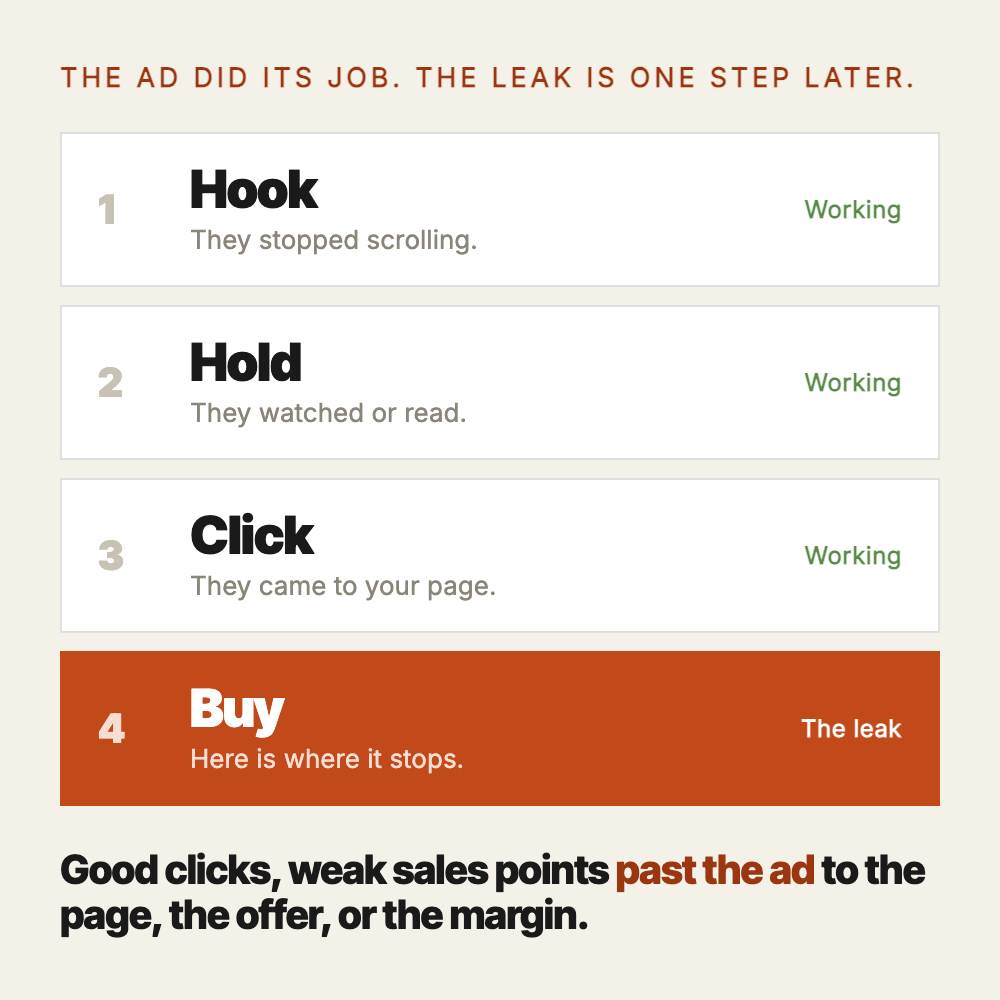
Clicks with no sales usually means the leak is after the ad, not inside it. The ad's only job is to earn a click from the right person. The landing page, the offer, and your margin decide whether that click becomes a sale. Before you rebuild anything, rule out two things: low single-digit conversion is normal in e-commerce, and since Apple's privacy changes some real sales are simply not attributed back to the click. Then check message match between the ad and the page. The click was rarely the problem.
- An ad earns the click. The page, the offer, and the margin decide the sale. A conversion gap points past the ad.
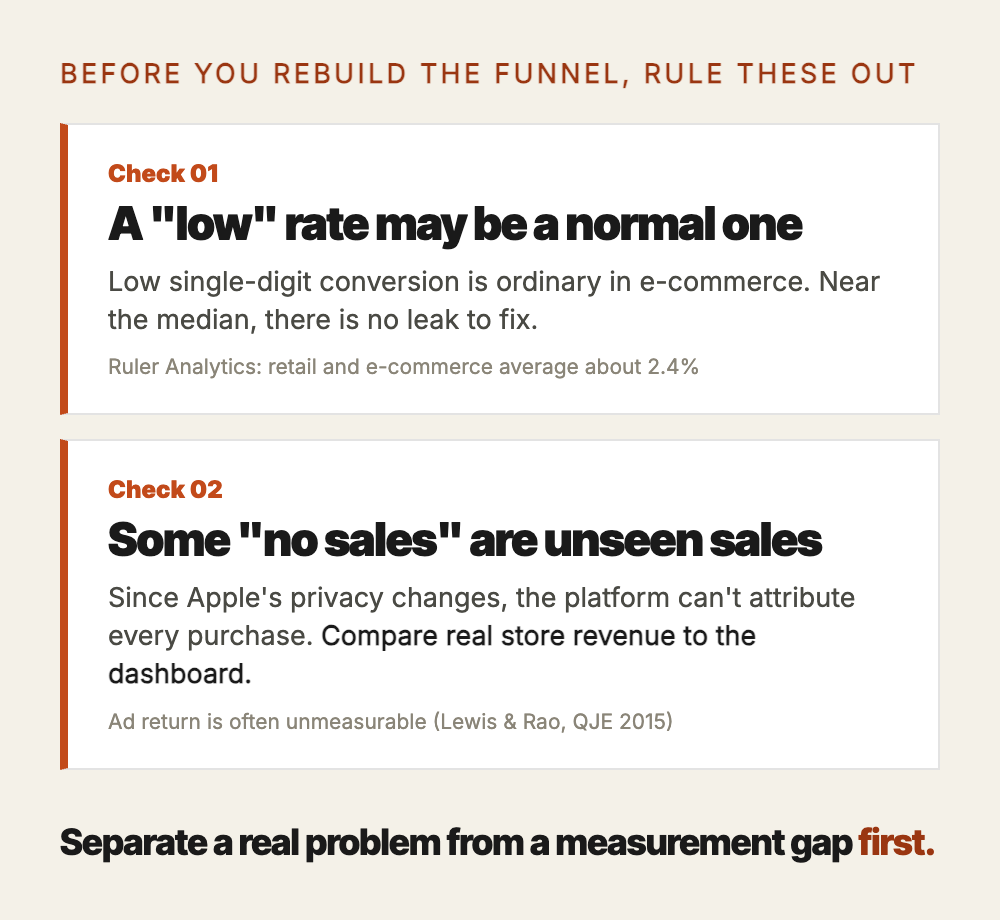
- Low single-digit conversion is normal. Ruler Analytics reports around 2.4% for retail and e-commerce, so confirm your rate is actually below break-even first.
- Part of "no sales" is unattributed sales. Compare your real store revenue to the ad dashboard before calling the funnel dead.
- When click-through is fine and conversion is not, look at message match: does the page keep the promise the ad made?
- Read hook, hold, click, and convert against the ad's own baseline to find which step actually broke.
Why do my Facebook ads get clicks but no sales?
An ad has one job: earn a click from the right person. It does not decide whether that person buys. That decision is made after the click, by the landing page, the offer, and the margin that was set before the ad ever ran.
Field research supports this. Blake, Nosko, and Tadelis (Econometrica, 2015) found that paid clicks are often less incremental than advertisers assume, meaning the demand and the offer, not the ad, were doing much of the work.
So when people click but do not buy, the honest question is not "why is the ad broken." The ad clearly did its job, it got the click. The question is which downstream layer is leaking.
The two reality checks, the diagnosis, and the fix are below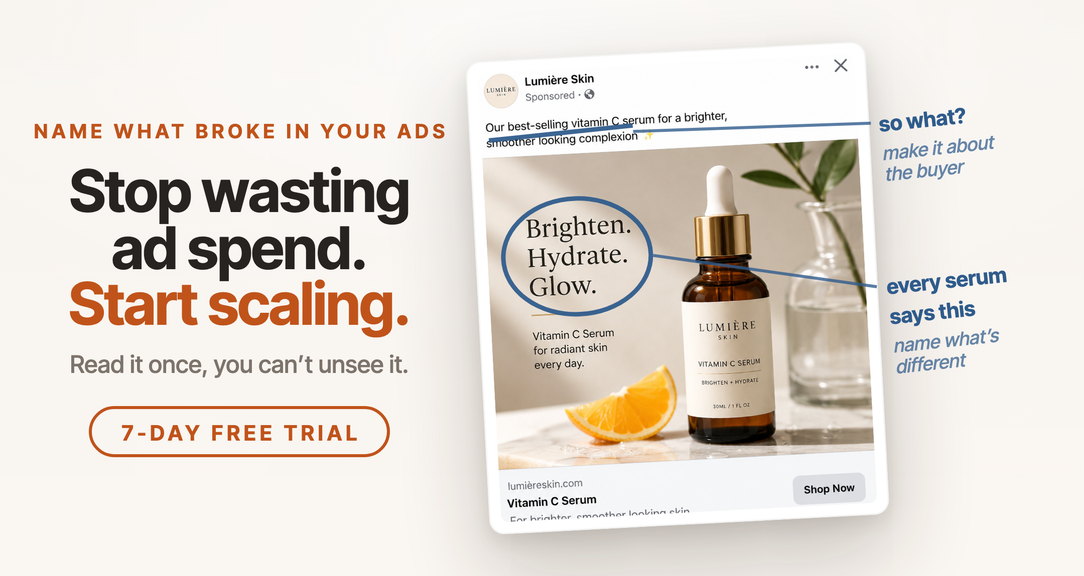
Is my conversion rate actually bad, or just normal?
Most founders panic at a conversion rate that is completely ordinary. Low single-digit conversion is normal in e-commerce, not a red flag by itself. Ruler Analytics, measuring across many industries, reports around 2.4% for retail and e-commerce.
So the first move is not to fix anything. It is to check whether your rate is actually below your break-even, or just below a number you assumed it should hit.
If a hundred clicks bring one or two sales, that may be a perfectly healthy funnel with a traffic volume problem, not a conversion problem. Those two need very different fixes.
Are these really "no sales," or sales I can't see?
Since Apple's iOS privacy changes, ad platforms cannot see every purchase and tie it back to the click that caused it. Some of your "no sales" are real sales the dashboard simply cannot attribute.
This is not a small effect. Advertisers structurally struggle to measure their own ad return with precision (Lewis and Rao, Quarterly Journal of Economics, 2015), so a dashboard that shows few conversions can sit on top of real revenue.
The check is simple. Compare what your store actually earned in a window to what the ad platform reports for the same window. If the store is up and the dashboard is flat, you have a measurement gap, not a dead funnel.
When clicks don't convert, where do I look first?
Once you have ruled out a normal rate and a measurement gap, the first place to look is message match: whether the landing page keeps the exact promise the ad made.
There is a mechanism behind this. Pirolli and Card's information scent research (Psychological Review, 1999) describes how people follow cues that a path will meet their goal, and abandon quickly when those cues drop. When the page does not visually and verbally continue the ad, the scent breaks and the visitor leaves.
A common version: the ad promises a specific product at a specific price, and the click lands on a generic homepage. The visitor cannot find what they were promised, so they bounce. This gets its own full breakdown in the companion article on whether your landing page matches your ad.
How do I find which step is actually broken?
Read your ad as a chain: hook, hold, click, then convert. Each step tells you where attention is lost. A weak hook points to the opening. A good hook but weak hold points to the body of the creative. Good clicks with weak conversion point past the ad, to the page or the offer.
Read each step against the ad's own past numbers, not against a benchmark you saw quoted somewhere. The "good" hook and hold percentages that circulate online are agency estimates from different samples, not Meta standards, so use them as a relative read, not a target.
The value of the chain is that it stops you guessing. Instead of rebuilding everything, you localize the leak to one step and fix that one thing.
What do I fix once I've found the leak?
Work in order, cheapest and most likely first. None of this is a paid method, it is just naming where the work actually is.
- Fix message match. Make the page repeat the ad's promise, price, and picture above the fold, so the click does not bounce.
- Strengthen the offer. A better offer converts more of the same clicks without touching targeting.
- Check the margin math. If the ads are near your break-even, the problem is economics, not conversion. See what a good break-even ROAS is.
- Only then touch the audience. If people are clicking, targeting is already finding interested people. Rebuild it last, not first.
The belief shift underneath all of this: the ad is a qualifier, not a closer. It earns the click from the right person, and the page, the offer, and the margin close the sale.
If you have been fixing clicks-but-no-sales by testing new audiences and creative, you have likely been asking the ad to fix a problem that lives after it. The Realignment Protocol is the paid framework built to diagnose this across all four layers, but the diagnosis starts with the checks above.
Frequently asked questions
What is a normal conversion rate for Facebook ad traffic?
Low single digits is normal for e-commerce. Ruler Analytics reports around 2.4% for retail and e-commerce. A rate near that is not a broken funnel, so confirm your number is actually below your break-even before rebuilding anything.
Why do my ads show clicks but my store shows fewer sessions?
Some of the gap is normal drop-off between the click and the page load, and some is measurement. Since Apple's iOS privacy changes, ad platforms cannot see every action, so click counts and on-site sessions rarely match exactly. Compare trends, not exact numbers.
Could my ads be getting fake or low-quality clicks?
It happens, but it is rarely the main cause. Before blaming click quality, rule out a normal conversion rate, unattributed sales, and a message-match gap on the landing page. Those three explain most clicks-but-no-sales cases.
Should I change my targeting if clicks do not convert?
Usually not first. If people are clicking, the targeting is at least finding interested people. A conversion problem more often lives on the page or in the offer, so fix message match and the offer before rebuilding the audience.
How long should I wait before deciding an ad does not convert?
Wait for enough traffic to judge, not enough time. A handful of clicks tells you nothing. Give it enough visitors that a normal low-single-digit conversion rate would have produced at least a few sales, then read it.
Related reading: if the real question is your cost per customer, see why your CAC is so high. For the page-side fix in depth, see does my landing page match my ad. For the broader read on which layer broke, see why Facebook ads stop working.