Does my landing page match my ad?
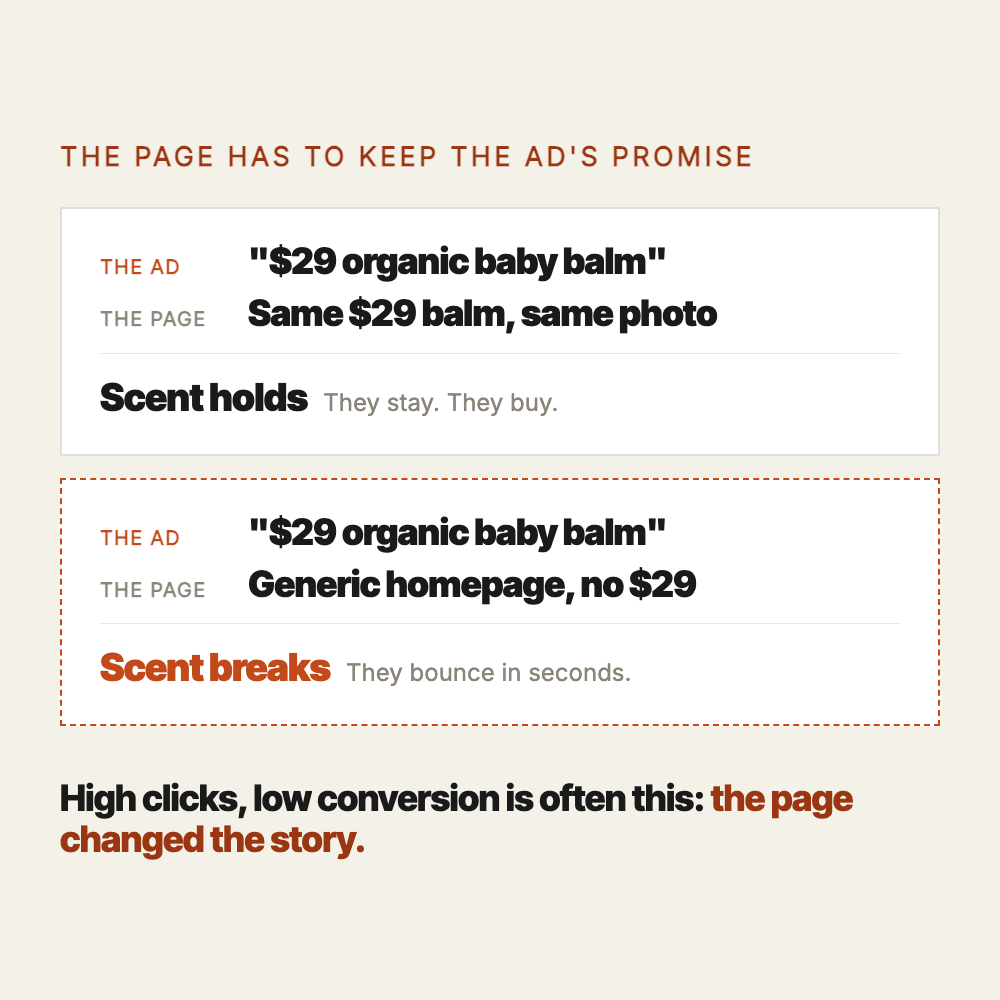
Message match is whether your landing page keeps the exact promise your ad made, in its words, its picture, and its offer. When it does, the visitor feels they are in the right place and stays. When it does not, the cue that got them to click disappears and they leave in seconds. A high click-through rate paired with a low conversion rate is often this exact break. Match the ad's headline, visual, and offer above the fold on the page. It is one of the cheapest leaks to fix and one of the most common.
- Message match is how closely the page continues the ad's promise. Strong match keeps the visitor; a break sends them away.
- High click-through with low conversion is a classic message-match symptom: the ad works, the page changes the story.
- Three things must match above the fold: the words, the picture, and the offer.
- The mechanism is real. People follow a cue that a page will meet their goal, and abandon fast when that cue drops.
- It is cheap to fix. Rewrite the top of the page to repeat the ad, before you touch targeting or creative.
What is message match?
Message match is the degree to which your landing page continues the promise your ad made. The ad sets an expectation: a product, a price, a feeling. The page either confirms that expectation immediately or contradicts it.
There is a well-established mechanism underneath this. Pirolli and Card's information scent research (Psychological Review, 1999) describes how people follow proximal cues that a path will meet their goal, and abandon it when the scent drops. The ad is the scent; the page either keeps it or loses it.
So the question in the title is not cosmetic. It is asking whether the page holds the thread that made someone click in the first place.
The three match points, the test, and the fix are below
Why does a mismatch cost me sales?
Because attention on a landing page is measured in seconds. When a visitor arrives and cannot immediately see the thing the ad promised, they do not patiently search for it. They conclude they are in the wrong place and leave.
This is why a strong ad can produce a weak result. The click-through rate looks healthy because the ad did its job, but the conversion rate is low because the page broke the promise. The ad and the page are being judged as one experience by the visitor, even though you build them separately.
Naming it this way matters, because the instinct when conversion is low is to blame the ad or the audience. If click-through is fine, the ad and the audience are usually working, and the page is where the money is leaking.
What exactly has to match?
Three things, and all of them above the fold, where the visitor decides in the first moments whether to stay.
- The words. The headline on the page repeats the ad's promise and phrasing, not a cleverer rewrite that makes the visitor translate.
- The picture. The product and visual look like the creative they just clicked, so it feels like the same place.
- The offer. The price, discount, or deal named in the ad is visible without scrolling or hunting for it.
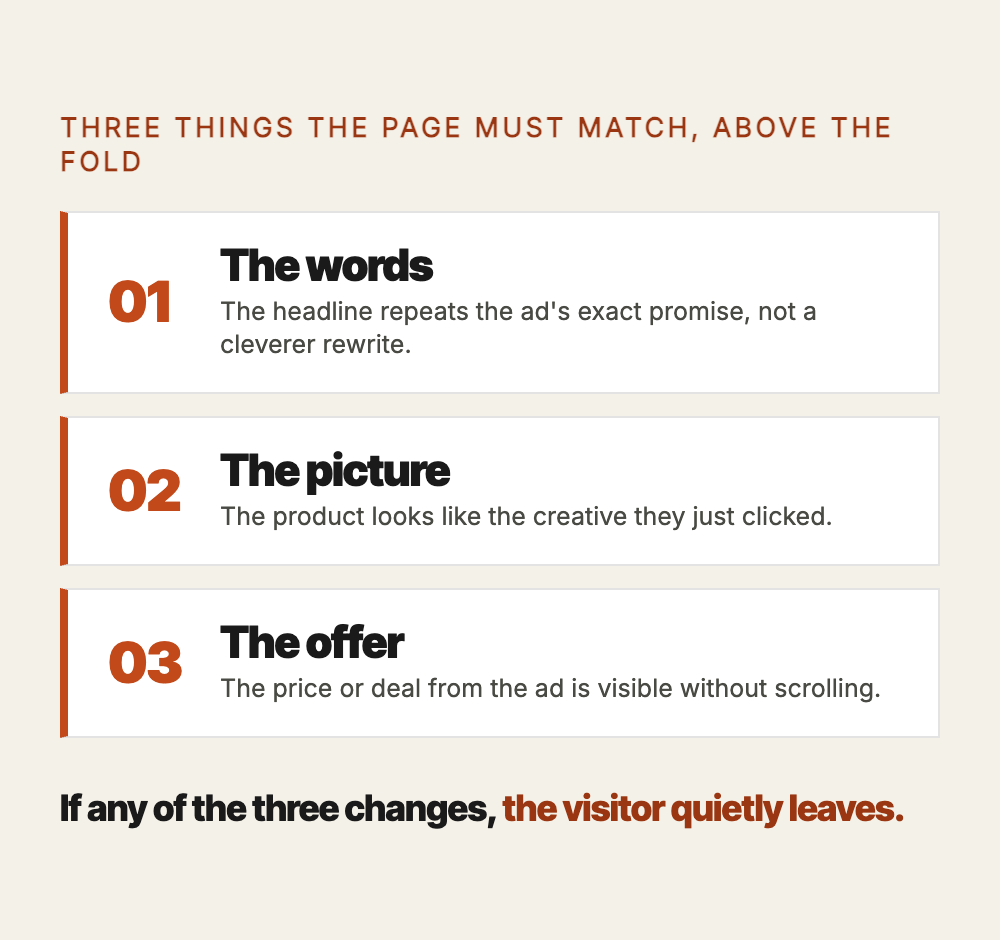
If any one of the three changes between the ad and the page, the match weakens. Change all three and the visitor has no reason to believe they landed where they intended to go.
How do I tell if I have a message-match problem?
Start with the numbers. If your click-through rate is healthy but your conversion rate is low, message match is one of the first things to check, because that pattern points past the ad to the page.
Then run the five-second test. Put your ad and the top of your landing page side by side. Ask whether the same words, the same picture, and the same offer appear on both. If a stranger could not tell in five seconds that they belong together, the match is broken.
Before you conclude the page is the problem, rule out the two things that fake this symptom: a conversion rate that is actually normal, and sales the platform cannot see. Both are covered in why your ads get clicks but no sales.
How do I fix message match?
The fix is usually cheap and fast, which is what makes a message-match leak so worth catching. You are editing the top of a page, not rebuilding a campaign.
- Rewrite the page headline to echo the ad. Use the ad's own promise as the first line the visitor reads.
- Lead with the matching visual. Put the product or image from the creative at the top, not a generic banner.
- Surface the exact offer. If the ad said a price or a deal, show it above the fold, not three scrolls down.
- Point specific ads at specific pages. A dedicated page beats a homepage whenever the ad made a specific promise.
Page speed belongs in the same conversation. A faster page holds more of the visitors who clicked, so make sure the match actually gets seen before the page loads. Fix the match first, since it is usually the larger leak, then tighten speed.
The belief shift underneath all of this: the ad and the landing page are one continuous experience to the person clicking, even though you build them in two different tools. The Realignment Protocol is the paid framework that treats the conversion path as its own pillar, but checking message match is something you can do this afternoon.
Frequently asked questions
What is message match in advertising?
Message match is how closely your landing page continues the promise your ad made. When the page repeats the ad's words, visual, and offer, the visitor feels they are in the right place and stays. When it does not, they leave, because the cue that made them click has disappeared.
Does every ad need its own landing page?
Not always a separate page, but the page it points to must continue that ad's specific promise. If the ad names a product and a price, sending the click to a generic homepage breaks the match. A dedicated page or a tightly matched section both work.
Can a homepage work as a landing page for ads?
Sometimes, for broad brand ads where the promise is general. For a specific offer, a homepage usually breaks message match because the visitor has to hunt for what the ad promised. The more specific the ad, the more a dedicated page helps.
Does landing page speed affect conversion too?
Yes. A faster page holds more of the visitors who clicked, so speed and message match work together. Fix the match first, since it is usually the larger and cheaper leak, then make sure the page loads quickly so the match ever gets seen.
How do I test whether my page matches my ad?
Put the ad and the top of the landing page side by side. Ask whether the same words, the same picture, and the same offer appear on both, above the fold. If a stranger could not tell they belong together in five seconds, the match is broken.
Related reading: for the full read on clicks that do not convert, see why your ads get clicks but no sales. If the deeper issue is cost per customer, see why your CAC is so high. For which layer broke overall, see why Facebook ads stop working.