Why are my Facebook CPMs so high?
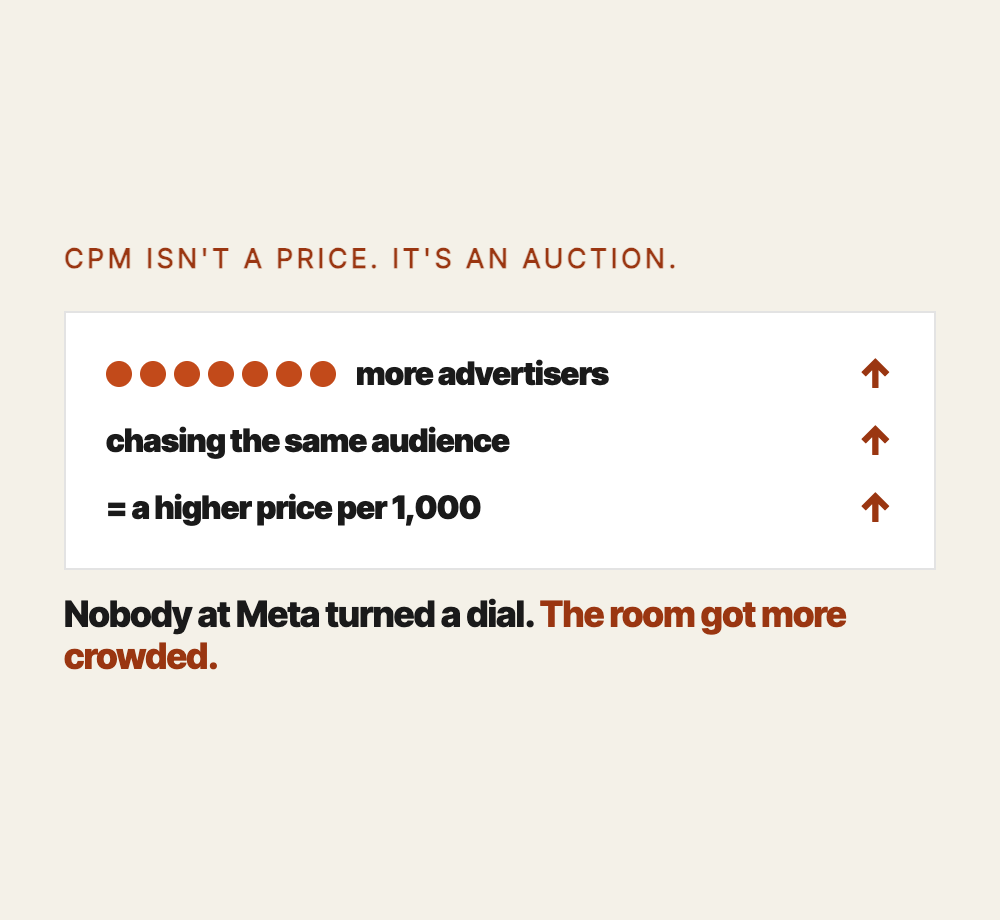
CPM (cost per 1,000 impressions) went up, and it feels like Meta just decided to charge you more. It didn't. CPM is the byproduct of a live auction between every advertiser chasing the same audience at the same moment. When more demand shows up for that audience, or your ad's predicted performance drops, your price per impression rises. That's competition, not a rate hike. The part worth remembering: CPM alone doesn't tell you if an ad is working. It only matters if it's dragging your cost per result up with it.
- CPM = spend divided by impressions, times 1,000. It's the price of reach, not a number Meta fixes.
- It rises because of the auction: more advertisers bidding for the same audience pushes the price up for everyone in it.
- Competition, seasonality, audience size, ad relevance, and placement all move it, and none of them are Meta "raising rates."
- Meta's auction weighs your bid alongside estimated action rate and ad quality. The highest bidder doesn't automatically win.
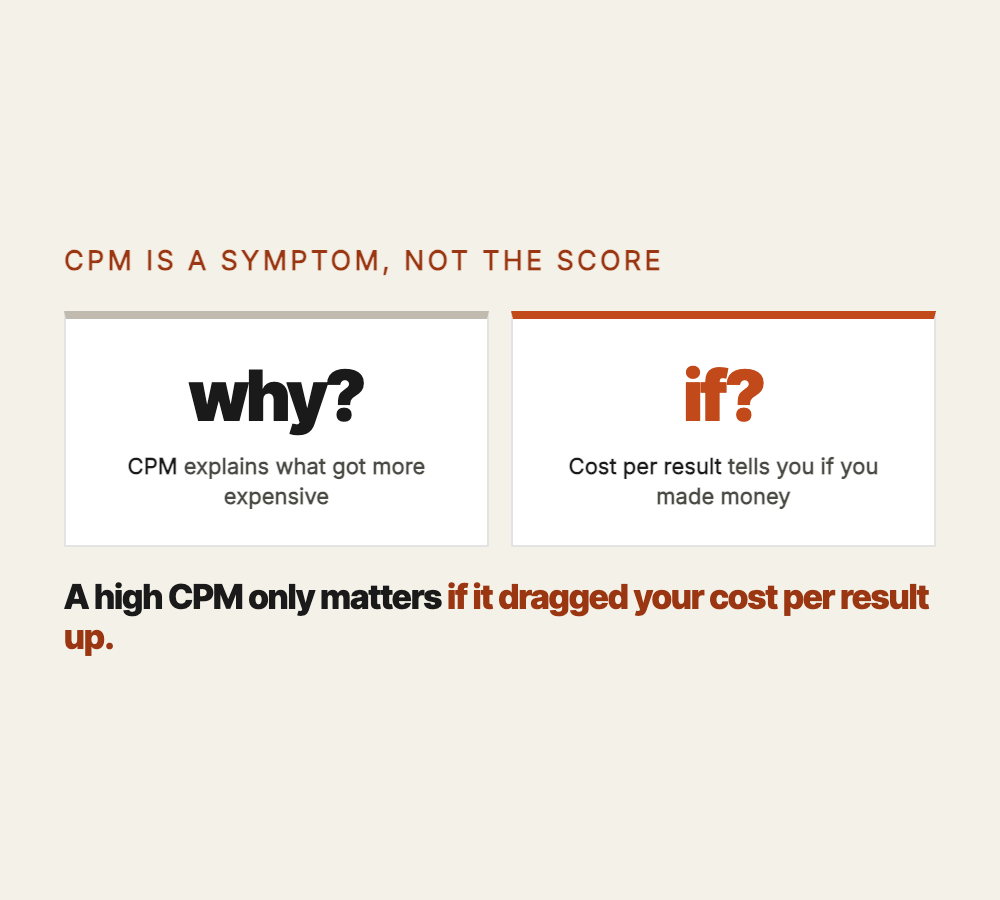
- A high CPM only becomes a real problem if your cost per result or MER moved with it. Check that before you panic.
What is CPM, actually?
CPM stands for cost per 1,000 impressions. The formula is spend divided by impressions, multiplied by 1,000. It's an official Meta metric, and it answers one question only: how expensive was it to put your ad in front of 1,000 sets of eyes.
That's it. CPM says nothing about whether those eyes clicked, bought, or cared. It's the price of reach, not the price of a result.
Treating it as a verdict on your ad is the first mistake most media buyers make when the number climbs.
Why does CPM go up if Meta doesn't set the price?
Meta doesn't hand out a fixed rate card for impressions. Every single impression is decided by a live auction, run in real time, every time your ad is eligible to show.
Advertisers bidding for the same audience are competing against each other for that same slice of attention. When more advertisers want the same people, at the same moment, the price for that impression rises.
Nobody at Meta is turning a dial. The market inside the auction is.
The drivers, the auction, and the diagnostic are below
What actually drives CPM higher?
Five forces move CPM, and they layer on top of each other. Auction competition is the biggest one: more advertisers chasing your audience raises the price for everyone in it.
Seasonality matters too. Q4, holiday weeks, and election windows bring more advertisers into the same auctions, all fighting for the same eyeballs.
Audience size and specificity play a role: a narrow, small audience gets bid up faster than a broad one. Ad relevance and quality signals affect it, and so does placement, since Stories, Reels, and feed all carry different competitive pressure.
How does Meta's ad auction actually decide who wins?
The highest bid does not automatically win the impression. Meta's auction weighs your bid together with the ad's estimated action rate and its ad quality.
A lower bid with a stronger predicted action rate and better quality can beat a higher bid with weaker signals. This is often described as "bid times estimated action rate plus ad quality," but that's an industry simplification of the idea, not Meta's literal published formula.
The real takeaway holds either way: a genuinely relevant, well-received ad can out-compete a bigger budget in the same auction.
Is a high CPM actually a problem?
Not automatically. CPM is diagnostic, it explains part of why your costs moved, but it isn't the number you make decisions on. Before you react, run three checks.
First, look at cost per result and MER (marketing efficiency ratio, total revenue divided by total ad spend). If those held steady or improved while CPM rose, you don't have a problem. Second, check frequency, which if climbing fast points to creative fatigue or saturation.
Third, check the calendar. A CPM spike during a known high-demand window explains itself. Only when a rising CPM drags cost per result up is there something to fix.
What should I actually be watching instead of CPM?
Cost per result and MER are the money metrics. Cost per result tells you what one purchase or lead actually cost. MER, total revenue divided by total ad spend, is the blended truth from your own ledger, and no single platform's attribution can inflate it the way summed return on ad spend (ROAS) sometimes can.
CPM, click-through rate (CTR), and frequency are diagnostics. They help explain why cost per result moved, but they aren't the decision itself. The fuller picture of which metrics actually matter, including whether your ad sets are competing against each other, is the next layer to work through.
Frequently asked questions
Is there a "normal" CPM I should be aiming for?
No single number is honest here. CPM varies enormously by account, niche, season, and audience, so any specific dollar figure you see quoted is a third-party estimate, not a Meta standard. The better question is whether your own CPM trend is dragging your cost per result up.
Does a rising CPM mean my ad is getting worse?
Not necessarily. CPM can rise purely because more advertisers are competing for your audience, especially in Q4, around holidays, or during elections. Check cost per result and MER before assuming your ad itself lost quality.
What's the difference between CPM and cost per result?
CPM is the price of reach, spend divided by impressions. Cost per result is what one actual purchase or lead cost you, spend divided by results. CPM is diagnostic, cost per result is the money metric you act on.
Can a smaller audience make my CPM go up?
Yes. Narrow, highly specific audiences tend to get bid up faster than broad ones, because there's less room in the auction and the same competing advertisers are chasing a smaller pool.
Why doesn't the highest bidder always win the impression?
Meta's auction considers your bid together with the ad's estimated action rate and its ad quality signals, not bid alone. A more relevant, better-received ad can win the impression over a bigger budget with weaker signals.
Related reading: what ad metrics actually matter and is it creative fatigue or something else. For the framework this sits inside, see the Realignment Protocol.