Is it creative fatigue, or something else?
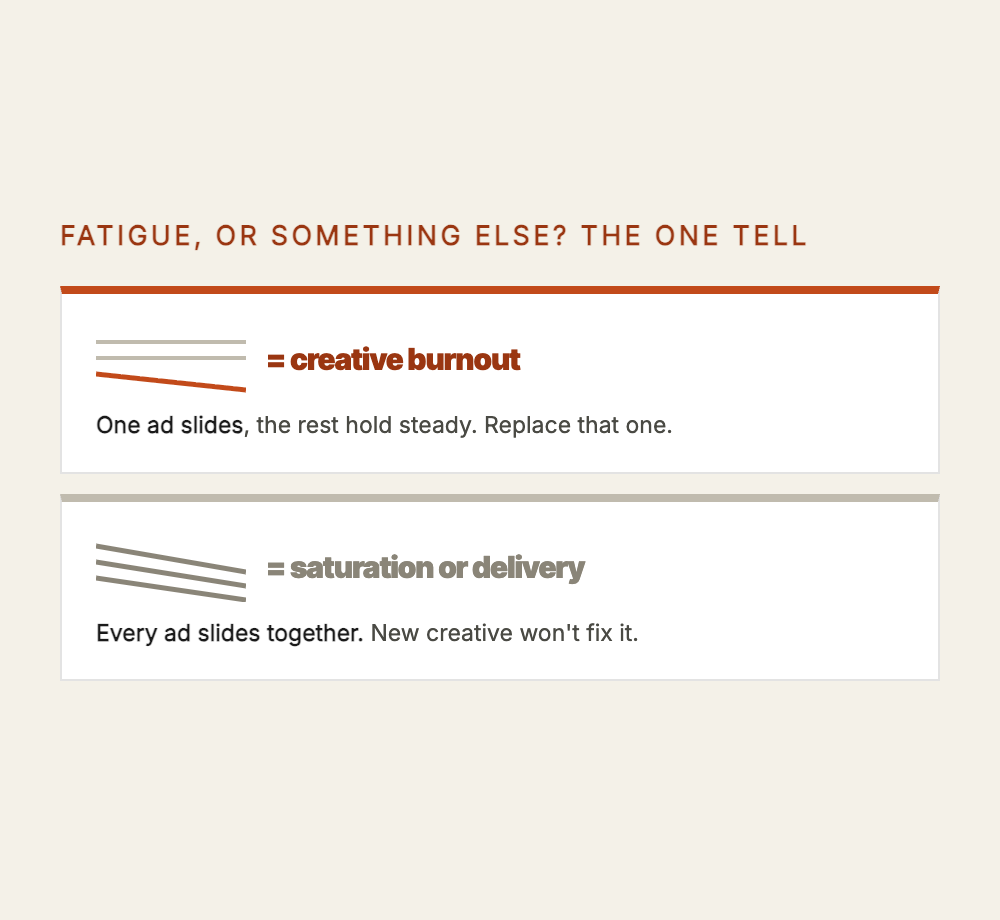
Usually it's something else. What buyers call "creative fatigue" is often audience saturation, a learning-phase reset, or a delivery shift wearing a fatigue costume. The fastest way to tell: look at frequency and performance across every ad in the ad set. If the decline is isolated to one ad while the others hold steady, that one creative is genuinely burning out. If every ad is sliding together, the problem is upstream of the creative, and a new creative won't fix it. Check the pattern before you brief a single new asset.
- Rising frequency across all your ads points to audience saturation or a delivery shift, not one creative wearing out.
- A decline isolated to one ad while the rest hold steady is real creative burnout.
- Ad wearout follows an inverted-U with no universal "refresh every N days" rule (Schmidt and Eisend, 2015).
- Same-week fatigue signals can be transient: annoyance at exposure can reverse into stronger preference weeks later (Kronrod and Huber, 2019).
- Meta's Andromeda system is real, but the claims that it made creative die faster are unsourced vendor estimates.
What is the one check that tells fatigue from everything else?
Open your ad set and compare frequency and performance across every ad in it, not just the one that slipped. This single comparison settles most fatigue arguments.
If frequency is climbing across all of your ads and performance is softening together, that is audience saturation or a delivery shift. The creative isn't the problem, so refreshing it won't help.
If one ad's cost per action (CPA, what you pay per result) or click-through rate (CTR, the share of viewers who click) drops while the rest hold steady, that one creative is genuinely burning out. Now a refresh makes sense.
How does creative wearout actually work?
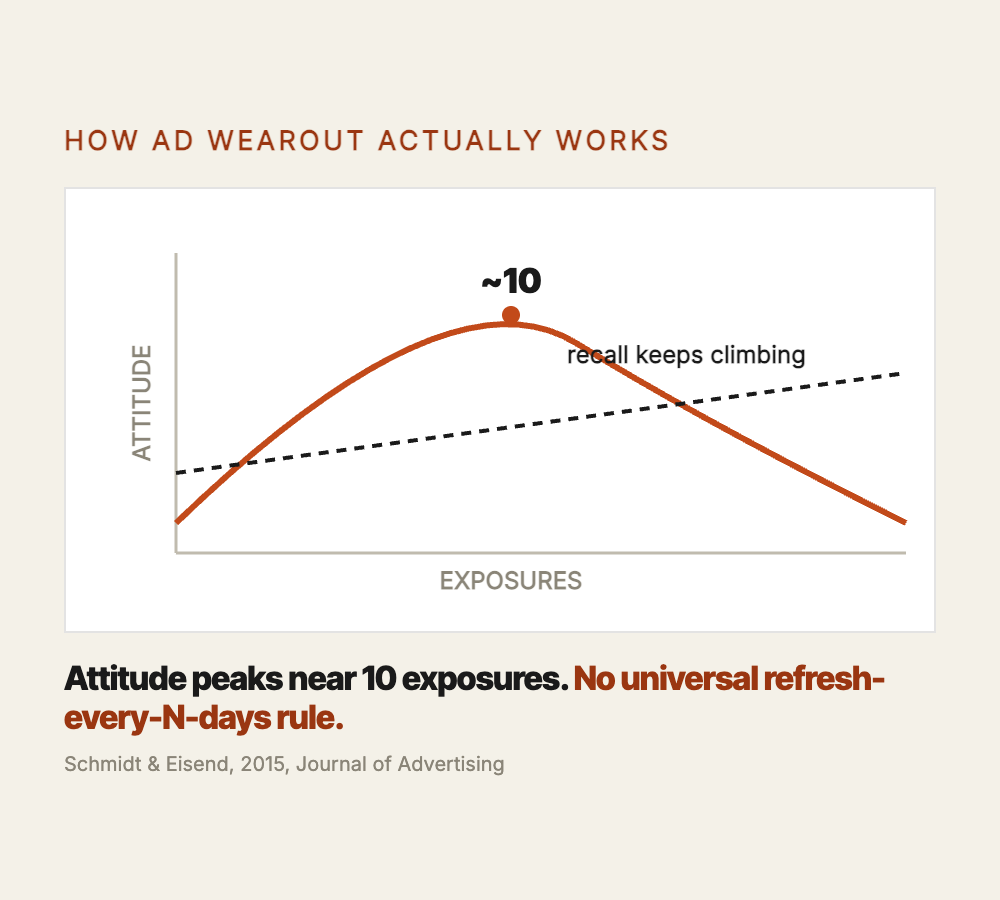
Wearout, an ad losing its pull the more the same person sees it, follows an inverted-U shape. Research on ad repetition (Schmidt and Eisend, 2015, Journal of Advertising) found attitude toward an ad peaks around 10 exposures while recall keeps climbing past that point.
The peak moves with spacing between exposures and how involved the viewer is. That is exactly why there is no universal "refresh every N days" rule; the right number depends on your audience and cadence.
There is also a timing trap. Kronrod and Huber (2019) found that annoyance measured right after exposure can reverse into higher brand preference weeks later. A bad week is not always a dead ad.

What is the diagnostic, in order?
Run these four checks before you conclude "fatigue," in this order. First, frequency across all ads vs one ad, the tell above.
Second, learning-phase status. A recent significant edit resets the learning phase, and unstable delivery there looks exactly like fatigue but isn't. Third, any recent budget or audience change, which shifts who sees the ad and can move numbers on its own.
Fourth, seasonality and the calendar. A slow week or a competitor's promotion can soften results account-wide. Only after those four is "this specific creative is worn out" the honest conclusion.
Did Meta's Andromeda update make creative die faster?
Andromeda is real. Meta's engineering team described it in December 2024 as a retrieval-stage system, with Meta reporting roughly 6% higher recall and 8% higher ad quality.
What is not confirmed is the claim, common in agency posts, that Andromeda shortened creative lifespan from six weeks to two, or set an 8-day median. Those numbers trace only to vendors, not to any Meta data.
So it's fair to say the delivery landscape shifts and Meta changes its systems. It is not fair to attach a specific fatigue clock to Andromeda. Treat any such number as an unverified estimate.
Should I just refresh creative every 2 to 4 weeks to be safe?
That timeline is common vendor guidance, not an independently verified benchmark. Refreshing on a fixed calendar treats every account the same, which the wearout research says is wrong.
If the decline isn't isolated to one ad, a calendar refresh won't fix the real cause; you'll just spend production budget papering over a targeting or budget problem.
Refresh when the isolation check says a specific creative is done, not because a date arrived. Let the pattern, not the calendar, trigger the work.
So what actually fixes it?
If the check points to saturation across all ads, the fix is upstream: broaden or refresh the audience, or address the delivery or budget change that moved things. New creative into a saturated audience just repeats the problem.
If the check points to one worn creative, replace that one, and fund the replacement inside your learning-phase budget so it can actually be read (see how many creatives to test at once).
Frequently asked questions
What is the fastest way to check if it is real creative fatigue?
Compare frequency and performance across every ad in the ad set. If the decline is isolated to one ad while the others hold steady, that is real creative burnout. If every ad is sliding together, look at saturation or delivery first, before you touch anything.
Does a click-through rate drop this week mean the ad is dead?
Not necessarily. Kronrod and Huber (2019) found that annoyance measured in the moment can reverse into higher brand preference weeks later. A single week's dip can be a transient signal rather than a permanent one, so wait for the pattern to confirm itself.
How many exposures before an ad wears out?
There is no fixed number. Schmidt and Eisend (2015) found attitude toward an ad peaks around 10 exposures on average, while recall keeps climbing past that point, and the exact peak moves with spacing and audience involvement.
Should I refresh creative every 2 to 4 weeks just to be safe?
That timeline is common vendor guidance, not an independently verified benchmark. Run the diagnostic checks first. If the decline is not isolated to one ad, refreshing on a fixed calendar will not fix the actual cause.
Is Meta's Andromeda update making creative fatigue happen faster?
Andromeda is a real Meta retrieval system confirmed in December 2024, with Meta reporting roughly 6% higher recall and 8% higher ad quality. The specific claims about shortened creative lifespan attached to it are unsourced vendor estimates and are not confirmed by any Meta-published data.
Related reading: when the whole account slips at once, see why your ad died overnight and why ads break when you scale. For the framework this sits inside, see the Realignment Protocol.