What is MER, and should I use it instead of ROAS?
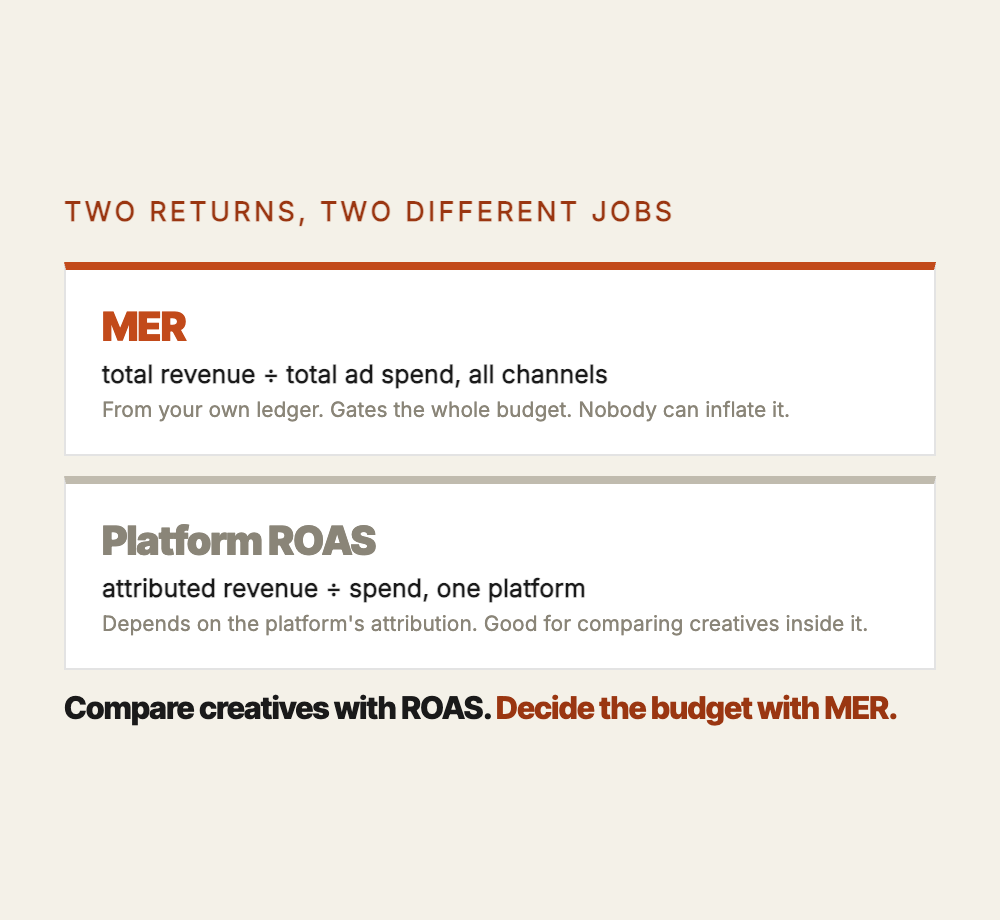
Marketing efficiency ratio (MER) is total revenue divided by total ad spend across every channel, pulled straight from your own sales ledger. Return on ad spend (ROAS) is attributed revenue divided by spend on one platform, using that platform's own attribution model. The same sale can get counted by Meta, Google, and TikTok at the same time, so summed ROAS overstates real impact. MER cannot be inflated this way because it only counts revenue you actually banked. Use ROAS to compare creatives inside one platform. Use MER to decide whether total budget goes up or down.
- MER = total revenue / total ad spend, blended across all channels, from your own ledger.
- ROAS = attributed revenue / ad spend, and it depends entirely on the platform's attribution model.
- One purchase can be claimed by three ad platforms at once, so added-up ROAS runs hot.
- ROAS is the right tool for comparing campaigns or creatives inside a single platform.
- MER is the right tool for the total-budget decision: spend more, hold, or cut.
What is MER and how is it different from ROAS?
MER is the plainest number in your business. Total revenue for the period, divided by total ad spend for that same period. It does not care which platform gets credit. It only cares what landed in your bank account against what you spent to get it.
ROAS works differently. It's attributed revenue divided by spend, and "attributed" is doing all the work in that sentence. Meta decides which sales it thinks its ads caused, using its own attribution window and model. Google does the same, with a different model.
That's why ROAS is a per-platform number, not a business number.
Why does my ROAS look better than my actual profit?
Because the same customer can touch three ad platforms before buying, and each platform is allowed to claim credit for that sale inside its own reporting. ROAS is a modeled return for one channel, not a statement about your bank balance.
Add up Meta's ROAS, Google's ROAS, and TikTok's ROAS for the same week and the total will almost always overstate what actually happened. None of the three knows what the others are claiming. The mechanics behind this exact gap are in why Meta reports different sales than Shopify.
MER doesn't have this problem, because it starts from your ledger, not from any platform's model.


How do I calculate my MER?
Pull total revenue for a period, say one week or one month, straight from your sales system. Pull total ad spend for that identical period, across every platform you run on: Meta, Google, TikTok, everything. Divide revenue by spend. That's your MER.
Example: $80,000 in revenue for the month, $20,000 in total ad spend across all platforms. MER is 4.0. Every dollar of ad spend generated four dollars of revenue, blended, no attribution model involved.
Compare this number month over month and you get a clean read on whether your marketing, as a whole system, is getting more or less efficient.
What counts as a "good" MER?
There is no universal "good" MER number, and this is a place where a caveat matters more than a rule. A software business with 85% margin can profitably run a lower MER than a physical product business with 30% margin, because the cost of goods eats a bigger share of every sale.
The honest benchmark is your own break-even, built from your margin, your average order value (AOV, revenue divided by orders), and your cost per acquisition (CPA, spend divided by results). Calculate the MER at which you stop making money once product cost, shipping, and overhead are included.
That number, not an industry average, is the one worth watching. The underlying math is in what is a good break-even ROAS.
Should I stop looking at ROAS altogether?
No. ROAS still has a real job, it's just not the job most people ask it to do. Inside one platform, ROAS is a valid way to compare one campaign against another, or one creative against another, because the attribution model is at least consistent within that platform's own reporting.
The mistake is using platform ROAS to decide the total ad budget for the business. That decision belongs to MER, because MER is the only number immune to any single platform's attribution quirks.
If you've ever wondered whether your reported number is even trustworthy at the platform level, that's answered in is my Facebook ROAS even real.
When should I use ROAS vs MER, day to day?
Use ROAS when you're inside one platform's ads manager, deciding which of five creatives to scale or which of three campaigns to pause. It's a fast, same-platform comparison tool, diagnostic in that narrow lane.
Use MER when you're deciding whether next month's total ad budget goes up, stays flat, or gets cut. That's a whole-business decision, and it needs a whole-business number. The fuller list of what to watch day to day builds on this.
Running both side by side, for their separate jobs, is the actual skill.
Frequently asked questions
Is MER the same thing as blended ROAS?
Yes, in practice. Marketing efficiency ratio and blended ROAS describe the same calculation: total revenue divided by total ad spend across every channel. The name MER is more common in performance marketing circles, and it avoids confusion with per-platform ROAS.
Why do Meta, Google, and TikTok all show me different numbers for the same sale?
Each platform runs its own attribution model and its own attribution window, and each is allowed to claim a sale it believes it influenced. This means the same customer purchase can appear as a win in more than one platform's reporting at the same time.
Does a high MER always mean a healthy business?
Not by itself. MER tells you the blended relationship between revenue and ad spend, but it doesn't include product cost, refunds, or overhead. Pair MER with your margin and break-even math before calling a number good or bad.
Can I calculate MER without expensive attribution software?
Yes. MER only needs two numbers you already have: total revenue from your sales system and total ad spend from your billing across platforms. No attribution model or third-party tool is required to compute it.
Should agencies report MER, ROAS, or both?
Both, for different reasons. ROAS shows an agency's work at the campaign or creative level, inside the platforms they manage. MER shows the client whether the whole marketing system, including work outside the agency's control, is getting more or less efficient.
Related reading: is my Facebook ROAS even real and what ad metrics actually matter. For the framework this sits inside, see the Realignment Protocol.