Is my Facebook ROAS even real?
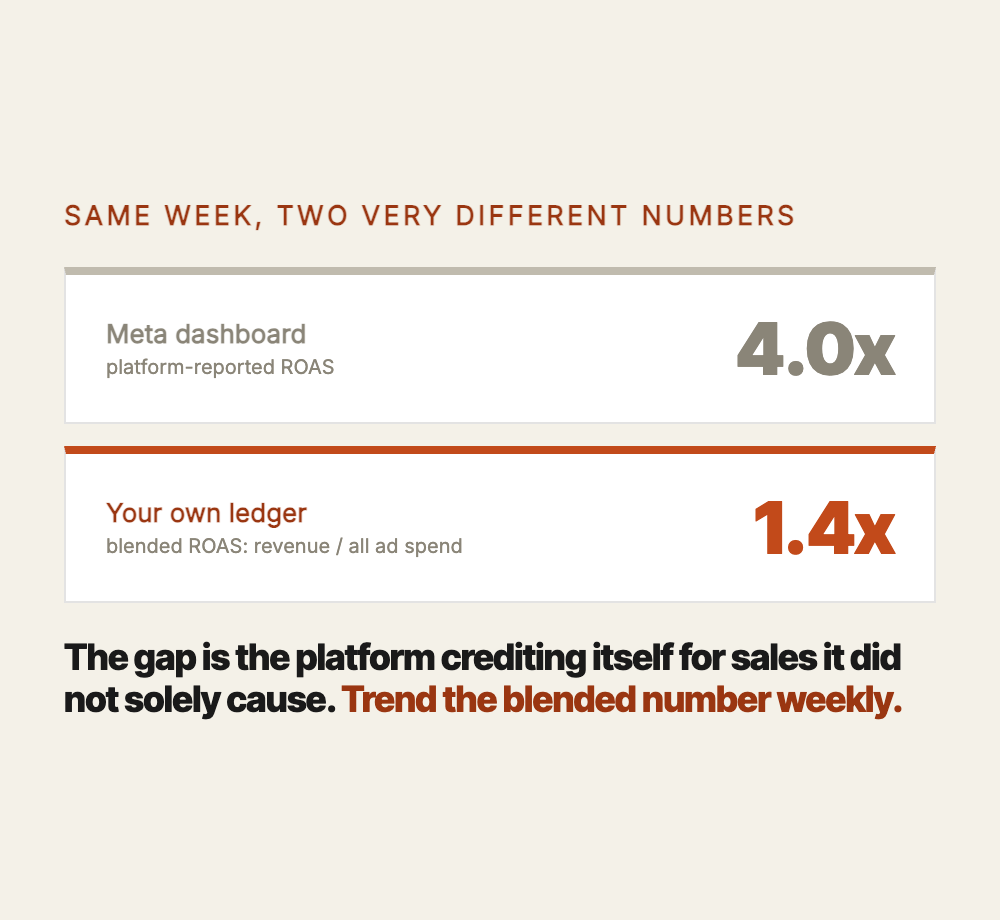
Probably not exactly, and that gap is normal, not a glitch. Meta's Ads Manager reports return on ad spend (ROAS) inside its own attribution model, crediting a sale to any ad a buyer clicked or saw within a set window. Peer-reviewed field experiments show platform-reported lift overstates the true, incremental sales an ad actually causes, in some cases by a factor of three. Your real return is a range you triangulate, not a single precise figure. The number to run your business on is blended ROAS: total revenue divided by total ad spend, pulled straight from your own sales ledger.
- Meta and Shopify measure different events by design, so a permanent gap between them is expected, not a tracking error.
- Peer-reviewed studies (Gordon et al., 2019 and 2023; Blake, Nosko and Tadelis, 2015) show platform attribution overstates true ad lift, in half of one large study by a factor of three.
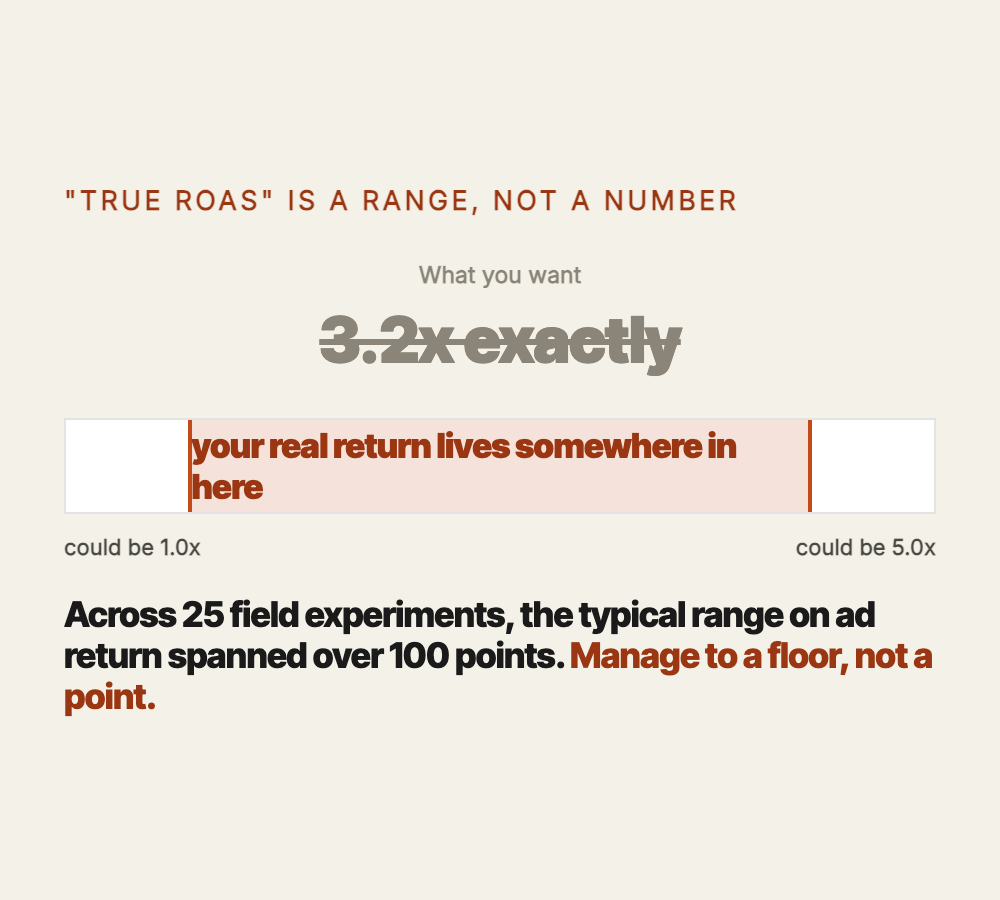
- "True ROAS" is a wide range, not a clean number. A landmark study found the typical confidence interval on ad return spans over 100 percentage points.
- Blended ROAS, or marketing efficiency ratio (MER), from your own sales data is the honest operating number, even though it has its own blind spots.
- Meta changed how it counts conversions twice in early 2026, so a dashboard swing this year can be the counting rule moving, not your ads.
Why does my Meta dashboard show a better return than my bank account?
Because the two numbers are answering different questions. Ads Manager counts a conversion when it can attribute a purchase to an ad, inside a window it defines. Your bank account, or your Shopify ledger, counts an order once, regardless of which ad platform wants credit for it.
If a customer saw your Instagram ad, later saw a Google ad, then bought, Meta, Google, and TikTok can each claim that same sale. The sum of every platform's "results" can easily exceed your actual total revenue.
That is not fraud. It is each system grading its own homework. The full mechanism is covered in why Meta reports different sales than Shopify.
Is Meta lying about my results?
No, but it is not measuring what you think it's measuring. Meta's own delivery algorithm tends to serve ads to people who were already close to buying, then counts their purchase as caused by the ad.
Four separate peer-reviewed field experiments confirm this pattern. Gordon, Zettelmeyer, Bhargava, and Chapsky (2019) ran 15 Facebook experiments and found attribution-style methods missed the true, randomized-trial answer by a factor of three in half the cases. A larger 2023 follow-up, and a separate eBay study on branded search, found the same direction.
Platforms tend to take credit for demand that would have converted anyway. That is the quiet reason the dashboard number runs higher than your bank balance.
How to calculate your real number is below
What is blended ROAS, and how do I calculate it?
Blended ROAS, sometimes called MER (marketing efficiency ratio), is total revenue divided by total ad spend across every channel, for the same time period. It comes entirely from your own sales ledger, not any ad platform.
Pull total store revenue for a week from Shopify. Pull total ad spend for that same week across Meta, Google, TikTok, and anything else running. Divide revenue by spend. That is your blended ROAS.
Now compare it to what Ads Manager reports for the same week. If Meta says 4.0x and your blended number is 1.4x, the gap is the platform crediting itself for sales it did not solely cause. Track blended ROAS weekly and manage your budget to that trend, not to the platform's number.
Why did my ROAS suddenly change in 2026?
Because Meta changed its own counting rules twice this year, separate from anything your ads did. On January 12, 2026, Meta removed the 7-day and 28-day view-through attribution windows, so the longest window it counts is now one day.
On March 3, 2026, Meta redefined a "click" to mean only a real link click, moving likes, comments, and short video views into a separate "engage-through" column. Both changes affect how a conversion gets counted, not how your ads actually perform.
Before assuming your campaigns broke, check whether your blended, ledger-based ROAS actually moved. If Shopify revenue is flat or up, the counting rule shifted under you. The dedicated read is why your Facebook results dropped in early 2026.
Is there a way to know my "true" ROAS?
Not a precise one, and that's worth saying plainly. A landmark study (Lewis and Rao, published in the Quarterly Journal of Economics) ran 25 large field experiments and found the typical 95% confidence interval on advertising return spans more than 100 percentage points.
That is not a measurement failure. Individual purchase behavior has enough natural noise that it swamps the ad effect at normal spend levels. The honest object is a range you narrow over time, not a single figure a tool finally reveals.
Anyone selling you a precise "true ROAS" number is selling more confidence than the data supports.
What should I actually do differently?
Manage your budget to blended ROAS, checked weekly against your own sales ledger, and treat the Ads Manager number as a signal for in-platform optimization, nothing more. When you see the platform number swing hard, check your ledger before touching your budget.
A few times a year, run a real test: turn a channel off in a region and watch what happens to revenue. That single test tells you something no dashboard can, because nobody selling you the ad is grading it.
Naming the platform number as "platform-reported," out loud, to yourself or your team, is what stops the most expensive mistake in paid media: mistaking a seller's number for a fact about your business.
Frequently asked questions
Is a 4x ROAS on Meta actually a 4x return?
Not necessarily. Meta's 4x reflects its own attribution model, which can credit sales that would have happened anyway. Compare it against your blended ROAS (total revenue over total ad spend) for the same period to see the real gap.
Why does my Shopify revenue not match what Meta reports as conversions?
They're counting different things. Meta attributes a conversion inside its own click and view window, while Shopify records an order once it happens. Multiple platforms can each claim credit for the same sale, so the totals won't line up.
Did something change with Facebook attribution recently?
Yes. Meta removed longer view-through attribution windows on January 12, 2026, and redefined what counts as a click on March 3, 2026. Both changes affect how conversions are counted, not how your ads are actually performing.
What is a good ROAS to aim for?
It depends on your margin and customer acquisition cost (CAC), and it should be judged on your blended number, not the platform's. The companion piece on break-even ROAS walks through how to set that number for your own margins.
Should I stop trusting Meta's reporting altogether?
No. Use it to optimize within the platform, such as which ad or audience is performing relative to others. Just don't use it as your source of truth for whether the channel is profitable; that judgment belongs to your blended ROAS and periodic real-world tests.
If you want the full discipline, the blended-floor habit, the quarterly holdout test, and how to read a dashboard swing without panicking, that's what the Realignment Protocol walks through at the Hub.