Why did my Facebook ad results drop in early 2026?
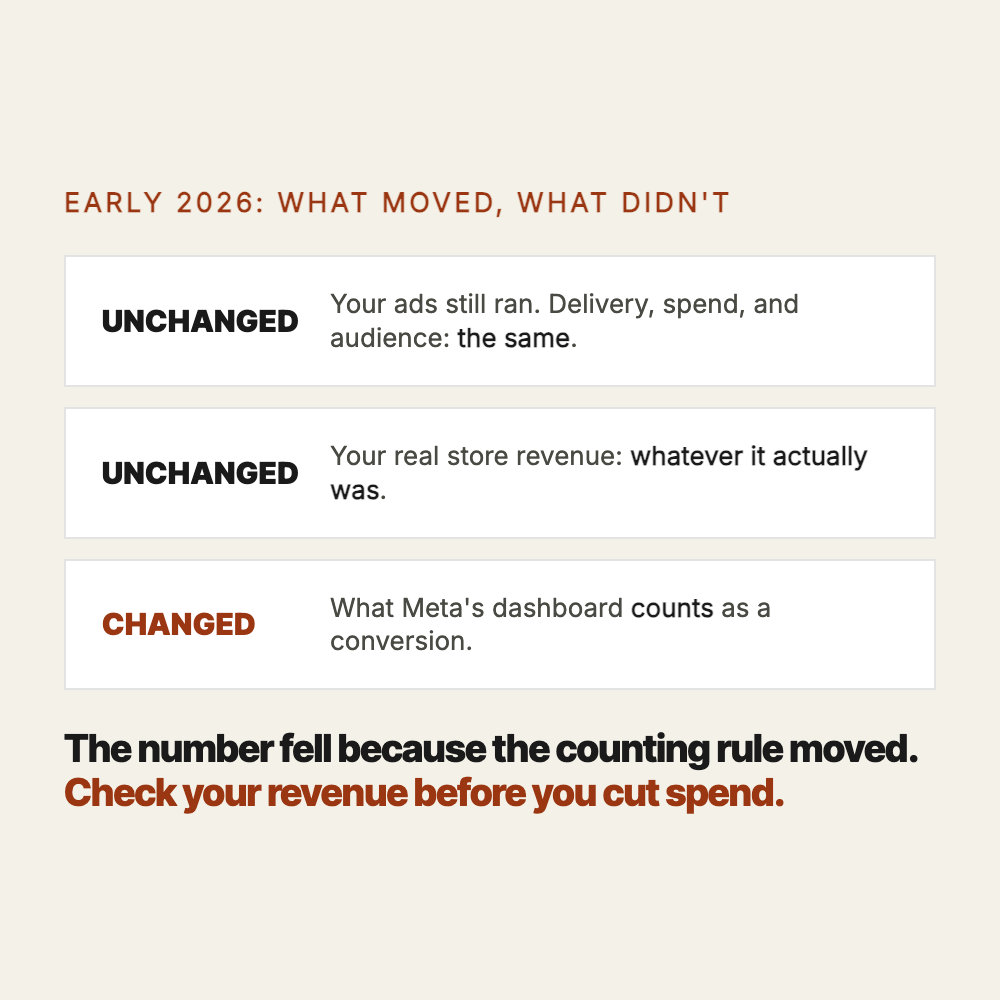
If your Meta Ads Manager numbers fell in January through March 2026 and you did not change your ads, budget, or audience, the most likely explanation is not your ads. Meta changed what its dashboard counts, twice. On January 12, 2026, Meta removed the 7-day and 28-day view-through attribution windows, so it stopped crediting purchases to people who merely saw an ad and bought later without clicking. On March 3, 2026, Meta redefined a "click" to mean only a real link click, moving likes, comments, saves, and short video views into a separate "engage-through" column. Both changes affect reporting, not delivery. Check your actual Shopify revenue and your blended return on ad spend (ROAS, total revenue divided by total ad spend) before you touch your budget.
- The dashboard drop is very likely a reporting change, not an ads problem: Meta cut two attribution windows and redefined "click" in early 2026.
- Check Shopify revenue and blended ROAS (or marketing efficiency ratio, MER: total revenue divided by total ad spend) before assuming your ads stopped working.
- Meta has done this before: it admitted to roughly 15% undercounted iOS conversions after Apple's App Tracking Transparency (ATT) change in 2021, later corrected to about 8%.
- There is no verified percentage for how much the 2026 changes shrank reported conversions. Treat any specific number you see in a blog post as an unverified estimate.
- Also check Shopify's pixel setting, since its default sharing mode changed on January 13, 2026, one day after Meta's first change.
What actually changed at Meta in early 2026?
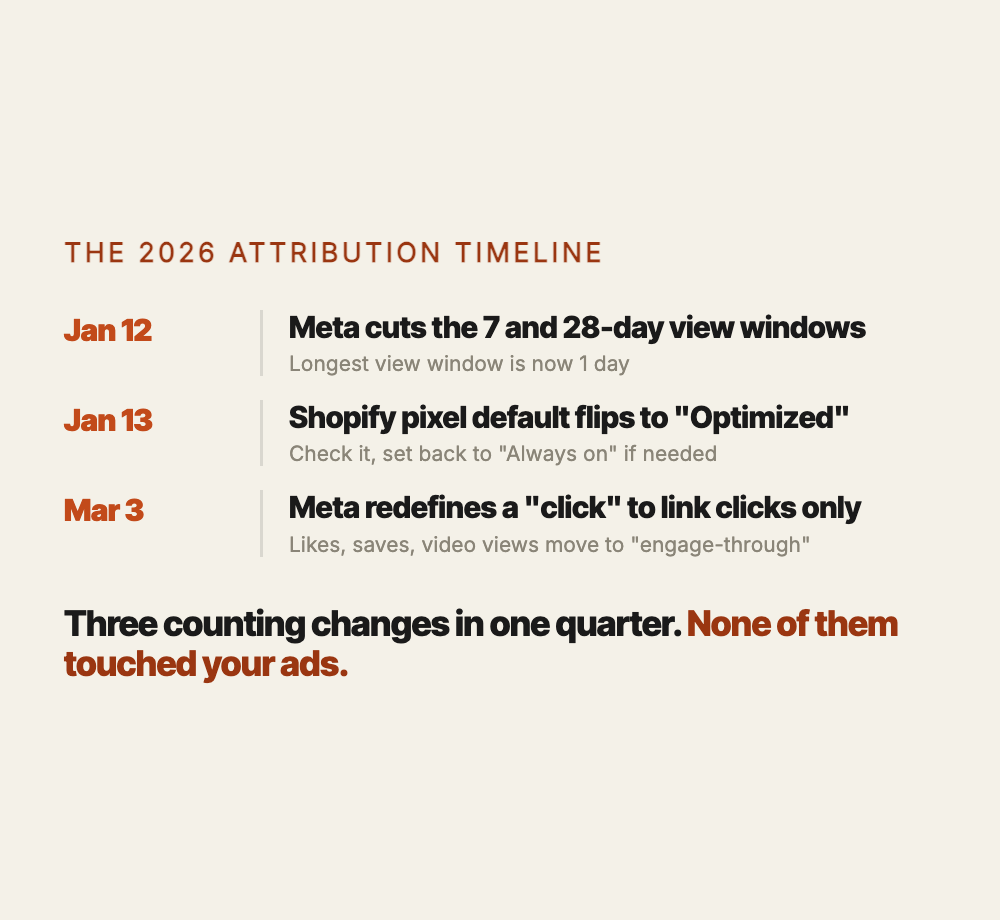
Two separate changes, about seven weeks apart. On January 12, 2026, Meta removed the 7-day and 28-day view-through windows from its Ads Insights application programming interface (API, the connection that feeds your dashboard numbers). Meta had announced this back on October 16, 2025.
Before that date, if someone saw your ad and bought within a week or a month without clicking, Meta could still count it. Now the longest view window is one day. Fewer purchases qualify for credit, even if buyer behavior did not change at all.
Then on March 3, 2026, Meta redefined "click-through" conversion. Only real link clicks count now. Likes, comments, saves, and short video views got moved into a renamed "engage-through" column instead. The engaged-view video threshold also dropped from 10 seconds to 5.

Did my sales actually drop, or just my reported conversions?
This is the diagnostic that matters more than anything else. Open two numbers side by side: your Meta dashboard's reported ROAS, and your blended ROAS or MER pulled straight from your own sales ledger (total Shopify revenue divided by total spend across every channel, not just Meta).
If Shopify revenue is flat or growing and only the Meta number fell, your ads are working. The dashboard lost the ability to see some of the credit it used to claim, that is all.
If Shopify revenue itself dropped by a similar size to the dashboard swing, something else is happening, and it is worth investigating separately. Pull this weekly, not once. A one-week blip proves nothing. A four-week trend in your own revenue tells you the truth your dashboard cannot.
Why does Meta's number disagree with Shopify's number at all?
Meta and Shopify are answering two different questions. Meta reports conversions its pixel and its Conversions API (CAPI, the server-side tracking Meta uses to record purchases) can attribute to an ad, inside whatever window Meta currently allows. Shopify reports orders it actually recorded on its own last-click logic.
These were never going to match exactly, even before 2026. The same order can get claimed by Meta, Google, and TikTok at once, since each platform's tracking has no visibility into what the others are doing.
This is a structural gap, not a tracking bug you can fix, and it gets its own full read in why Meta reports different sales than Shopify. What changed in 2026 is that the gap got wider, because Meta shrank its own counting window on both sides.
Is this the same thing that happened with Apple's privacy changes?
It rhymes, but it is a different mechanism. In April 2021, Apple's App Tracking Transparency (ATT) let iPhone users opt out of being tracked across apps. Meta later disclosed it was underreporting iOS web conversions by roughly 15%, a number it brought down to about 8% by early 2022 through fixes on its side.
That earlier drop came from lost tracking signal, users blocking the pixel from seeing them. The 2026 changes are different: Meta did not lose visibility into anything. It chose to stop counting categories of activity it used to count.
The parallel is useful for one reason: it shows Meta has changed its counting rules before, the market adjusted, and the businesses that came through it were the ones already watching their own revenue ledger instead of trusting the platform number as gospel.
Should I cut my ad spend because ROAS looks worse?
Not on the dashboard number alone. Cutting spend because a reporting rule changed, while your actual revenue held steady, is the single most expensive mistake available to you right now.
Before making any spend decision, run the diagnostic above: compare Shopify revenue and blended ROAS against the Meta dashboard swing over at least two to four weeks. If your own ledger is flat or up, the ads did not stop working, your dashboard stopped seeing part of what it used to.
If blended ROAS from your own numbers is genuinely down, that is real information worth acting on. But that decision should come from your ledger, not from a number Meta itself just narrowed the definition of.
What else changed around the same time that could be adding to the confusion?
One more piece worth checking directly in your own Shopify admin: Shopify changed the default setting for its Meta App Pixel data sharing to "Optimized" on January 13, 2026, one day after Meta's first change. If your setting flipped and you did not notice, that can shift signal quality on top of Meta's own reporting changes.
Go into your Shopify pixel settings and confirm whether it is set to "Optimized" or "Always on." If you want the fullest signal back, "Always on" is the setting to check for, though this only affects signal quality, not whether your ads themselves are performing.
This is a plumbing check, not a fix for the attribution window changes above. It is simply one more variable worth ruling out before you conclude anything about your ads. If the drop predates 2026 or looks different from this, the broader read is why your Facebook ads stopped working.
Frequently asked questions
Did Facebook ads stop working in 2026?
Not based on anything Meta has published. What changed is what Meta's dashboard counts as a conversion, not how ads get delivered. Check your own Shopify revenue and blended ROAS before concluding your ads underperformed.
How much did conversions actually drop from the January and March 2026 changes?
There's no verified figure. Percentages like "15 to 40 percent" circulate in agency blog posts, but none trace back to Meta, Shopify, or any independent measurement. The honest answer is that reported conversions fell for many advertisers, the size varies by account, and it hasn't been measured industry-wide.
What is the difference between a click-through and an engage-through conversion now?
As of March 3, 2026, click-through means only a real link click on your ad. Likes, comments, saves, and short video views that used to count toward click-based attribution now sit in a separate "engage-through" column and are reported differently.
Why does my Shopify revenue not match what Meta reports?
Meta counts conversions it can attribute inside its own tracking window. Shopify counts the orders it actually recorded. The same sale can also get claimed by other ad platforms at the same time, so some disagreement is normal, and 2026's changes widened it further.
What should I actually watch instead of the Meta ROAS number?
Blended ROAS or MER, calculated from your total Shopify revenue divided by total ad spend across every channel, checked weekly. It's the one number no platform can inflate on your behalf, and it's the fastest way to tell whether the dashboard is showing you a real problem or a reporting artifact.
Want the full walkthrough on separating a reporting artifact from a real ads problem, plus how to read your own numbers going forward? The Realignment Protocol covers it at the Hub.