Are my ad sets competing against each other?
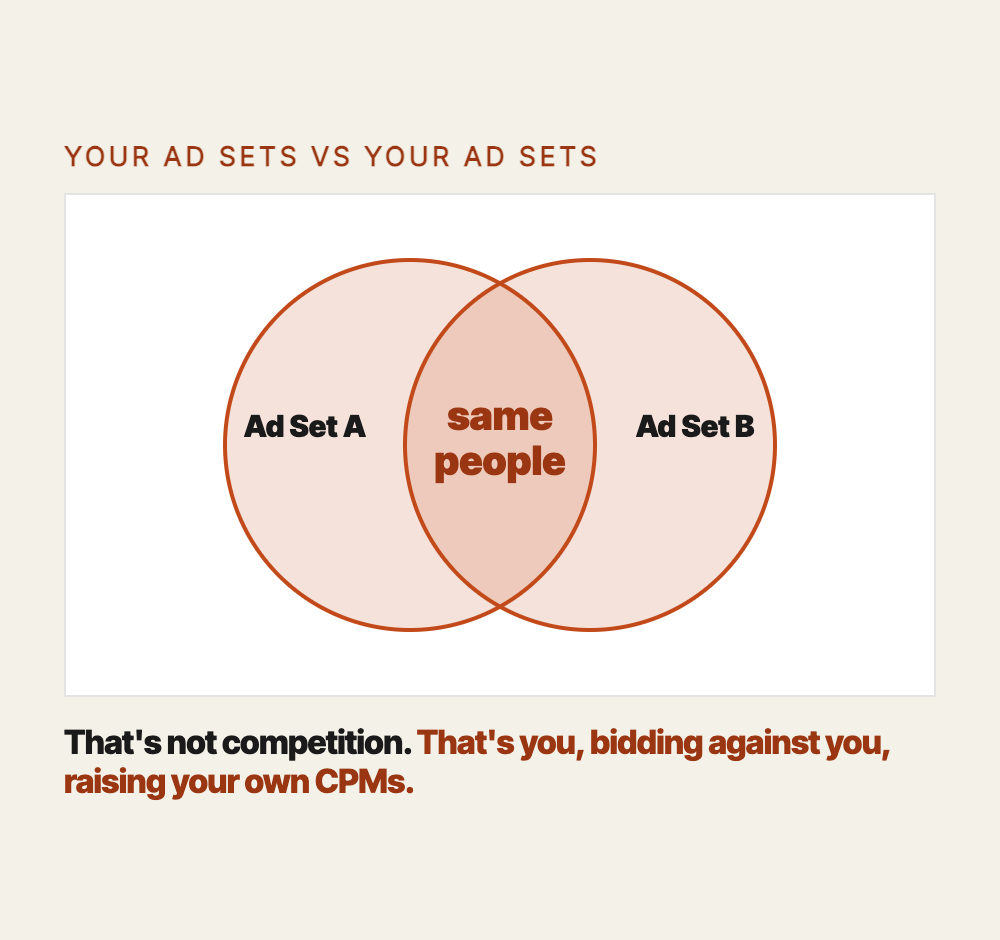
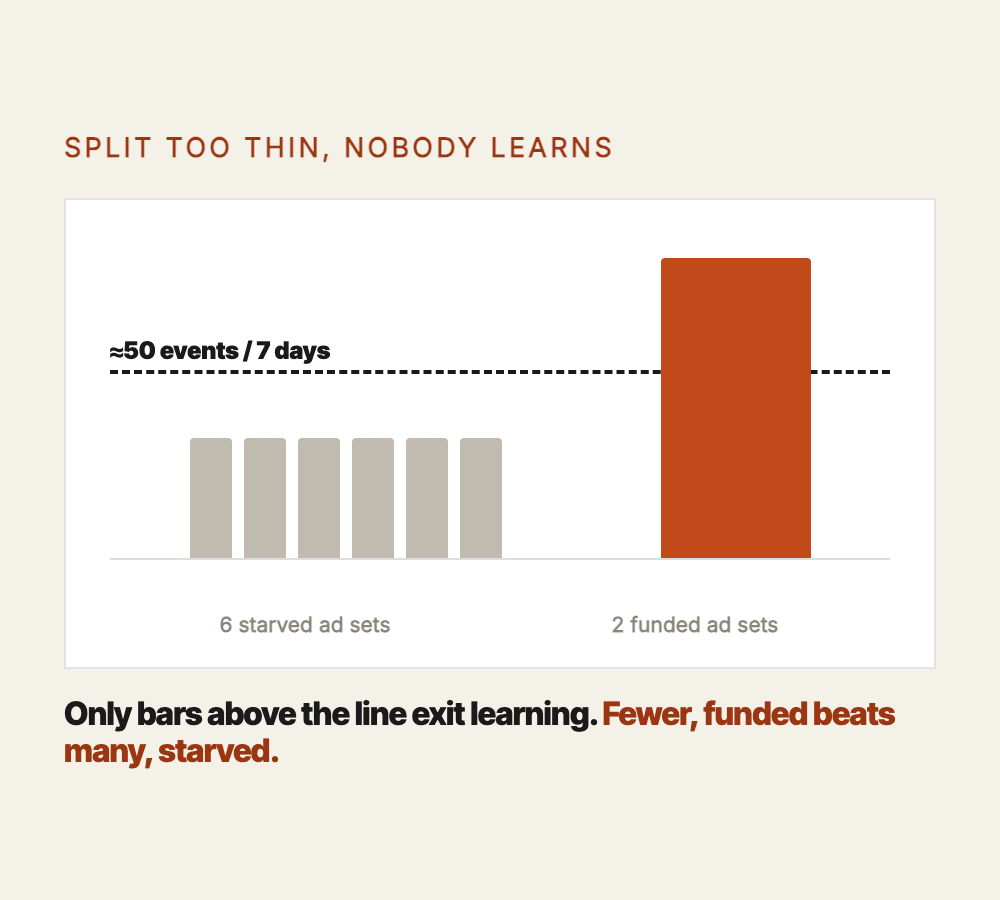
Yes. When two of your own ad sets target overlapping audiences with the same creative, they enter the same auction and bid against each other for the same person. Meta's system deduplicates who actually sees the ad, but the bidding still happens twice, which pushes your own cost per thousand impressions (CPM) up. This gets worse the more you segment your account, because splitting a modest budget across many narrow ad sets also starves each one below the roughly 50 optimization events per week Meta's learning phase needs. The fix is the same for both problems: fewer, broader ad sets, or a single pooled budget across them.
- Your own ad sets can and do bid against each other when audiences overlap and creative is shared.
- Splitting a small budget across too many ad sets keeps each one below the learning-phase floor Meta needs to stabilize delivery.
- Over-segmentation causes both problems at once: it starves signal and increases overlap.
- Consolidating into fewer, broader ad sets, or pooling budget across them, reduces both.
- Meta is pushing the whole platform toward broader, automated targeting, a real tradeoff of control for efficiency, not a free upgrade.
What does it mean when ad sets "compete" with each other?
Every ad set you run enters Meta's auction separately. Meta's system does deduplicate at the impression level, meaning it won't literally show the same ad twice to the same person from two of your own ad sets in the same moment.
But the bidding still happens twice. If Ad Set A and Ad Set B both target a similar slice of your audience with the same creative, they are both raising their hand for the same people. That drives your own cost per thousand impressions (CPM) up, because you're competing with yourself instead of reaching new people.
This is self-competition. It is not a bug, it is a direct result of how you built the account structure.
How do I know if my ad sets are actually doing this?
Three things to check right now, no tools beyond what you already have. First, open Meta's audience overlap tool and compare any two ad sets that target similar interests, lookalikes, or the same warm audience. High overlap means they're chasing the same people.
Second, look at CPM trends across your own ad sets in the same campaign, not against industry benchmarks. If CPMs are climbing across several of your own ad sets at once without a market-wide reason, that's often self-competition.
Third, list your active ad sets side by side: geo, audience, and creative. Any two rows that look nearly identical are the ones fighting each other.
Why over-segmentation compounds, and the fix, are below
Why does over-segmentation make it worse?
Meta's learning phase needs roughly 50 optimization events per ad set in a rolling 7-day window to exit "learning limited." That's Meta's own number, not a guess.
When you split a modest budget across many narrow ad sets, each one gets a smaller slice. Fewer dollars per ad set means fewer events per week, which means more ad sets stuck below that floor.
At the same time, more ad sets from narrower audience slices increases the odds that two of them overlap. So heavy segmentation doesn't just slow learning, it actively increases self-competition on top of it. Both come from the same root cause, which is why how many ad sets to run is the first question to settle.
Does consolidating into fewer ad sets actually fix it?
Consolidating reduces the number of places your budget can collide with itself. Fewer ad sets means fewer overlapping pairs, and each remaining ad set gets a bigger share of spend, which moves it toward the 50-event floor faster.
One practical version is pooling budget across ad sets in a single campaign, what Meta now calls Advantage+ campaign budget (formerly CBO, campaign budget optimization). It lets one budget flow toward whichever ad set is performing best, instead of you fixing a dollar amount per ad set.
It's documented that pooled-budget campaigns often concentrate the majority of spend on one or two ad sets fast, which finds the winner for you, though it can also hide which segment is driving results if you're not watching. See CBO or ABO which budget setting for how to choose.
Is Advantage+ the same thing as "going broad"?
They point the same direction but aren't identical. "Going broad" is a targeting decision, fewer restrictions on who can see the ad. Advantage+ is Meta's broader push to automate both targeting and budget across the account, and it has become the default rather than an option.
The timeline is worth knowing. Advantage+ became the default for Sales, Leads, and App campaigns around June 2025. Detailed Targeting, the manual interest-based targeting tool, was consolidated in June 2025 and fully deprecated in January 2026. Meta is also removing older legacy campaign APIs.
This mirrors a path Google already ran, Smart Bidding in 2016 and broad match becoming the default for new Search campaigns in July 2024. It's a real trade of manual control for automated efficiency. See Advantage+ or manual campaigns for how to weigh it.
Should I just switch everything to Advantage+?
Not automatically, and the evidence itself is split, which is worth stating plainly. Meta's own reporting says Advantage+ Shopping outperforms manual by roughly 22% on return on ad spend (ROAS, revenue per dollar spent). That's Meta's own figure, not an independent measurement.
The strongest independent evidence points the other way. A study by Measured, using more than 30 geo holdout tests over a year, found Advantage+ Shopping's true incremental ROAS, the extra revenue it actually caused rather than revenue it would have gotten anyway, came in below traditional prospecting and retargeting. One vendor's tests aren't the final word, but it's the best independent check that exists.
A common practitioner pattern is a hybrid: Advantage+ for broad prospecting, manual structure for retargeting or brand carve-outs. That's practice, not a proven rule.
Frequently asked questions
Do overlapping ad sets actually cost me money, or is it just theory?
It is measurable, not theoretical. When two of your ad sets target similar audiences with the same creative, they both enter the auction for the same people, which raises your own cost per thousand impressions (CPM). You can see it in Meta's audience overlap tool and in your own CPM trend across ad sets.
How many optimization events does an ad set need before it's stable?
Meta's own guidance is roughly 50 optimization events per ad set within a rolling 7-day window. Below that, the ad set is considered "learning limited" and delivery stays unstable, which also makes cost per action harder to read accurately.
What's the difference between CBO and Advantage+ campaign budget?
They are the same thing under a new name. Meta renamed campaign budget optimization (CBO) to Advantage+ campaign budget. It pools one budget across all ad sets in a campaign and shifts spend toward whichever ad set is performing best, instead of a fixed dollar amount per ad set.
Does Advantage+ definitely perform better than manual campaigns?
The evidence is genuinely split. Meta reports about 22% higher return on ad spend for Advantage+ Shopping, but that's Meta's own figure. The one independent study, from Measured using geo holdout testing, found its true incremental return came in below traditional prospecting and retargeting.
Is manual targeting going away completely?
Meta has been steadily removing manual options rather than adding automated ones alongside them. Detailed Targeting was deprecated in January 2026, Advantage+ became the default for several campaign objectives in mid-2025, and older campaign APIs are being phased out on Meta's own schedule.
Related reading: how many ad sets to run and CBO or ABO which budget setting. For the framework this sits inside, see the Realignment Protocol.