How many ad sets should I actually run?
There is no single right number of ad sets. The right number is whatever your daily budget can actually fund past Meta's learning phase, which needs roughly 50 optimization events (results like purchases or leads) per ad set in a rolling 7 days to stabilize delivery. Work backward from your budget and target cost per action (CPA), not forward from how many audiences you'd like to test. Most accounts running 8 to 12 ad sets on a modest budget are starving every single one of them.
- An ad set needs about 50 optimization events per week to exit the learning phase and deliver stably.
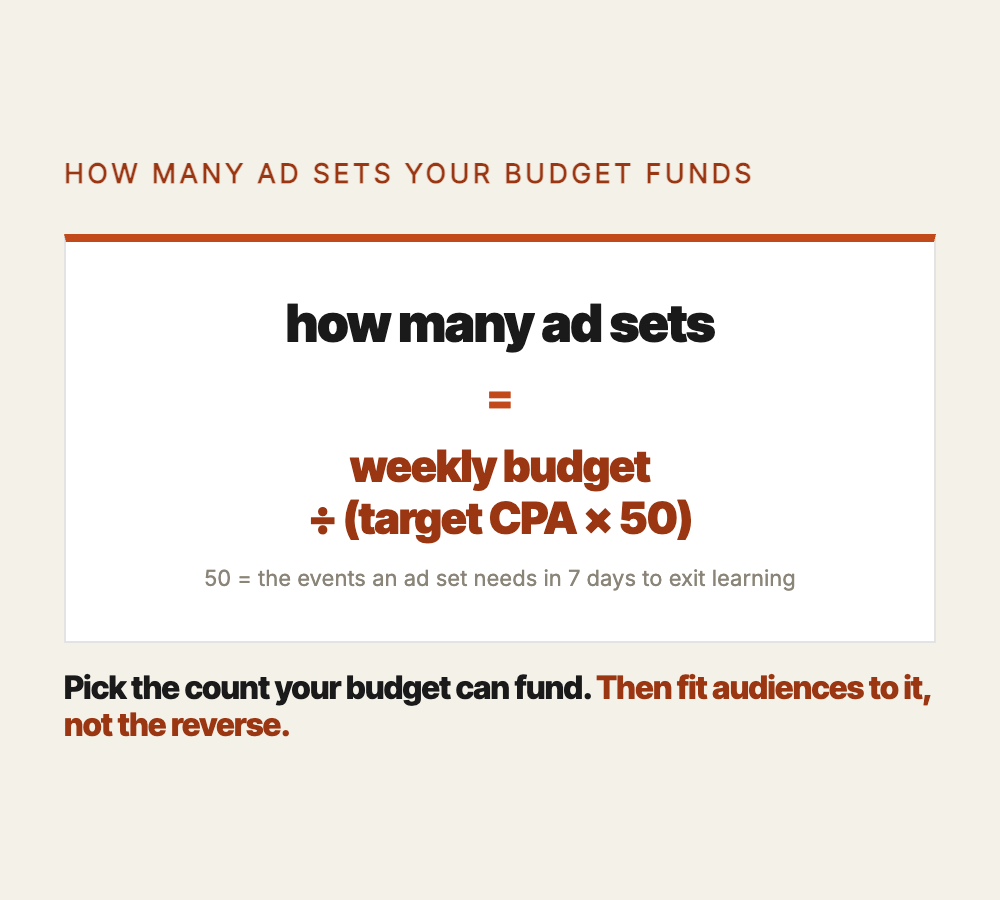
- The formula: ad-set count = weekly budget divided by (target CPA times 50).
- Splitting a small budget across too many ad sets keeps every one of them learning limited, forever.
- Over-segmented ad sets targeting overlapping audiences end up bidding against each other.
- Consolidating into fewer, broader ad sets (or pooling budget with Advantage+ campaign budget) is usually the fix, not more targeting precision.
Why does ad-set count feel impossible to get right?
Most media buyers pick ad-set count the way they'd pick audiences: by instinct. One set for lookalikes, one for interest stacks, one for retargeting, one for a broad test. It feels thorough.
The problem is Meta doesn't reward thoroughness. It rewards signal. Every ad set you add divides your budget one more way, and each slice has to clear its own bar before Meta will deliver it stably.
If your budget can't clear that bar for every ad set you've created, you're not testing four audiences. You're keeping four ad sets stuck in learning-phase purgatory at once, and paying for all four.
What is the learning phase, and why does it control everything?
The learning phase is the period where Meta's delivery system is still figuring out who to show your ad to. Meta's own guidance says an ad set needs about 50 optimization events, meaning results it's optimizing for, in a rolling 7-day window to exit it.
Below that threshold, the ad set is "learning limited." Delivery stays unstable and costs swing. This isn't a soft guideline. It's the floor that should decide your ad-set count, not the other way around.
Once you treat 50 events per week as the real constraint, the question changes from "how many audiences do I want to test" to "how many ad sets can I actually fund to 50 events each."
The worked count math and the automation question are below
How many ad sets can my budget actually fund?
Here's the math, worked with round, purely illustrative numbers. Say you're spending $1,000 a day, or $7,000 a week. Your target CPA (cost per action, the amount you're willing to pay per result) is $50.
Each ad set needs 50 conversions a week to clear the learning phase. At $50 per conversion, that's $2,500 a week the ad set needs. $7,000 divided by $2,500 is 2.8. Round down: your budget honestly supports 2 ad sets, not the 6 or 8 most accounts run.
That's the formula in one line: ad-set count = weekly budget divided by (target CPA times 50). Plug in your own numbers before you build your next campaign, not after.
What happens if I have too many ad sets?
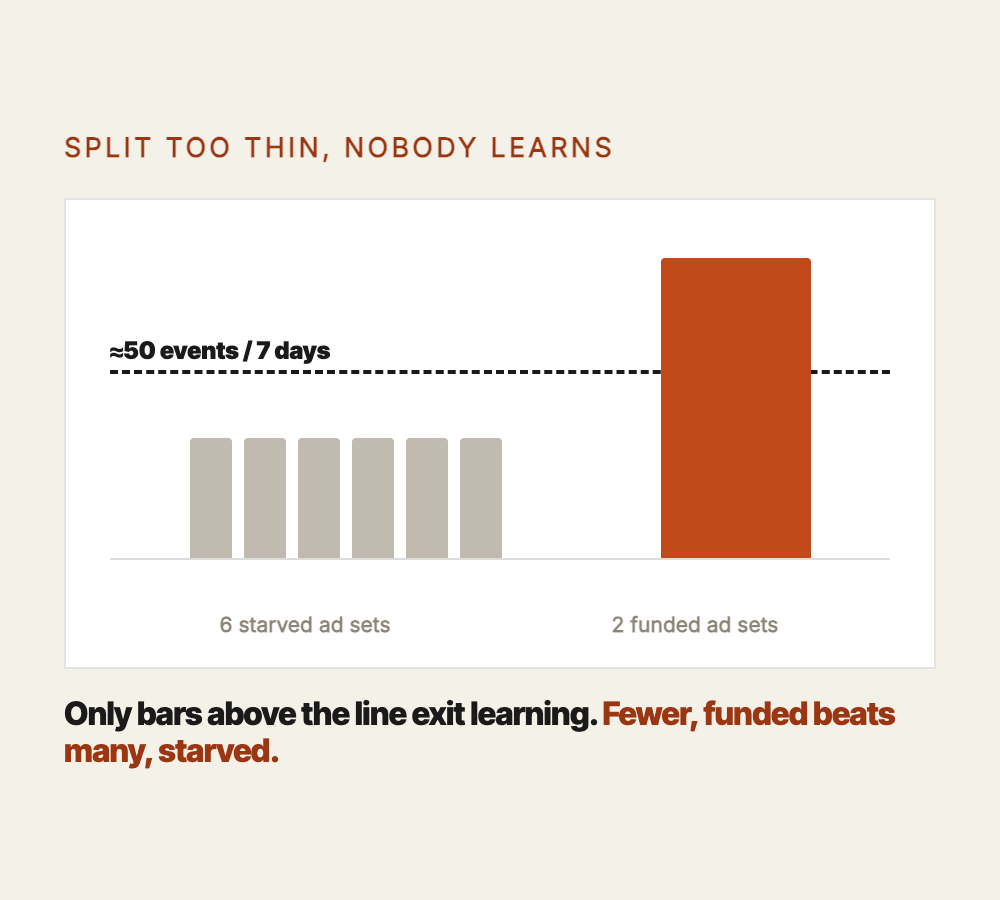
Every ad set past what your budget supports gets starved below the learning-phase floor. It never stabilizes, so its cost per result stays erratic and its reported performance is close to meaningless.
There's a second cost. When multiple ad sets chase overlapping audiences with similar creative, they compete in the same auction. Meta deduplicates at the impression level, but your ad sets are still effectively bidding against each other, which raises your own costs, the audience-overlap problem covered in are my ad sets competing against each other.
The fix is almost always fewer, broader ad sets, not more segmentation.
CBO or ABO, does the budget setting matter here?
Yes, because it changes how your funded ad sets get spend. Meta renamed campaign budget optimization (CBO) to Advantage+ campaign budget. It pools one campaign-level budget and distributes it across ad sets in real time toward whatever is performing.
Ad set budget optimization (ABO) splits budget per ad set yourself. Advantage+ campaign budget often concentrates 80% of spend on one or two ad sets fast, which can hide which segment is driving results even when total performance looks fine.
Neither setting rescues an account that created more ad sets than its budget can fund. It just changes how the shortage gets distributed. The full tradeoff is in CBO or ABO which budget setting.
Should I let Meta pick with Advantage+ instead?
This is genuinely contested, so both sides matter. Meta's own reporting says Advantage+ Shopping beats manual by about 22% return on ad spend (ROAS, revenue per dollar spent). That's Meta's figure, not an independent one.
The strongest independent evidence is different. A study by Measured, running over 30 geo-based holdout tests, found Advantage+ Shopping's true incremental ROAS came in below traditional prospecting and retargeting, because Meta-reported ROAS can overstate lift.
Meta is also making automation the default and retiring manual controls. A hybrid, Advantage+ for broad prospecting with manual carve-outs for retargeting, is common practitioner practice, not a proven rule. There's no single correct ad-set count for every account; the Realignment Protocol is built to diagnose which structure fits yours.
Frequently asked questions
How many ad sets should I run for a $1,000/month budget?
At roughly $33 a day, most target CPAs will only support one or two ad sets before you hit the 50-events-per-week floor. Run the formula with your own target CPA rather than assuming a fixed number.
What counts as an "optimization event" for the 50-per-week rule?
It's whatever action your ad set is optimized to get, most often a purchase or a lead, not clicks or link taps. Check your ad set's optimization goal to know which event Meta is counting.
Should I test more ad creatives instead of more ad sets?
Often yes. Adding creative variety inside one funded ad set doesn't divide your budget the way adding ad sets does. See how many ad creatives to test at once for how many is too many.
If Advantage+ campaign budget concentrates spend on one ad set, is that a problem?
Not automatically. It can simply mean that ad set is your best performer. It becomes a problem when it hides a segment you actually need visibility into, like a brand-new audience you're trying to evaluate.
Is there a "correct" number of ad sets that works for most accounts?
No. It's a function of your specific budget and target CPA, not a fixed rule. Treat any number you read elsewhere, including the examples above, as illustrative only until you run your own math.
Related reading: CBO or ABO which budget setting and are my ad sets competing. For the framework this sits inside, see the Realignment Protocol.