CBO or ABO: which budget setting should I use?
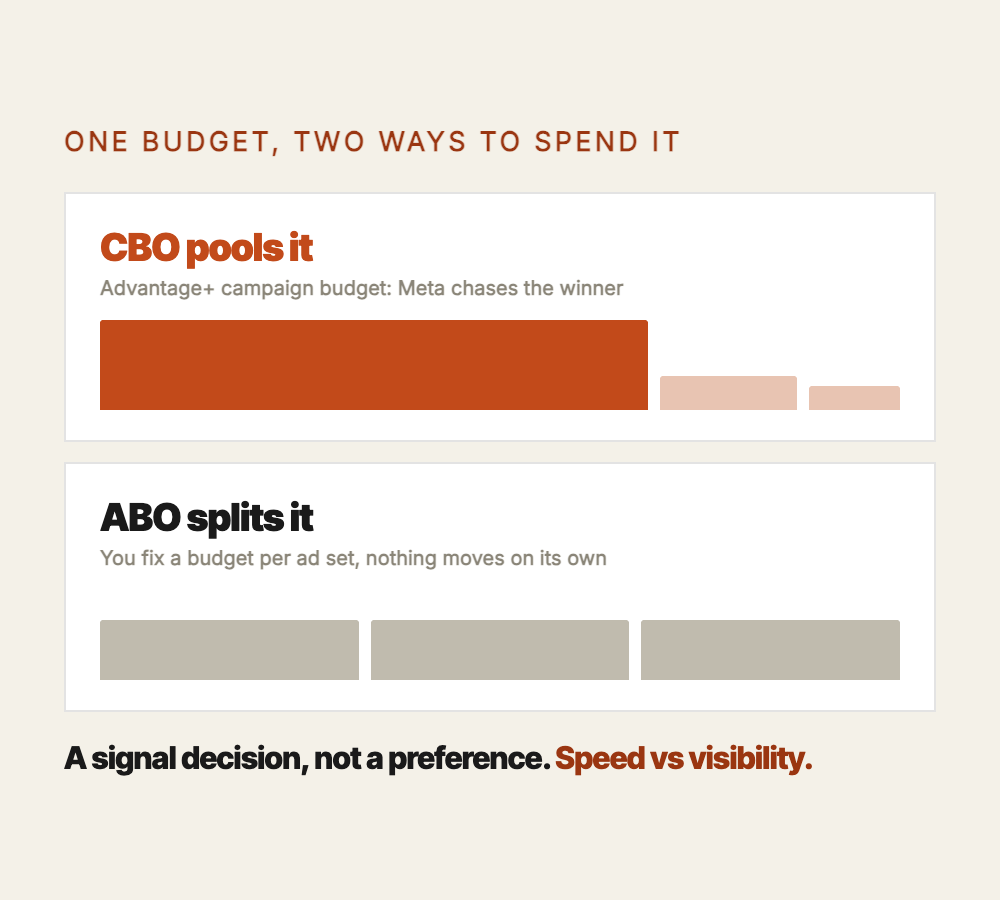
Campaign budget optimization (CBO), now officially called Advantage+ campaign budget, pools one budget across every ad set in a campaign and shifts spend in real time toward whichever ad set is producing results. Ad set budget optimization (ABO) locks a fixed budget to each ad set so nothing moves until you move it. Neither one is better. The real question is whether you need spend to reach Meta's learning-phase signal fast, which favors CBO, or whether you need to read each segment clearly before you scale it, which favors ABO. Get that tradeoff backwards and you either starve every ad set below signal or fly blind on which one is working.
- CBO (Advantage+ campaign budget) pools spend across ad sets and reallocates it toward the best opportunity in real time.
- ABO (ad set budget optimization) sets a fixed budget per ad set, so nothing shifts without you touching it.
- Meta renamed CBO to Advantage+ campaign budget. The renaming changed the label, not the mechanics.
- CBO commonly concentrates around 80% of spend on one or two ad sets fast, which hides what a third or fourth segment might have done.
- Read in ABO at low spend, scale winners in CBO once budget is real is common practitioner practice, not an official Meta rule.
What's the actual difference between CBO and ABO?
CBO (campaign budget optimization) sets one total budget at the campaign level. Meta's delivery system then decides, ad set by ad set and hour by hour, where that money buys the best result. ABO (ad set budget optimization) sets a fixed dollar amount on each individual ad set instead.
Under ABO, if one ad set is winning and another is dead, both keep spending their assigned amount until you change it. Under CBO, Meta reallocates automatically.
Meta has since renamed CBO to Advantage+ campaign budget, but the underlying mechanic, one pooled budget versus many fixed ones, hasn't changed.
Why does CBO push budget toward one ad set so fast?
Meta's delivery system is built to find the cheapest path to your stated result, and it moves fast once it sees one. Documented platform behavior shows CBO commonly puts around 80% of a campaign's spend behind just one or two ad sets within days.
That's not a bug. It's the system doing exactly what pooled budgeting is supposed to do: chase the strongest signal.
The cost is visibility. If a third ad set was quietly building toward a good cost per action (CPA, what you pay per result), it may get starved out before you see the data, part of why ads break when you scale without a plan for reading the account underneath.

Does pooling spend stop my ad sets competing?
Partly. Meta's auction deduplicates people at the impression level, so a person can't be shown the same ad twice for the same objective by accident. But when two ad sets target overlapping audiences with similar creative, they still bid against each other in the same auction.
Pooling budget through CBO reduces this some, because Meta is allocating across the ad sets itself rather than you funding both equally. Fewer, broader ad sets reduce overlap further.
This is really a structure question as much as a budget setting, which is why are my ad sets competing against each other is usually worth checking before you touch the budget toggle.
How much budget do I need before this setting matters?
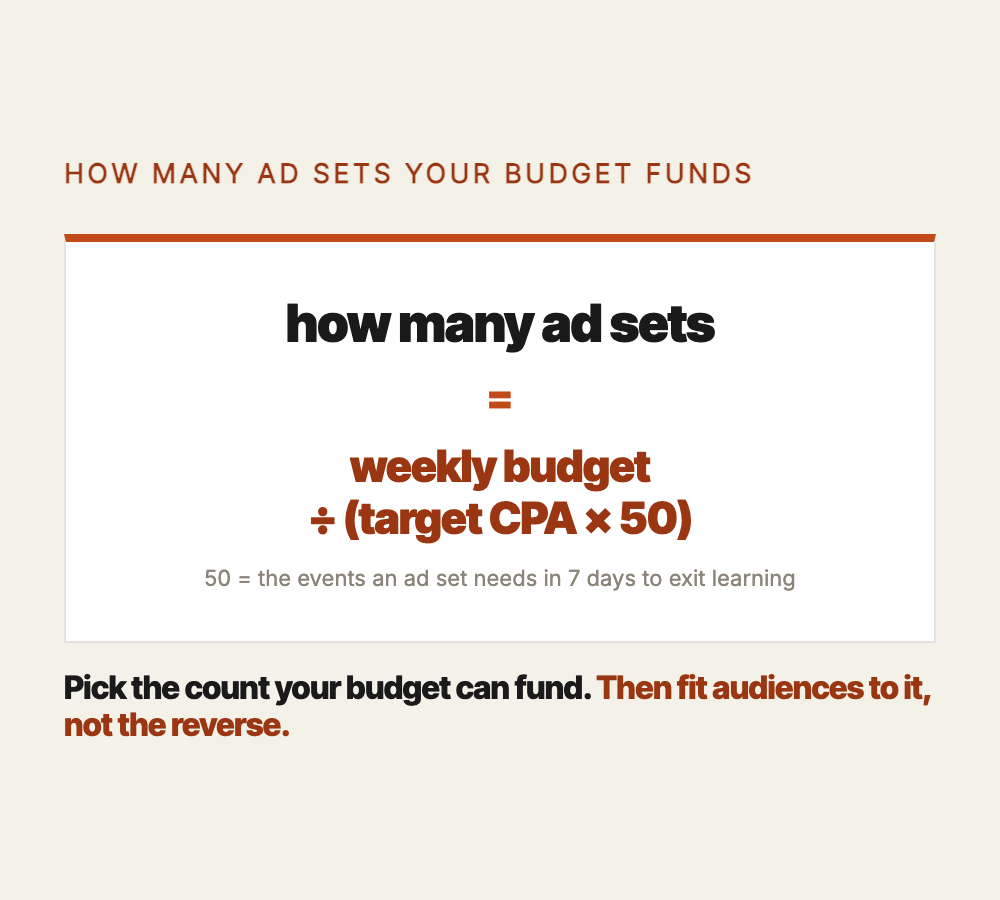
This is a math problem before it's a preference. Meta's learning-phase guidance says an ad set needs roughly 50 optimization events in a rolling 7-day window to exit "learning limited" and deliver stably.
Work backward from that. If your target CPA is $40, each ad set needs roughly $2,000 in a week to hit 50 events. Divide your weekly budget by that number to know how many ad sets you can fund, which answers how many ad sets to run more honestly than any rule of thumb.
Split a modest budget across too many ad sets and every one stays learning limited, regardless of which budget setting you picked.
Which one should I actually use?
Start with the math. If your weekly budget divided by (target CPA times 50) gives you one or two ad sets of signal, CBO (Advantage+ campaign budget) is the reasonable default. There isn't enough budget to spread across ad sets in ABO without starving them.
If your budget clears three or more full-signal ad sets, ABO earns its keep, at least temporarily. You can read each segment's real performance before deciding what to consolidate or cut.
Many practitioners test and read in ABO at low volume, then move confirmed winners into CBO once budget is real. That sequencing is common practitioner practice, not a documented Meta rule, so treat it as a starting point.
Is Advantage+ automation actually better, or just easier?
Here the evidence genuinely splits, so it's worth naming both sides. Meta's own reporting says Advantage+ Shopping campaigns produce about 22% higher return on ad spend (ROAS) than manual (4.52x versus 3.70x). That's Meta's figure, self-reported, not an independent study.
The one independent test available, over 30 geo holdout experiments from measurement vendor Measured, found the opposite: Advantage+ Shopping's true incremental ROAS came in below traditional prospecting and retargeting, because Meta-reported ROAS tends to overstate real lift.
Meta is also making automation the default and phasing out manual targeting, so this is increasingly a control-for-convenience trade. The full read is in Advantage+ or manual campaigns.
Frequently asked questions
Is CBO the same thing as Advantage+ campaign budget?
Yes. Meta renamed campaign budget optimization (CBO) to Advantage+ campaign budget. The mechanic is unchanged: one pooled budget that Meta's system reallocates across ad sets in real time based on where it sees the best opportunity.
Why does my CBO campaign only spend on one ad set?
That's expected behavior, not a malfunction. Documented platform data shows CBO commonly concentrates around 80% of spend on one or two ad sets within days, because the system is chasing the strongest signal it can find, which can hide other segments that might have worked.
How many ad sets can I run on a small budget?
Divide your total weekly budget by your target cost per action (CPA) times roughly 50, since that's the number of optimization events Meta says an ad set needs in a rolling 7 days to exit the learning phase. Whatever that number comes out to is your realistic ad-set ceiling.
Should I test in ABO before scaling in CBO?
Many practitioners do: test and read individual ad-set performance in ABO at low spend, then move confirmed winners into a pooled CBO once the budget is large enough to fund several ad sets past the learning phase. This is a common practitioner sequence, not an official Meta rule.
Is Advantage+ automation actually more efficient than manual campaigns?
Depends who's measuring. Meta's own reporting shows about 22% higher ROAS for Advantage+ Shopping versus manual, but that's self-reported. The one independent incrementality study, geo holdout tests from Measured, found the incremental return actually came in below traditional prospecting and retargeting. Both numbers are real; they measure different things.
Related reading: how many ad sets to run and are my ad sets competing. For the framework this sits inside, see the Realignment Protocol.