Advantage+ or manual campaigns: which should I use?
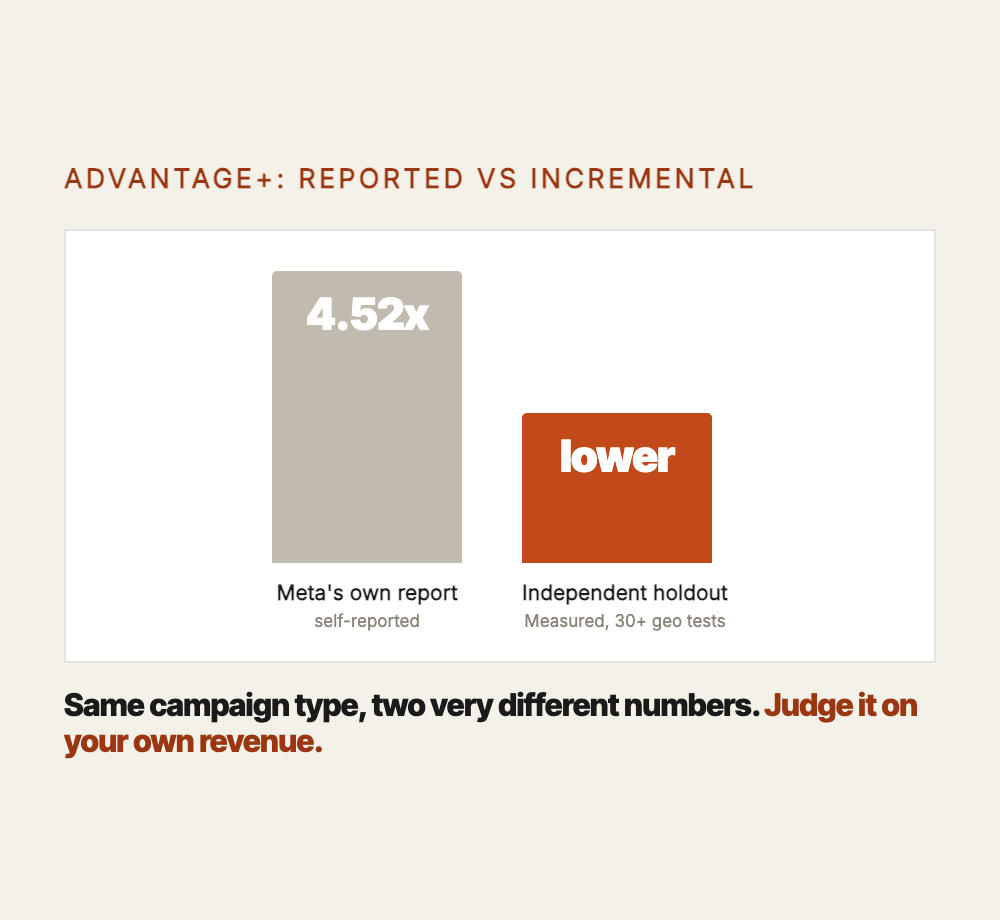
This is not a free upgrade, it is a control-for-efficiency trade, and Meta is quietly making the manual path harder to keep. Advantage+ Shopping campaigns (ASC) are Meta's automated campaign type, and Meta's own reporting says they beat manual campaigns by about 22% return on ad spend (ROAS). But the one independent incrementality study found the opposite: true incremental lift came in below traditional prospecting and retargeting. Detailed Targeting is already gone and legacy manual APIs are being phased out, so judge Advantage+ on your own blended results, not on Meta's number alone.
- Advantage+ Shopping campaigns (ASC) hand targeting, placement, and creative selection to Meta's automation instead of you setting them manually.
- Meta reports ASC beats manual by about 22% ROAS (4.52x vs 3.70x), but that's Meta's own self-reported figure, not an independent finding.
- The one independent incrementality study (Measured, 30+ geo holdout tests) found ASC's true incremental ROAS came in below traditional prospecting and retargeting.
- Meta has made Advantage+ the default for Sales, Leads, and App campaigns and is removing manual targeting, so opting out is getting harder.
- A hybrid, Advantage+ for broad prospecting and manual for retargeting or brand carve-outs, is common practitioner practice, not a proven rule.
What does Advantage+ Shopping do differently from a manual campaign?
In a manual campaign, you choose the audience, the placements, and often the budget split between ad sets. You decide who sees the ad and where.
An Advantage+ Shopping campaign (ASC) hands most of those decisions to Meta's system. You still supply the creative, the offer, and the budget. Meta decides who to show it to, which placements to use, and how to shift spend toward whatever is converting in real time.
The trade is simple to state. You give up granular control over targeting in exchange for Meta's algorithm reacting faster than you can to what's working. Whether that trade pays off is exactly the contested part.
Does Advantage+ actually perform better than manual campaigns?
Depends who is counting, and that matters more than it sounds. Meta's own reporting says ASC beats manual by roughly 22% ROAS, 4.52x versus 3.70x. That number comes from Meta, is widely repeated by vendors, and is not an independent measurement.
The strongest independent evidence says something different. Measured ran over 30 geo holdout tests across a full year and found ASC's median incremental ROAS, the return you actually caused beyond people who'd have bought anyway, came in below traditional prospecting and retargeting. Meta-reported ROAS overstated the real lift.
Neither number cancels the other out. One is the platform grading its own automation. The other is one independent vendor's holdout tests, the best outside evidence that exists, but still one study. The honest read is that reported and incremental performance disagree.
Why Meta is pushing it, and how to test it honestly, are below
Why is Meta pushing everyone toward Advantage+ right now?
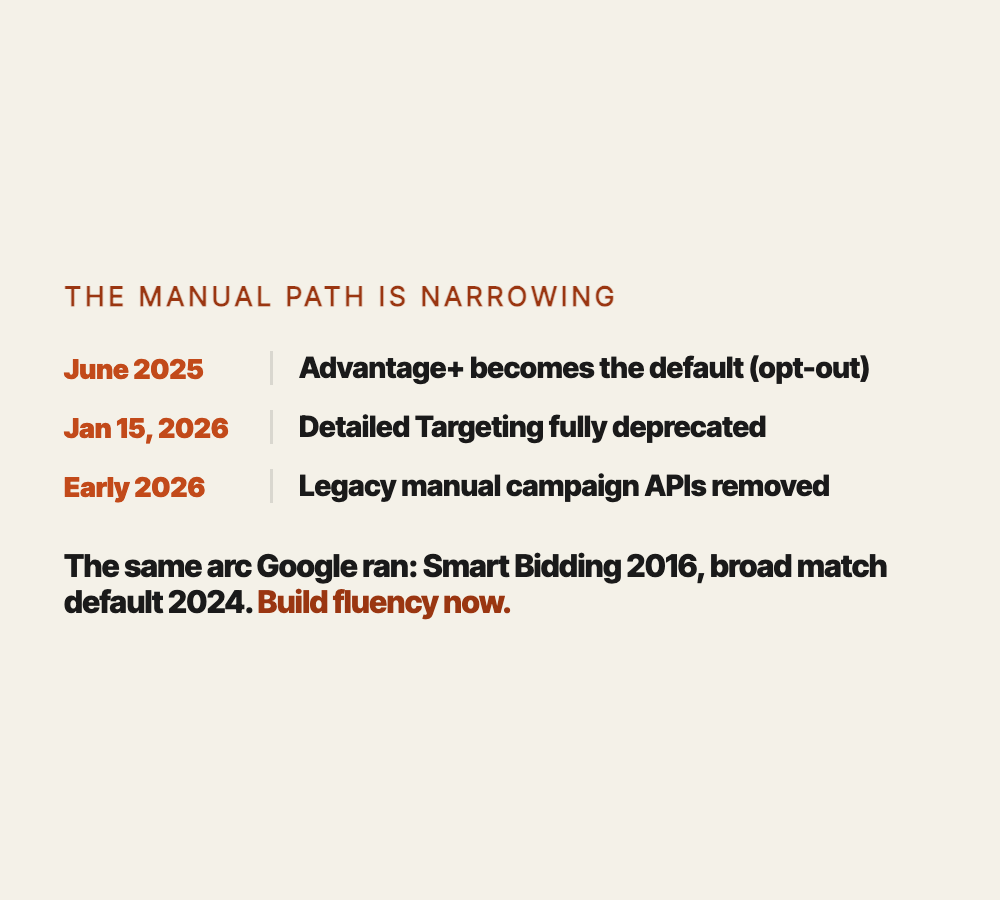
Because the manual path is being narrowed, on a documented timeline. Advantage+ became the default for Sales, Leads, and App campaigns around June 2025, opt-out rather than opt-in. Detailed Targeting, a core manual targeting tool, was consolidated in June 2025 then fully deprecated on January 15, 2026.
Legacy campaign APIs are being removed too. New legacy campaigns were blocked starting with Marketing API v24.0 in October 2025, and the older setup is scheduled for full removal in early 2026.
This is not new for the industry. Google ran the same arc: Smart Bidding launched in 2016, broad match became the default for new Search campaigns in July 2024. Automation becoming the default, then the only option, is the pattern platforms follow once the tooling matures.
Is a full switch right, or is a hybrid smarter?
Many practitioners run both at once rather than picking a side. Advantage+ handles broad, top-of-funnel prospecting where its real-time signal reading has room to work. Manual campaigns get kept for retargeting, brand carve-outs, or segments where you have a specific reason to control who sees what.
This hybrid is common practice, not a settled rule with proof behind it. It exists because prospecting is exactly the kind of decision automation handles well, lots of signal, fast iteration, no strong reason to hand-pick, while retargeting often involves people you already know something about that the algorithm doesn't.
If you're deciding where to start, prospecting is the lower-risk place to hand control to Advantage+. Retargeting and any warm segment you already understand is the higher-risk place to keep manual for now.
How do I honestly test Advantage+ against manual, on my own numbers?
Don't decide this off Meta's 22% figure. That number is self-reported, and the one independent study found the opposite. Test it on your account, the same discipline behind checking whether your ROAS is even real.
Run a real comparison instead of trusting the dashboard. Split comparable budget between an Advantage+ campaign and a manual campaign for the same offer over the same weeks, then compare blended return on ad spend across your actual revenue, not just what each platform reports.
Better still, if you can run or approximate a geo holdout the way Measured did, cut Advantage+ off in a subset of regions and compare total revenue there against similar regions still running it. Watch it over two to four weeks, not two days; learning-phase noise will drown out a short test.
So which should I use this week?
Start Advantage+ where the decision is lowest-risk: broad prospecting, where you don't have a strong reason to hand-pick the audience. Keep manual, for now, on retargeting and any warm segment you already understand.
Run the comparison test above before you commit either way. Judge the result on your own blended numbers and, if you can manage it, an actual holdout, not on the 22% figure Meta publishes about itself.
Expect the manual option to keep shrinking, so build fluency with Advantage+ now rather than wait for a forced migration. This sits next to CBO or ABO which budget setting, since Advantage+ campaign budget (the renamed CBO) works alongside Advantage+ Shopping.
Frequently asked questions
Is Advantage+ Shopping always better than manual campaigns?
No. Meta's own reporting says it beats manual by about 22% ROAS, but that's a self-reported figure. The one independent incrementality study found the opposite, ASC's true incremental lift came in below traditional prospecting and retargeting. Treat it as contested, not settled.
What does ROAS mean and why does "incremental" change the number?
ROAS is return on ad spend, revenue divided by ad cost. Incremental ROAS strips out the buyers who would have purchased anyway and measures only the extra revenue the ad actually caused. Reported ROAS and incremental ROAS can tell very different stories from the same campaign.
Can I still run manual campaigns, or is Meta forcing everyone onto Advantage+?
You can still run manual campaigns today, but the option is narrowing. Advantage+ became the default for Sales, Leads, and App campaigns in mid-2025, Detailed Targeting was deprecated in January 2026, and legacy manual campaign APIs are being phased out through early 2026.
Should I run Advantage+ and manual campaigns at the same time?
Many practitioners do, using Advantage+ for broad prospecting and manual for retargeting or specific segments they understand well. This hybrid is common practice, not a proven universal rule, so treat it as a reasonable starting structure, not a fixed formula.
How long should I test Advantage+ before deciding if it works?
Give any test at least two to four weeks per format, comparing your own blended ROAS or, if possible, an actual geo holdout against real revenue. Two days of data is mostly noise, and short tests are exactly what makes the reported-versus-incremental gap easy to miss.
Related reading: is my Facebook ROAS even real and CBO or ABO which budget setting. For the framework this sits inside, see the Realignment Protocol.