UGC vs static vs video: which ad format converts?
There is no format that wins for every advertiser. User-generated content (UGC, ads that look like a real customer filmed them, not a studio production), static images, and video each convert better in some spots and worse in others, and the spot that matters is the one your own campaign sits in. Video tends to pull more clicks and often cost more per result, but that is a direction, not a rule, and the exact numbers quoted online are not settled science. The number that should decide your next production budget is the one sitting in your own ad account, not a benchmark chart from a blog post.
- No format has a peer-reviewed, universal win. Direction only: video tends to pull more clicks and often costs more per result.
- UGC production is commonly quoted from around $99 a video (services like Billo) up to a few thousand, a practitioner range, not a fixed price.
- Meta's learning phase (~50 optimization events in a rolling 7 days) caps how many format variants you can reliably read.
- Wearout follows an inverted-U shape and applies to every format, not just one.
- Decide by funnel stage first, then let your own blended numbers settle the tie.
Why do format benchmarks disagree so much?
Because most of the specific numbers circulating online are practitioner estimates dressed up as facts. Real published benchmarks exist and they disagree with each other too.
One widely cited practitioner benchmark from Hootsuite puts average video ad click-through rate (CTR, the share of viewers who click) around 1.14% against static around 0.90%, offered here as an illustrative comparison, not a number you should expect to hit.
That gap is real in direction (video usually clicks more) but the size moves by industry, platform, and creative quality. Treat any single pair of numbers you find online, including this one, as a rough compass.
Does video really convert better than static ads?
Video tends to win on attention and clicks. It also tends to cost more per result, because production is heavier and the format asks for more watch time before the message lands. That trade-off is directionally consistent across practitioner reporting, but no peer-reviewed study settles exact conversion numbers between formats.
Static images are cheap to produce and fast to test in volume. That speed advantage matters more than people credit, because it lets you learn what message and angle work before you spend on a heavier video build.
Static often wins on cost efficiency even when it loses on raw click volume. Neither format is universally better.
The cost, the ceiling, and the decision framework are below
What does UGC actually cost, and is it worth it?
UGC is the format built to look like a genuine customer talking to camera, not a polished studio shoot. Practitioner pricing runs roughly from $99 a video through platforms like Billo up to a few thousand dollars for higher-production UGC with paid creators.
That is a wide range because "UGC" covers everything from a single unscripted phone clip to a directed, edited creator video. The appeal is that UGC often earns trust faster than an obviously branded ad, especially cold.
Cost and quality both vary enough that you should treat any specific price you read as a starting estimate, then confirm it against quotes from the actual creators or platforms you're considering.
How does the learning phase limit how many formats I can test?
Meta's platform needs an ad set to hit roughly 50 optimization events in a rolling 7-day window before it stabilizes out of the learning phase. Meta's own guidance is to keep it to 6 or fewer creatives per ad set.
This is the real ceiling on format testing, more than any performance chart. If your budget can't generate 50 events per creative in a week, adding a fourth or fifth format to test at once just produces noise.
This is one reason how many creatives to test at once matters more than which format wins in theory.
Does creative fatigue differ by format?
Wearout follows an inverted-U shape regardless of format. Attitude toward an ad tends to peak around 10 exposures while recall keeps climbing, and the right number shifts with spacing and involvement. There is no single "refresh every N days" rule for any format.
The useful diagnostic is the same across formats: if frequency is climbing across every ad, that is usually audience saturation or a delivery shift, not one creative burning out. It's worth ruling out before concluding fatigue (see is it creative fatigue or something else).
So how do I actually decide which format to run?
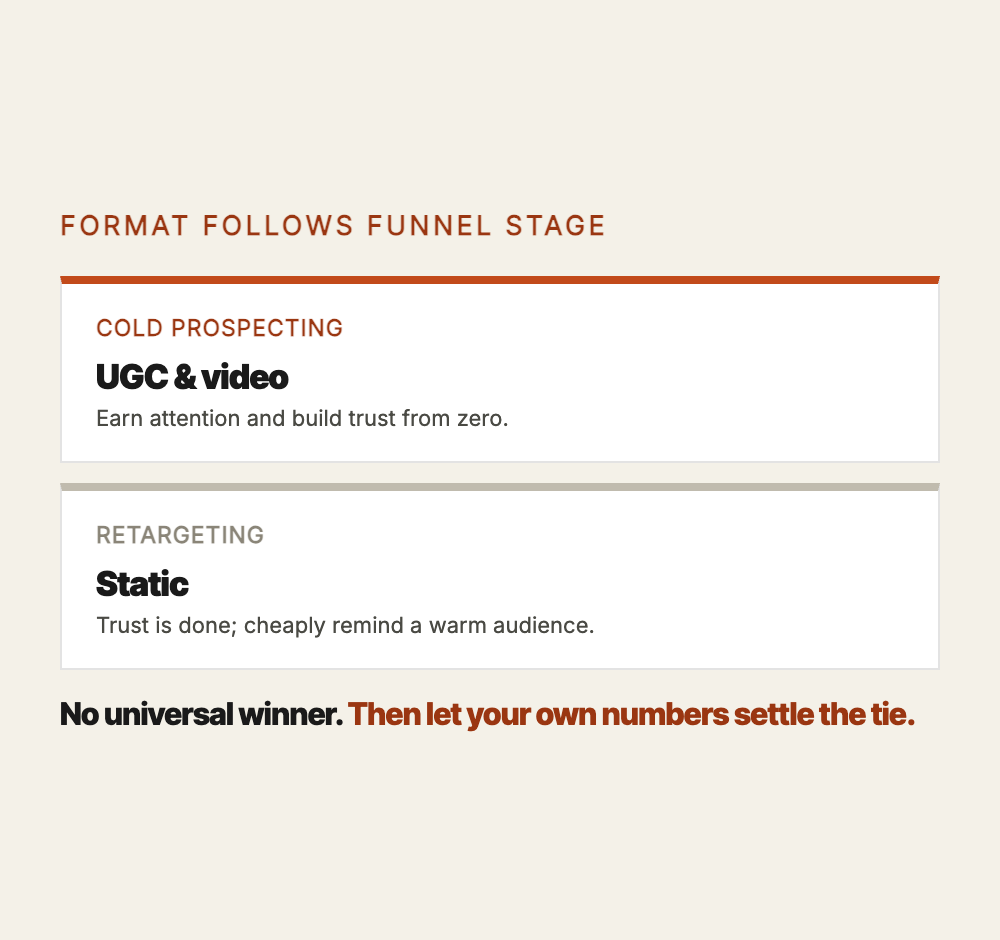
Decide by funnel stage first, then confirm with your own numbers. Broad prospecting (cold audiences who don't know you) tends to reward formats that earn attention fast and build trust from zero, which is why UGC and video often get tested first there.
Retargeting (people who already saw your brand) tends to tolerate a plainer static ad, because the trust groundwork is done and the job is just reminding them.
Inside your budget's learning-phase ceiling, run a small controlled test across stages, then read your own blended cost per acquisition and return on ad spend, not an outside benchmark. If your ads get clicks but not sales, the format probably isn't the problem (see clicks but no sales).
Frequently asked questions
Does UGC always outperform static ads?
No. UGC often builds trust faster in cold prospecting, but static ads are cheaper and faster to produce in volume, which can make them more cost-efficient overall. There is no universal winner; it depends on funnel stage and your own account's results.
Is video worth the extra production cost?
It can be, especially for cold audiences where attention is scarce. Video tends to pull more clicks in practitioner reporting, but it also tends to cost more per result, so weigh that against your budget before committing production dollars to it exclusively.
How many creatives should I test across formats at once?
Stay within what your budget can push through Meta's learning phase, roughly 50 optimization events per creative in a rolling 7 days, and Meta's own guidance caps it at 6 or fewer creatives per ad set. Testing more than that usually means none of them get a clean read.
How do I know if my ad is fatiguing versus something else being wrong?
Check whether frequency is rising across every ad in the account (saturation, not one creative) or isolated to a single ad (that one creative wearing out). A short-term dip sometimes reverses into stronger brand preference weeks later, so don't overreact to one bad week.
What is the single best format to start with if I'm brand new to paid ads?
There isn't one best format in the abstract. Match the format to the funnel stage you're running (prospecting versus retargeting), test a small controlled set within your learning-phase budget, then let your own cost per acquisition and return on ad spend decide going forward.
Related reading: how many creatives to test at once and is it creative fatigue or something else. For the framework this sits inside, see the Realignment Protocol.