A website conversion audit is a structured review of your website that finds the specific reasons visitors are not calling you. It looks at four things: whether people can find you in the first place, whether your site clearly says who you are and what you do, whether visitors trust you enough to pick up the phone, and whether the path from landing on your page to dialing your number is easy. It tells you which of those four things is the actual problem, and what fixing it looks like.
What does "website conversion audit" actually mean for a plumber or roofer?
The phrase sounds like agency talk. Strip the jargon and here is what it describes. You may also see it called a conversion audit or a CRO audit. Those terms all describe the same diagnostic process.
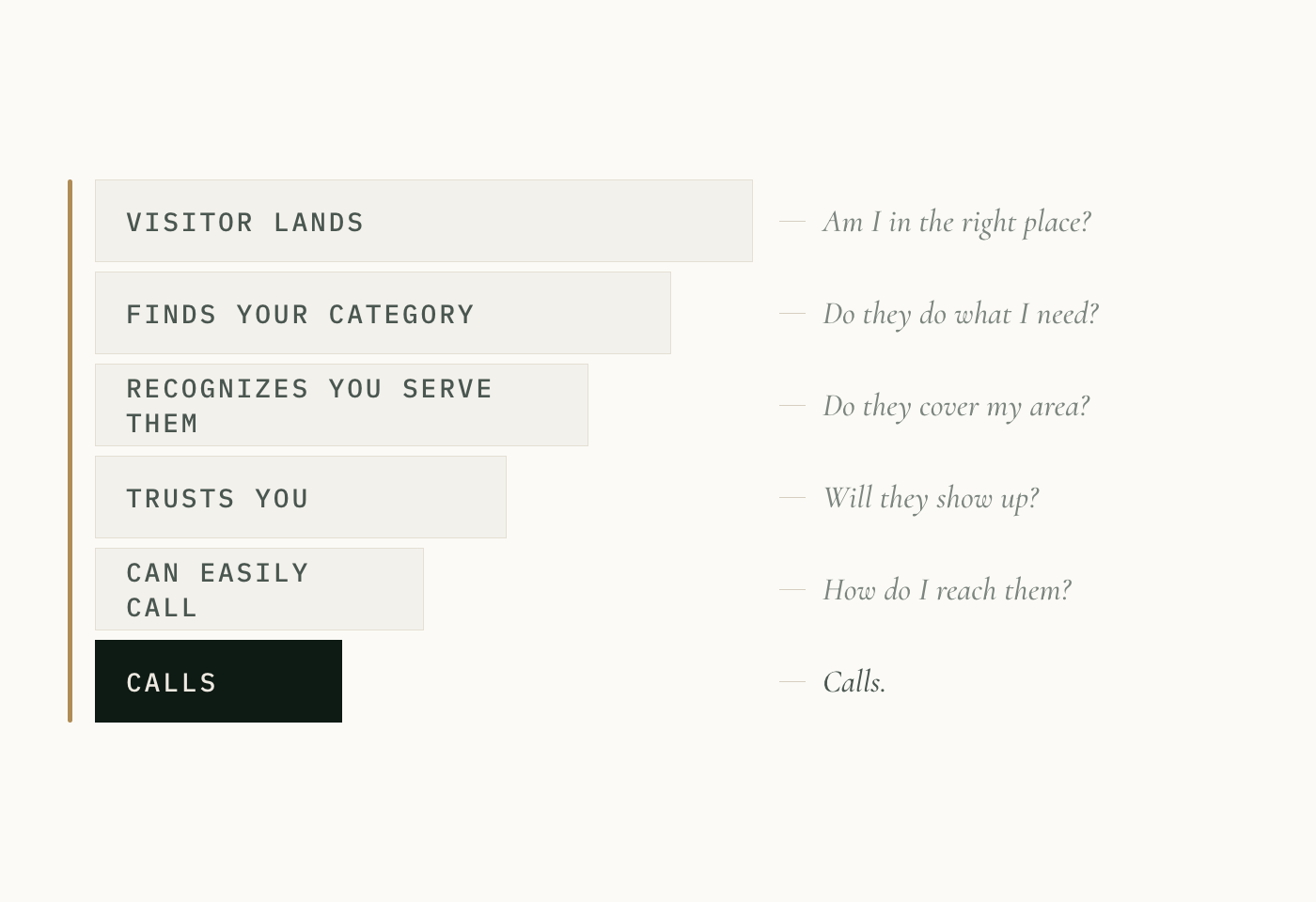
When someone searches "emergency plumber near me" or "roof replacement estimate Dallas," your website gets one job: turn that visit into a phone call. Most of the time, it fails silently. The visitor arrives, looks around for a few seconds, and leaves without calling. You never see it happen, and your phone stays quiet.
A website conversion audit is a methodical way of finding out exactly where that failure is happening. Someone goes through the site the same way a new visitor would, but with a specific list of things to look for, and tells you what is causing the drop-off. Not a vague list of improvements. A specific finding: the problem is here, and here is what it looks like to fix it.
The word "conversion" in the name just means the moment a visitor becomes a caller. It is not a marketing word you need to learn. You can forget it after this paragraph. What matters is the phone ringing.
What does a website audit for service businesses actually examine?
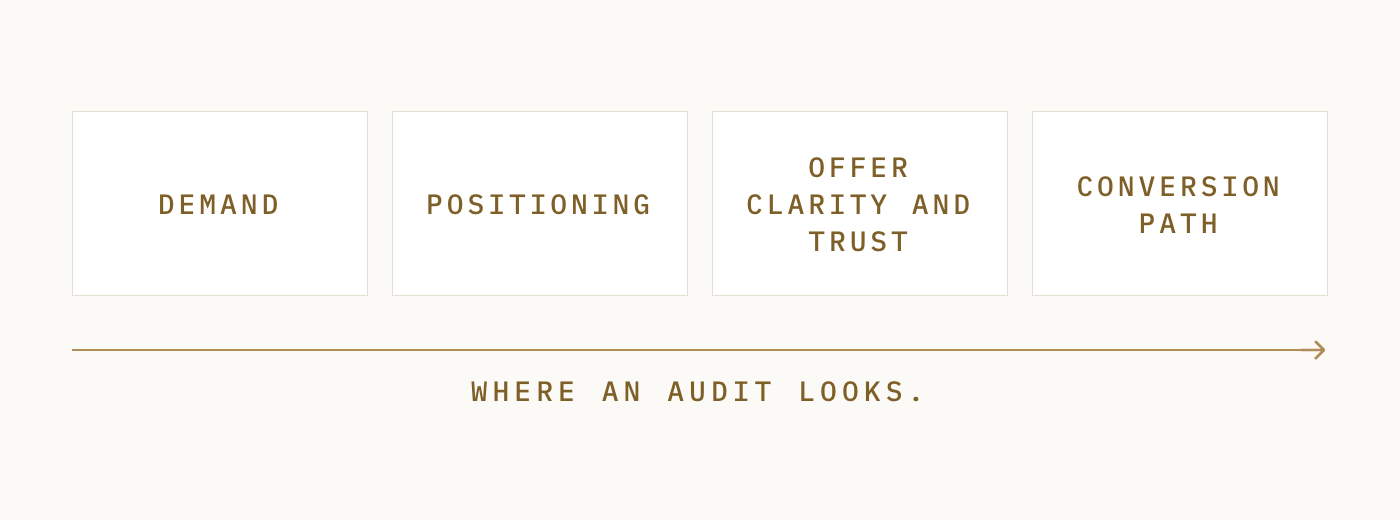
A solid audit for a service business looks at four areas. These are not arbitrary. They follow the order in which a real visitor experiences your site, and they cover every place a call can be lost.
1. Demand: can people find you at all? Before anyone can call from your site, they have to reach it. This part of the audit looks at whether your site shows up when your customers search for what you do. A plumbing site that ranks for "plumber [city]" gets calls. One that only ranks for your business name by accident gets very few, because nobody searches your name until they already know you. This is not a deep dive into search strategy. But an audit will flag if your site has a basic visibility problem that means the other three areas do not even matter yet.
2. Positioning: does your site clearly say what you do and who you serve? Visitors decide within a few seconds whether they are in the right place. If your homepage headline says something like "Quality Service, Done Right," they cannot tell whether you are a plumber, a roofer, or an electrician. They cannot tell if you serve residential or commercial. They cannot tell if you cover their zip code. This area looks at whether your site answers the visitor's first question immediately: is this the kind of company I am looking for, and do they serve people like me?
3. Offer and trust: does the visitor trust you enough to call? Getting a call from your site requires the visitor to take a small risk. They do not know you. They are about to invite a stranger into their home or hand over a significant check for a roof. This part of the audit looks at whether your site gives visitors reasons to believe you are the right call. That includes whether your services are described clearly (not in contractor jargon), whether there is evidence you have done this work before, and whether anything on the page creates doubt or confusion. According to the BrightLocal Local Consumer Review Survey (2026), 54% of consumers visit a business website after reading positive reviews. A roofing site that lists credentials, shows real photos from real jobs, and explains what happens after you call reads differently from one that is mostly a logo and a phone number. The audit finds the gap between what your site currently communicates and what it needs to communicate.
4. Conversion path: is calling you easy and obvious? This is the most common failure point for sites that have decent traffic. The visitor is ready to call. They just cannot figure out how to do it quickly. This area looks at whether your phone number is visible without scrolling, whether the site works on a phone (where most service calls start), and whether anything between the visitor's decision and the actual call creates friction. According to Think with Google (2017), as page load time goes from one second to three seconds, the probability of a visitor bouncing increases 32%. Even one extra step, or one second of extra load time, can lose the call.
One thing the audit does not tell you is whether your services are priced right for your market. That comparison requires looking at competitors in your category, not your site alone.
What does a website conversion audit output actually look like?
An audit should give you something specific, not a scorecard with letter grades.
When we run this as a Profit Leak Audit for a roofing or plumbing company, a finding looks like this: "Your homepage does not name the service areas you cover. A visitor searching for a plumber in a specific neighborhood cannot confirm you serve them, so they leave." That is a positioning finding. Fixing it means adding your service area clearly to the page.
The output you do not want is a list of 40 things to improve ranked by "impact" with no connection to whether those things are actually costing you calls. That kind of output is built for agencies, not owners.
A good audit separates what is actually causing you to lose calls right now from what would be nice to improve someday. Most service business sites have one or two places where the call is being lost. The audit names them.
One finding category that surprises many owners: contact form responsiveness. According to Leadferno's research on website lead management (2023), 42.6% of submitted contact form leads received no response at all. If your contact form is broken or goes unmonitored, the audit will surface that as a specific, fixable finding.
Some audits also include an estimate of what fixing the problem could change. A site getting 600 visitors a month with a very low call rate is leaving significant calls behind compared to a site in the same market with a higher call rate. Naming the gap in concrete terms helps you decide whether acting on the audit makes sense.
When does a service business website need a conversion audit?
You need an audit when you have evidence that visitors are arriving but not calling. Specifically:
- Your Google Analytics (or any basic traffic tool) shows visitors landing on your site, but your call volume does not match. You might be getting 300 to 500 visits a month with fewer than five or six calls coming from the site.
- You recently paid for a new website and the phone did not change.
- Your SEO company reports "traffic is up" but your call volume stayed flat.
- You are running Google Ads and the ads show clicks, but the calls from those clicks are low relative to your spend.
In all of these cases, the problem is likely happening somewhere between the visitor arriving and the call happening. The audit finds where.
When does a service business NOT need a conversion audit?
This matters as much as knowing when you do need one.
We turn away potential clients when the core problem is traffic, not conversion. If your site gets fewer than 100 visitors a month, fixing the conversion path will not move your phone. The audit addresses what happens to the visitors you already have. If you do not have visitors, the priority is visibility first. (If you are in that situation, the article Why Your Website Gets Traffic but No Calls covers the most common reasons for that gap.) An audit is the wrong tool for a traffic problem.
You do not need an audit if you already know the specific problem. If your site is five years old, has no photos of your work, and you know it looks outdated, you probably do not need a formal audit to confirm that. You need a site fix.
You do not need an audit before your site is live. Audits are diagnostic, not prescriptive. They work on an existing site with real visitor behavior to examine. A site that is not yet live has nothing to audit.
The honest summary: an audit is most useful when something specific is not working and you cannot tell why. It removes the guessing.
Request a Free Site Review from vi.design. We will look at your site against the four areas above and tell you which one is the problem. No pitch, no upsell. A diagnostic read and a straight answer.
Request a Free Site Review →Frequently asked questions
How is a website conversion audit different from an SEO audit?
An SEO audit focuses on whether your site ranks in search engines. It looks at technical factors, keyword targeting, and whether other sites link to yours. A website conversion audit focuses on what happens after someone arrives. Both matter, but they answer different questions. An SEO audit answers: can they find me. A conversion audit answers: why are they not calling when they do find me. For most service businesses getting some traffic but few calls, the conversion audit is the more urgent of the two.
How long does a website audit take?
For most service business sites, which typically run 5 to 15 pages, we deliver findings within 3 to 5 business days from start to delivery. The audit examines each page against the four diagnostic areas, so the depth of the review matters more than the page count. What takes time is reading the site as a real visitor would, checking the positioning against your actual market and service area, and sizing each finding by whether it is costing calls right now or is a secondary issue. A same-day "audit" that delivers a generic checklist is not the same thing. You want one with specific findings tied to your actual site, your actual market, and your actual visitor path.
Can I do a website audit myself?
You can run a self-check on the most common failure points. Look at your homepage: does it say in one sentence what you do and what city you serve? Is your phone number visible at the top of the page without scrolling on a phone? If a stranger looked at your site for eight seconds, would they know whether to call you? These questions will surface obvious problems. What a self-check misses is the visitor perspective, the gap between what you intend to communicate and what a stranger actually reads. That gap is where most calls are lost, and it is genuinely hard to see in your own site.
Does a website audit tell me whether to fix my site or build a new one?
Often, yes. One of the outputs of a good audit is a judgment on whether the problems found are fixable on the existing site or whether the site's structure is part of the problem. A single missing element, like a clear service-area statement or a visible phone number, is a fix. A site where the layout itself creates friction, the mobile experience is broken, and the positioning is unclear across every page is more likely a rebuild candidate. The audit should name which situation you are in.
What is the difference between a free site review and a paid audit?
Our free site review is a lighter first look: a few specific observations on the most visible conversion problems, with a plain-language summary of what they are costing you. It is useful for a quick read on whether a bigger problem exists. A paid Profit Leak Audit is the full diagnostic across all four categories, with every finding sized and documented. The free review is the starting point. If it finds something, the full audit tells you the complete picture.