If your website gets traffic but the phone is not ringing, the problem is almost never a traffic problem. Traffic and calls are two different things, and a website can fail at turning one into the other for five specific reasons, none of which have anything to do with how many visitors you are getting. The path from someone landing on your site to someone picking up the phone and calling you is a chain with distinct links, and any single broken link drops the call.
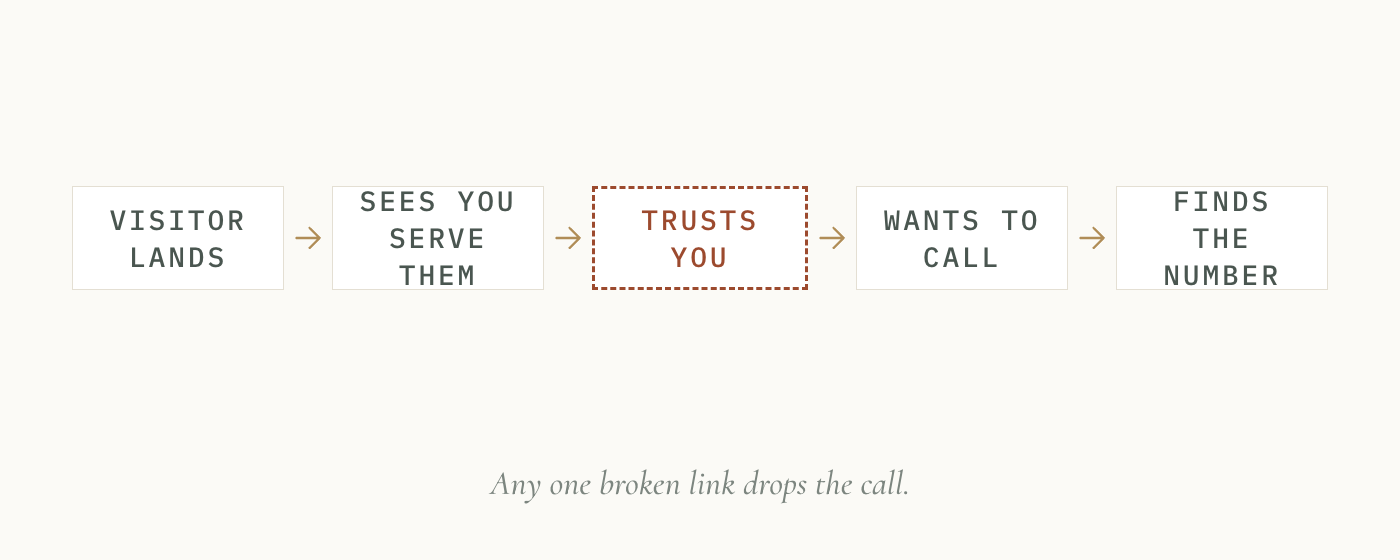
Every time someone lands on your website and leaves without calling, they made a decision somewhere along that chain. Not necessarily at the first link. Not necessarily at the last. The job of a diagnosis is to find which link broke. Here are the five places where traffic stops turning into calls.
Why does having website traffic not automatically mean getting calls?
A roofing company in Tulsa gets 400 visitors a month from Google and takes three calls a week. The traffic is real. The problem is not SEO. Something in the path between arriving and calling is breaking down. A visitor landing on your page is like someone walking up to the front door of your shop. Traffic counts the people who tried the door. Calls are the people who actually walked in and asked for help. Between the door and the counter, there are several places where someone can decide to leave.
The reason this matters is practical. If you assume your problem is traffic and you invest in more SEO or more ads, you are spending money to send more people to a door that is already causing them to leave. According to SOCi's Consumer Behavior Index (2024), 72% of consumers use Google to search for local business information. The visitors are searching. Fixing the door is faster and cheaper than building a bigger crowd at it.
Why does your site need to name the cities it serves before anything else?
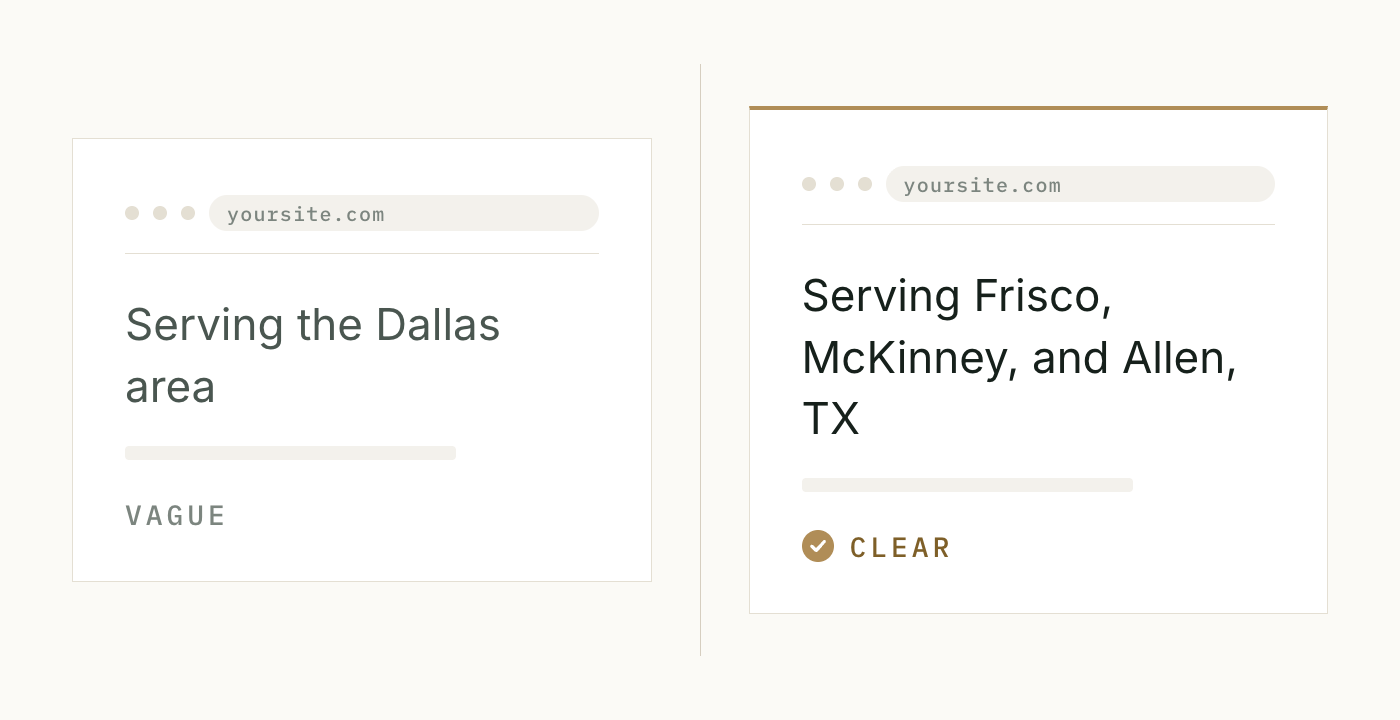
The first thing most visitors check, consciously or not, is whether you are even an option for them. A plumber in Dallas visiting a site that says "serving the greater metro area" has to do work to confirm you cover their neighborhood. Most of them will not do that work. They will leave and call the company whose site said "serving Frisco, McKinney, and Allen" on the first screen.
How to check thisOpen your homepage on your phone. Without scrolling, can you read the specific cities or zip codes you serve? If you have to scroll to find your service area, or if it says only "serving [City]" without neighborhoods, this link in the chain is weak.
Why do visitors leave before reading what you offer?
Most people who land on a service business website from a Google search have a specific question in their head. A roofer's potential customer searched "roof leak repair Tulsa" because they have a leak right now. They want to know: do you fix roof leaks, are you in Tulsa, and can I trust you? If your homepage answers those questions in the first two or three seconds, the visitor stays. If your homepage opens with your company history, your certifications, or a generic tagline about quality service, the visitor is gone before they read any of it.
How to check thisAsk someone who has never seen your site to visit it on their phone and tell you, after five seconds, what your company does and who it is for. If they cannot answer both questions in five seconds, your page is not answering the visitor's actual question fast enough.
What makes a visitor confident enough to call a service company they have never used?
Calling a service business is asking a stranger into your home or onto your property. That takes a different level of trust than ordering a product from a website. Visitors who land on your site are asking, even if not consciously: is this a real company, do other people use them, and will they show up?
According to the BrightLocal Local Consumer Review Survey (2026), 85% of consumers are more likely to use a business after reading positive reviews. If your site has no reviews, or only has reviews that say "great service" with no specifics, you are not giving the visitor enough evidence to make that call to a stranger feel low-risk.
How to check thisLook at your site the way a cautious first-time customer would. Is there at least one review that mentions a specific situation, like they fixed a burst pipe on a Sunday at 9pm? Are there photos of real jobs, not stock photos? Is there any signal that your business is active right now, like a recent date on a review, and not just a site that was set up years ago and never touched?
Why does listing your services not answer the questions visitors actually have?
There is a gap between "we offer HVAC repair" and "here is what happens when you call us." Most service business websites live entirely in the first column. They list the services. They do not explain the process. A visitor reading a list of services is still left with unresolved questions: How fast do you respond? Do I have to be home? Will you tell me the price before you start? Do you charge a diagnostic fee? Every one of those unresolved questions is a reason not to call.
How to check thisRead your services page and write down every practical question a first-time customer would still have after reading it. If you can write down more than three unanswered questions, your page is not closing the gap between "here is what we offer" and "here is what it is like to work with us."
Why does a hard-to-find phone number cost you calls even from interested visitors?
This is the most mechanical failure on the list and also one of the most common. The call button is hard to find. The phone number is only in the footer. The contact form asks for eight fields before you can submit it. On mobile, the phone number is not a clickable link.
Page load speed compounds this problem: according to Think with Google (2017), as page load time goes from one second to five seconds, the probability of a visitor bouncing increases 90%. A slow page means many visitors never see your phone number at all.
A visitor who has read through your site and decided they want to call you should be able to do so in one tap. If they have to hunt for your number, most of them will not hunt. They will close the tab.
How to check thisPick up your phone and go to your website right now. Do not search for your number. Just scroll through the page as a customer would. How many seconds does it take before you can tap a button and have your phone start dialing? If the answer is more than ten seconds, or if there is no tappable phone link at all, this link in the chain is broken.
What if you check all five and the phone still is not ringing?
If you work through all five checks and nothing is clearly broken, there are two other possibilities worth considering.
The first is a demand problem: the searches that bring people to your site may not be searches where people are ready to call anyone yet. One way to check: look at the search terms bringing people to your site. If they include "ideas," "guide," or "how-to," those visitors are researching, not ready to call.
The second is a positioning problem: visitors may be finding your site, confirming you are a real company, and still choosing a competitor because something about how you present your services makes the competitor look like the safer choice. One signal: if you are not the lowest-priced option but your site does not explain why, visitors may be defaulting to the familiar competitor.
One concrete limit of this checklist: it cannot tell you whether your offer is priced wrong for your market. That takes comparing your service and pricing presentation against competitors in your category.
The diagnostic we run, called a Profit Leak Audit, maps each of these failure points to one of four areas we examine on every site: whether the right visitors are finding you, whether your messaging clearly names who you serve, whether the site earns enough trust to make someone call, and whether the path to calling is frictionless. Both demand and positioning issues show up in that review.
Frequently asked questions
My plumbing website gets traffic from Google but I am not getting any calls. What should I check first?
Start with your phone on your homepage. Without scrolling, check three things: does the page say exactly where you serve (city names, not "the metro area"), does it show real reviews from real jobs, and is there a button you can tap immediately to call. These three checks cover the most common failure points for plumbing and roofing sites. Most traffic-without-calls problems trace back to one of them.
I added more reviews and updated my photos but I am still not getting calls from my website. What else could it be?
Reviews and photos fix the trust link in the chain, but there are four other links. The most likely remaining issues are specificity (your site lists services but does not explain what happens when someone calls, what the process looks like, or what they can expect from a first visit) and friction (on mobile, can a visitor tap one button and have the phone dial, or do they have to search for your number). Check both of those next.
Does getting more traffic help if my website is not turning visitors into calls?
No, and it can make the problem worse by making your numbers look better than they are. If your site has a broken link somewhere in the chain between a visitor arriving and a visitor calling, adding more visitors just means more people hit that broken link and leave without calling. The fix is diagnosing where the chain breaks, not adding more people to the front of it.
Is this a website design problem or a content problem?
Usually both. The design controls whether visitors can find your number fast and whether the page communicates your service area clearly on the first screen. The content controls whether visitors trust you and whether they understand what to expect. A site that has good design but thin content, or detailed content buried in a design that takes ten seconds to find the phone number, will still lose calls. Both have to work together. For a deeper look at what the design layer covers versus the content layer, see our guide to what a service business website should include.
How do I know if my problem is SEO (not enough traffic) versus something wrong with how my site handles the visitors who are already there?
Check your Google Search Console or any basic analytics. If you are getting fewer than about 150 visits a month from your target area, you probably have a visibility problem and more traffic is the right priority. If you are getting 300 or more visits a month and the phone is quiet, the traffic is there and the problem is how your site handles the visitors who are already there. Fix the chain first, then grow the traffic.
If you want a structured read on which of these five failure points your site has, we do that as a free review. We look at the site against each one, name which link in the chain is broken, and tell you what to address first. No pitch, no upsell. A diagnostic read and a straight answer.
Request a Free Site Review →