The question "do I need a new website or just SEO" almost always means one of two separate problems. The first is a visibility problem: not enough of the right people are finding your site. The fix is SEO or paid ads. The second is a site problem: the right people are already arriving and still not calling. The fix is the site itself, what it says and how it is laid out. Most service business owners spend money on the wrong one because they have not checked which problem they actually have. This article walks you through that check in plain language.
Can Getting Found and Getting Calls Ever Be the Same Problem?
A plumber in a mid-size city runs a Google search for "emergency plumber near me." He finds his own site on page two. He thinks: I need SEO, get to page one, the calls will follow.
He pays for SEO. Six months later he is on page one. The calls trickle in but not at the rate he expected. The problem was not only that people could not find him. Some could find him and chose not to call.
These are two separate failure points, and they need separate fixes.
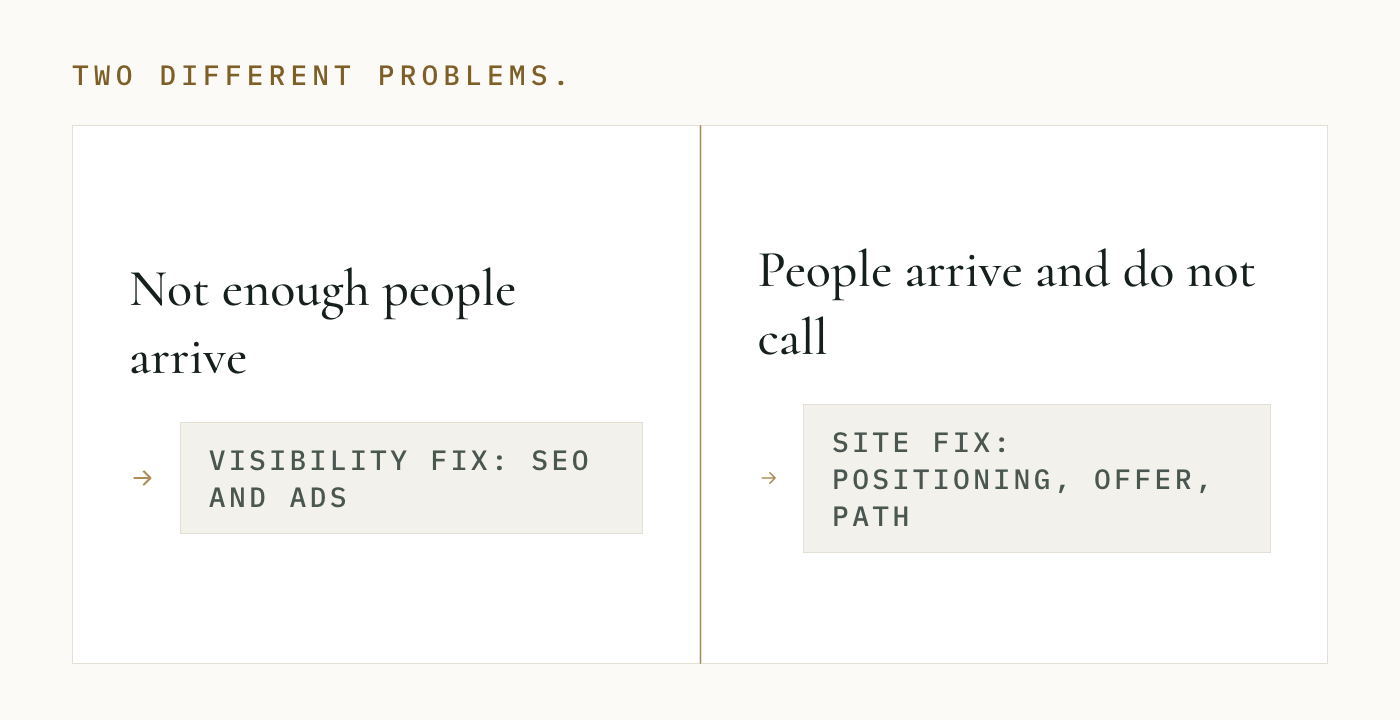
The first is a visibility problem: not enough of the right people arrive at your site. The fix is SEO (getting ranked in search results) or paid ads that bring people in.
The second is a site problem: the right people arrive and something about the site stops them from calling. The fix is the site itself, what it says, how it is organized, and whether it makes calling feel like the obvious next step.
Fixing visibility when the real problem is the site means you pay to send more people to a page that was never going to make them call. Fixing the site when the real problem is visibility means you improve something nobody is seeing.
How Do I Know If I Need a New Website or Just SEO?
Start with one question: how many people are visiting your site each month?
If you do not know, install Google Search Console (it is free and takes about five minutes to set up). It will show you how many people clicked through to your site from a Google search and what they searched to find you.
Here is the rough read:
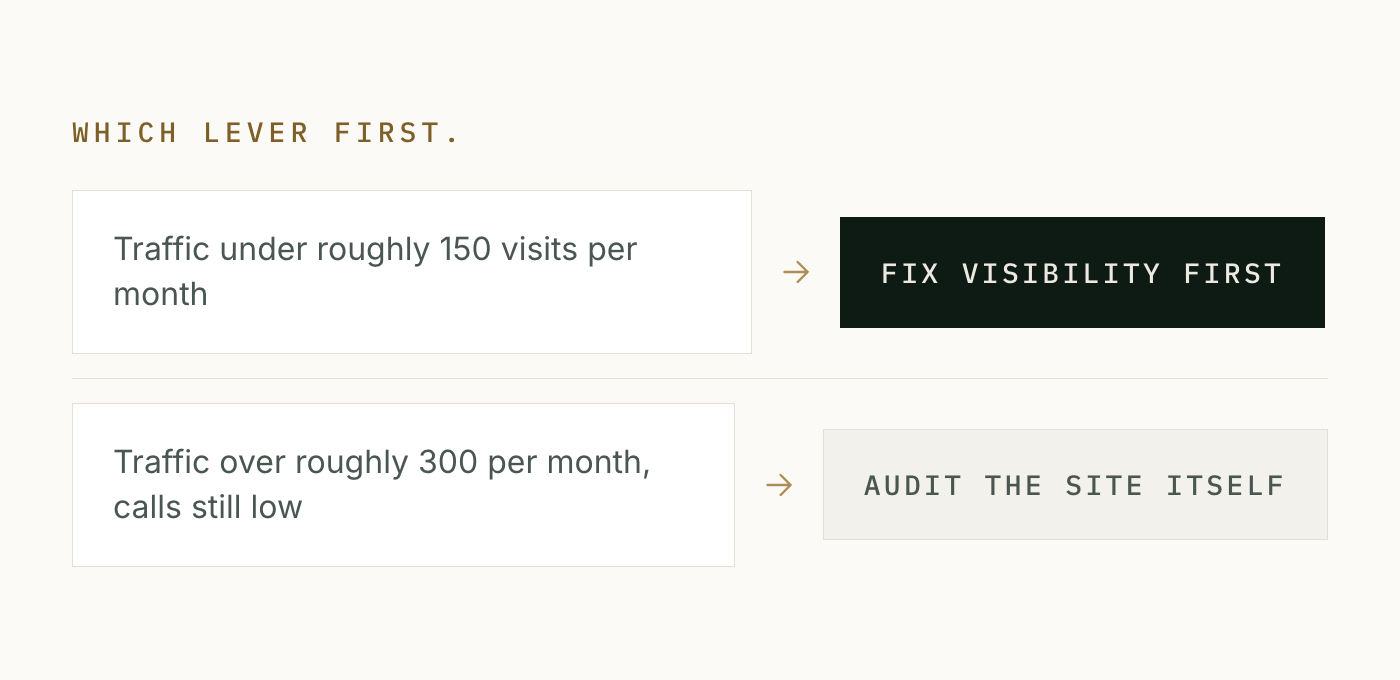
If your site gets fewer than 150 to 200 visitors per month from search, the primary problem is almost certainly visibility. Not enough people are finding you in the first place. Site changes will not fix this because there is not enough traffic to work with.
If your site gets 300 or more visitors per month and you are still not getting steady calls, the traffic exists. The problem is what happens after people arrive.
Neither number is a hard threshold. A roofer in a major metro and a plumber in a small town have different baselines. The question is whether meaningful traffic already exists relative to your service area.
What Does a Visibility Problem Look Like?
A roofing company gets 60 to 80 visitors a month. Their site has been live for two years. They rank on page three or four for most of their keywords. Calls are almost nonexistent.
This is a visibility problem. The site may be perfectly clear, well laid out, easy to call from. It does not matter yet because not enough people are finding it.
The right pull here is SEO, if they want slower results over 6 to 12 months, or paid ads if they need calls faster. Both are about bringing more of the right people to the door.
Note: a site with serious content problems (no clear service list, no local signals, no trust markers) can hold back SEO rankings. So there can be overlap. But the first question is still: is anyone coming?
What Does a Conversion Problem Look Like?
An HVAC company gets 500 to 700 visitors a month from search. They rank well. Their Google Business Profile has solid reviews. But they get only two or three calls in a given week, even though the site has plenty of visitors to work with. Something is breaking between the visit and the call.
According to BrightLocal's Local Consumer Review Survey (2026), 54 percent of consumers visit a business's website after reading positive reviews. When a site has the reviews to earn that visit and still is not producing calls, the problem is in the site itself.
This is a site problem. The traffic is there. Something about the site is breaking the moment when a visitor decides whether to call or leave.
Common causes in local service sites:
The phone number is not in the top part of the page, above where someone has to scroll. A visitor on mobile who has to hunt for a number will leave.
The site does not say clearly what they do and where. "Professional HVAC services" with no city or county name tells a visitor nothing about whether this company serves their area.
The site does not give the visitor a reason to choose this company over anyone else they find. Price, speed, guarantee, or a specific credential that competitors do not have.
The request a quote or contact form is buried, or it asks for information the visitor is not ready to give on a first visit.
Each of these is a positioning, offer clarity, or layout problem. None of them is fixed by more SEO. These are the four areas our site audits examine: whether the positioning reaches the right audience, whether the offer is clear, whether the visual design earns trust, and whether the layout moves a visitor toward a call.
What If I Have Both Problems?
This is common. A plumbing company has thin traffic and a site that would not convert even with better traffic.
The sequence matters here. Fix visibility first. SEO or ads bring traffic. Once traffic is meaningful (say, 300 or more visitors per month), you will have enough signal to see what is breaking on the site.
With 60 visitors a month, even a healthy site might produce only one call. You cannot tell whether that silence is a site problem or just the floor of a thin traffic sample. Fix visibility first, then read what happens.
The exception: if the site has obvious structural problems, fix those before spending on SEO or ads. Those are not problems that need a detailed diagnosis. They are baseline requirements. According to Think with Google (2017), as page load time goes from one second to five seconds, the probability of a visitor leaving before the page loads increases 90 percent. A page that takes 8 seconds to load on mobile will lose most visitors before they see a single service you offer.
What Can I Diagnose on My Own?
Three things you can check without any tool or paid help:
First, pull up your site on your phone. Not on your desktop. Your visitors are on mobile. Is the phone number visible without scrolling? Is there a tap-to-call button? Can you read the text without zooming in? If the answer to any of these is no, that is a site problem you can see directly. Google found (2018) that 76 percent of people who search for something nearby on their phone visit a business within a day. If your site makes that step harder than it needs to be, you are losing the people who were closest to calling.
Second, read the first section of your homepage out loud as if you have never heard of your company. Does it say what you do, where you do it, and why someone should call you instead of the next result? If it sounds like it could belong to any plumber or roofer anywhere, it is not doing its job.
Third, search for your own business on Google using the terms your customers would use. "Plumber [your city]." "Emergency roof repair [your county]." If you do not appear on the first page or in the map section, visibility is the first problem to solve.
These three checks are not a full diagnosis. But they will tell you which direction to pull first.
Before moving on: if you were advising another local service business and they told you they redesigned their site six months ago but calls are still flat, which problem would you check for first? That question is the same one this diagnostic is designed to answer, applied to a different business.
What This Diagnostic Does Not Tell You
Knowing which category your problem falls into, visibility or site, is the starting point, not the solution.
The diagnostic above tells you which lever to pull first. It does not tell you exactly which part of your site is losing visitors, which keywords to target, how to write the messaging that makes someone call you instead of the next result, or how to structure a page so that a visitor who is comparing three plumbers picks you.
Those are the questions a structured site audit works through, lens by lens. We look at your specific traffic data, your competitors in your market, and your current messaging, then tell you which of these problems you actually have and which to address first.
Frequently asked questions
Can my site rank well and still not get calls?
Yes, and this is one of the most common situations local service owners run into. Ranking on page one gets you in front of people. Whether they call depends on what they see when they arrive. If the site does not quickly show them what you do, where you do it, and why you over the next result, many of them leave. Ranking is a visibility win. Calls come from what happens after the click.
How many visitors do I need before I can tell if my site is converting?
There is no single number that applies to every business, but under 150 visitors per month makes it very hard to read patterns. With that little traffic, two or three calls a month might actually be a reasonable rate and you would not know. Get to 300 or more visitors per month and the signal becomes clearer. Until then, fixing visibility is the more reliable first move.
Why is my website not getting leads even after SEO?
A new design does not fix a visibility problem unless the redesign also included technical SEO improvements such as proper page structure, local keyword use, load speed, and mobile usability. And a new design does not automatically fix a site problem if the messaging is still unclear or the phone number is still hard to find. The question is still the same one: are people arriving, and if so, what are they doing when they get there?
What is the difference between SEO and a website redesign?
SEO is work done to help your site show up in search results. It includes things like putting the right keywords on your pages, building local signals so Google connects your business to your city or county, and making sure the site loads quickly and works on mobile. A redesign is a change to what the site looks and says, usually to make it clearer and easier to navigate. They overlap in some areas, but they solve different problems. SEO brings people to the door. The site either makes them call or it does not.
Should I fix my website before I start running ads?
If the site has basic structural problems such as no visible phone number, slow load time on mobile, or no clear statement of what you do and where, fix those first. Running ads to a site that has obvious problems like these means paying for traffic that was never going to convert. If the site passes the basic checks above, ads can work even if the site is not perfectly optimized. The ad brings the visitor. The site's job is to not lose them once they arrive.
If you want a clear read on whether your site has a visibility problem or a site problem, we do that as a free review. We look at your traffic, your page structure, and your conversion path, then tell you which problem is active and where to start. No pitch, no upsell. A diagnostic read and a straight answer.
Request a Free Site Review →